

Elements of Modern Physics
340
0
Z
(b)
M(Z) – M(Z ) in M V
A
16
12
8
4
27
28
29
30
31
e
e
–
64
Cu
e
–
e
64 Ni
64 Zn
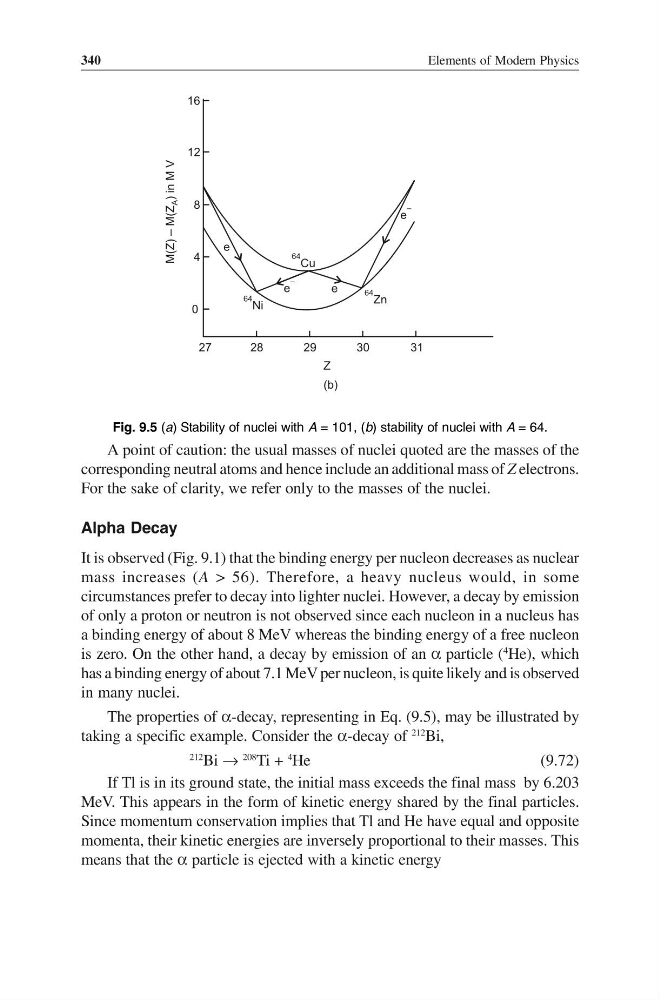
Fig. 9.5 (a) Stability of nuclei with A = 101, (b) stability of nuclei with A = 64.
A point of caution: the usual masses of nuclei quoted are the masses of the
corresponding neutral atoms and hence include an additional mass of Z electrons.
For the sake of clarity, we refer only to the masses of the nuclei.
Alpha Decay
It is observed (Fig. 9.1) that the binding energy per nucleon decreases as nuclear
mass increases (A > 56). Therefore, a heavy nucleus would, in some
circumstances prefer to decay into lighter nuclei. However, a decay by emission
of only a proton or neutron is not observed since each nucleon in a nucleus has
a binding energy of about 8 MeV whereas the binding energy of a free nucleon
is zero. On the other hand, a decay by emission of an α particle (
4
He), which
has a binding energy of about 7.1 MeV per nucleon, is quite likely and is observed
in many nuclei.
The properties of α-decay, representing in Eq. (9.5), may be illustrated by
taking a specific example. Consider the α-decay of
212
Bi,
212
Bi →
208
Ti +
4
He
(9.72)
If Tl is in its ground state, the initial mass exceeds the final mass by 6.203
MeV. This appears in the form of kinetic energy shared by the final particles.
Since momentum conservation implies that Tl and He have equal and opposite
momenta, their kinetic energies are inversely proportional to their masses. This
means that the α particle is ejected with a kinetic energy
340
0
Z
(b)
M(Z) – M(Z ) in M V
A
16
12
8
4
27
28
29
30
31
e
e
–
64
Cu
e
–
e
64 Ni
64 Zn
Fig. 9.5 (a) Stability of nuclei with A = 101, (b) stability of nuclei with A = 64.
A point of caution: the usual masses of nuclei quoted are the masses of the
corresponding neutral atoms and hence include an additional mass of Z electrons.
For the sake of clarity, we refer only to the masses of the nuclei.
Alpha Decay
It is observed (Fig. 9.1) that the binding energy per nucleon decreases as nuclear
mass increases (A > 56). Therefore, a heavy nucleus would, in some
circumstances prefer to decay into lighter nuclei. However, a decay by emission
of only a proton or neutron is not observed since each nucleon in a nucleus has
a binding energy of about 8 MeV whereas the binding energy of a free nucleon
is zero. On the other hand, a decay by emission of an α particle (
4
He), which
has a binding energy of about 7.1 MeV per nucleon, is quite likely and is observed
in many nuclei.
The properties of α-decay, representing in Eq. (9.5), may be illustrated by
taking a specific example. Consider the α-decay of
212
Bi,
212
Bi →
208
Ti +
4
He
(9.72)
If Tl is in its ground state, the initial mass exceeds the final mass by 6.203
MeV. This appears in the form of kinetic energy shared by the final particles.
Since momentum conservation implies that Tl and He have equal and opposite
momenta, their kinetic energies are inversely proportional to their masses. This
means that the α particle is ejected with a kinetic energy