

The Nucleus
339
Solving for Z A ,
Z A =
4
2/3
4
3
2
n
p
m m
a
A
a a A
−
+
+
(9.70)
For a 3 = 0.710, it is seen that Z A is smaller than A/2 for A ≥ 3, and most of the
heavy nuclei will have more neutrons than protons.
Expansion of M(Z, A) about the point Z = Z A leads to
M(Z, A) = M(Z A , A) + (a 3 A
–1/3
+ a 4 A
–1
) (Z – Z A )
2
+ ...
(9.71)
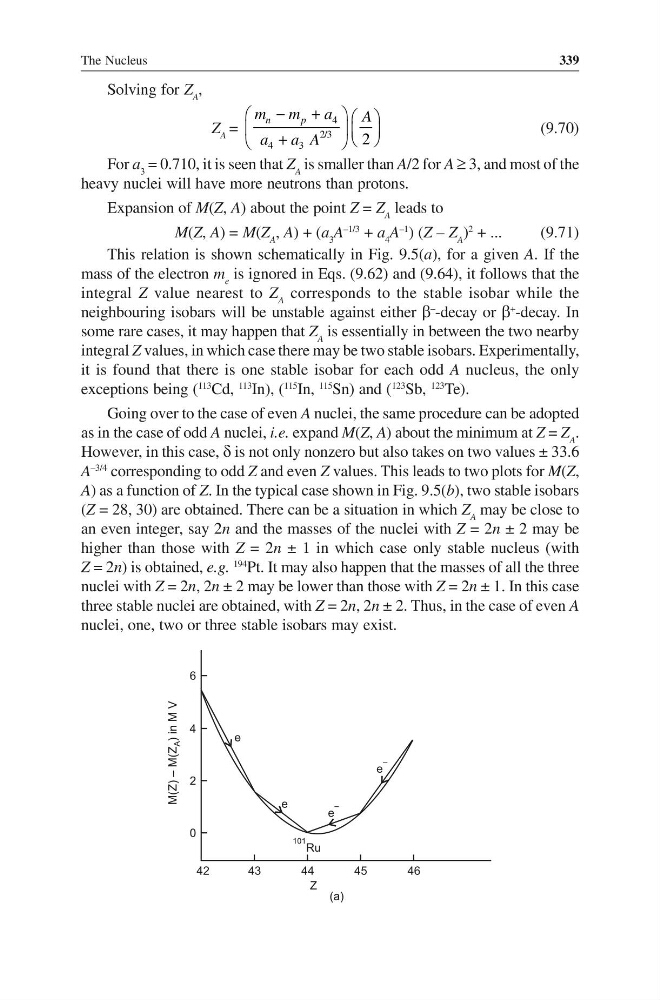
This relation is shown schematically in Fig. 9.5(a), for a given A. If the
mass of the electron m e is ignored in Eqs. (9.62) and (9.64), it follows that the
integral Z value nearest to Z A corresponds to the stable isobar while the
neighbouring isobars will be unstable against either β
–
-decay or β
+
-decay. In
some rare cases, it may happen that Z A is essentially in between the two nearby
integral Z values, in which case there may be two stable isobars. Experimentally,
it is found that there is one stable isobar for each odd A nucleus, the only
exceptions being (
113
Cd,
113
In), (
115
In,
115
Sn) and (
123
Sb,
123
Te).
Going over to the case of even A nuclei, the same procedure can be adopted
as in the case of odd A nuclei, i.e. expand M(Z, A) about the minimum at Z = Z A .
However, in this case, δ is not only nonzero but also takes on two values ± 33.6
A
–3/4
corresponding to odd Z and even Z values. This leads to two plots for M(Z,
A) as a function of Z. In the typical case shown in Fig. 9.5(b), two stable isobars
(Z = 28, 30) are obtained. There can be a situation in which Z A may be close to
an even integer, say 2n and the masses of the nuclei with Z = 2n ± 2 may be
higher than those with Z = 2n ± 1 in which case only stable nucleus (with
Z = 2n) is obtained, e.g.
194
Pt. It may also happen that the masses of all the three
nuclei with Z = 2n, 2n ± 2 may be lower than those with Z = 2n ± 1. In this case
three stable nuclei are obtained, with Z = 2n, 2n ± 2. Thus, in the case of even A
nuclei, one, two or three stable isobars may exist.
42
43
44
45
46
Z (a)
M(Z) – M(Z ) in M V
A
6
4
2
0
101 Ru
e
e
e
–
e
–
339
Solving for Z A ,
Z A =
4
2/3
4
3
2
n
p
m m
a
A
a a A
−
+
+
(9.70)
For a 3 = 0.710, it is seen that Z A is smaller than A/2 for A ≥ 3, and most of the
heavy nuclei will have more neutrons than protons.
Expansion of M(Z, A) about the point Z = Z A leads to
M(Z, A) = M(Z A , A) + (a 3 A
–1/3
+ a 4 A
–1
) (Z – Z A )
2
+ ...
(9.71)
This relation is shown schematically in Fig. 9.5(a), for a given A. If the
mass of the electron m e is ignored in Eqs. (9.62) and (9.64), it follows that the
integral Z value nearest to Z A corresponds to the stable isobar while the
neighbouring isobars will be unstable against either β
–
-decay or β
+
-decay. In
some rare cases, it may happen that Z A is essentially in between the two nearby
integral Z values, in which case there may be two stable isobars. Experimentally,
it is found that there is one stable isobar for each odd A nucleus, the only
exceptions being (
113
Cd,
113
In), (
115
In,
115
Sn) and (
123
Sb,
123
Te).
Going over to the case of even A nuclei, the same procedure can be adopted
as in the case of odd A nuclei, i.e. expand M(Z, A) about the minimum at Z = Z A .
However, in this case, δ is not only nonzero but also takes on two values ± 33.6
A
–3/4
corresponding to odd Z and even Z values. This leads to two plots for M(Z,
A) as a function of Z. In the typical case shown in Fig. 9.5(b), two stable isobars
(Z = 28, 30) are obtained. There can be a situation in which Z A may be close to
an even integer, say 2n and the masses of the nuclei with Z = 2n ± 2 may be
higher than those with Z = 2n ± 1 in which case only stable nucleus (with
Z = 2n) is obtained, e.g.
194
Pt. It may also happen that the masses of all the three
nuclei with Z = 2n, 2n ± 2 may be lower than those with Z = 2n ± 1. In this case
three stable nuclei are obtained, with Z = 2n, 2n ± 2. Thus, in the case of even A
nuclei, one, two or three stable isobars may exist.
42
43
44
45
46
Z (a)
M(Z) – M(Z ) in M V
A
6
4
2
0
101 Ru
e
e
e
–
e
–