

Elements of Modern Physics
338
This quantity τ is the average lifetime of the nucleus (see Sec. 6.4). For
example
238
U has a lifetime of about 6.5 × 10
9
years, comparable with the age of
the universe.
The allowed decays in general must satisfy certain conservation laws such
as charge conservation, energy-momentum conservation, etc. γ-decays involve
changes only in the energy levels, the components of the nucleus remaining the
same. Here, we concentrate on β-decay, α-decay, and fission, which alter the
composition of the nucleus.
Conservation of energy allows only those decays which satisfy the following
rules:
1. A nucleus is unstable against the emission of an electron [Eq. (9.8)], i.e.
β
–
-decay, if
M(Z, A) > M(Z + 1, A) + m e
(9.62)
It is unstable against the absorption of an electron [Eq. (9.10)] if
M(Z, A) + m e > M(Z – 1, A)
(9.63)
It is suitable against the emission of a positron [Eq. (9.9)], β
+
-decay, if
M(Z, A) > M(Z – 1, A) + m e
(9.64)
2. A nucleus is unstable against breakup into two fragments if
M(Z, A) > M(Z′, A′) + M(Z – Z′, A – A′)
(9.65)
In particular, it may decay by emitting a portion if
M(Z, A) > M(Z – 1, A – 1) + m p
(9.66)
or by emitting an α particle if
M(Z, A) > M(Z – 2, A – 4) + m α
(9.67)
It may be noted that because of the large binding energy per nucleon, the
decays via the emission of a heavy particle are important mainly in heavy nuclei.
For determining the stability pattern of lighter nuclei, it is necessary to consider
only electron emission or absorption.
Beta Decay
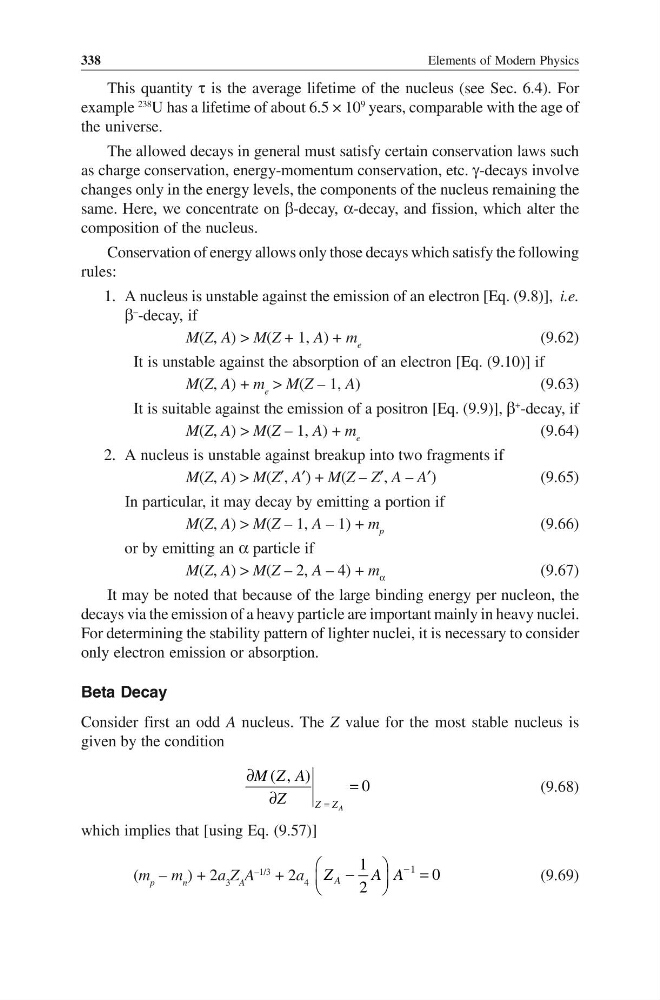
Consider first an odd A nucleus. The Z value for the most stable nucleus is
given by the condition
( , )
0
A
Z Z
M Z A
Z
=
∂
=
∂
(9.68)
which implies that [using Eq. (9.57)]
(m p – m n ) + 2a 3 Z A A
–1/3
+ 2a 4
1
1
0
2
A
Z
A A
−
−
=
(9.69)
338
This quantity τ is the average lifetime of the nucleus (see Sec. 6.4). For
example
238
U has a lifetime of about 6.5 × 10
9
years, comparable with the age of
the universe.
The allowed decays in general must satisfy certain conservation laws such
as charge conservation, energy-momentum conservation, etc. γ-decays involve
changes only in the energy levels, the components of the nucleus remaining the
same. Here, we concentrate on β-decay, α-decay, and fission, which alter the
composition of the nucleus.
Conservation of energy allows only those decays which satisfy the following
rules:
1. A nucleus is unstable against the emission of an electron [Eq. (9.8)], i.e.
β
–
-decay, if
M(Z, A) > M(Z + 1, A) + m e
(9.62)
It is unstable against the absorption of an electron [Eq. (9.10)] if
M(Z, A) + m e > M(Z – 1, A)
(9.63)
It is suitable against the emission of a positron [Eq. (9.9)], β
+
-decay, if
M(Z, A) > M(Z – 1, A) + m e
(9.64)
2. A nucleus is unstable against breakup into two fragments if
M(Z, A) > M(Z′, A′) + M(Z – Z′, A – A′)
(9.65)
In particular, it may decay by emitting a portion if
M(Z, A) > M(Z – 1, A – 1) + m p
(9.66)
or by emitting an α particle if
M(Z, A) > M(Z – 2, A – 4) + m α
(9.67)
It may be noted that because of the large binding energy per nucleon, the
decays via the emission of a heavy particle are important mainly in heavy nuclei.
For determining the stability pattern of lighter nuclei, it is necessary to consider
only electron emission or absorption.
Beta Decay
Consider first an odd A nucleus. The Z value for the most stable nucleus is
given by the condition
( , )
0
A
Z Z
M Z A
Z
=
∂
=
∂
(9.68)
which implies that [using Eq. (9.57)]
(m p – m n ) + 2a 3 Z A A
–1/3
+ 2a 4
1
1
0
2
A
Z
A A
−
−
=
(9.69)