

The Nucleus
337
because of the imbalance of protons and neutrons. Finally, it is noted that the
Pauli principle allows pairs of protons and neutrons with spin
1
2
to occupy the
same energy state whereas and odd proton of neutron is forced to go into a
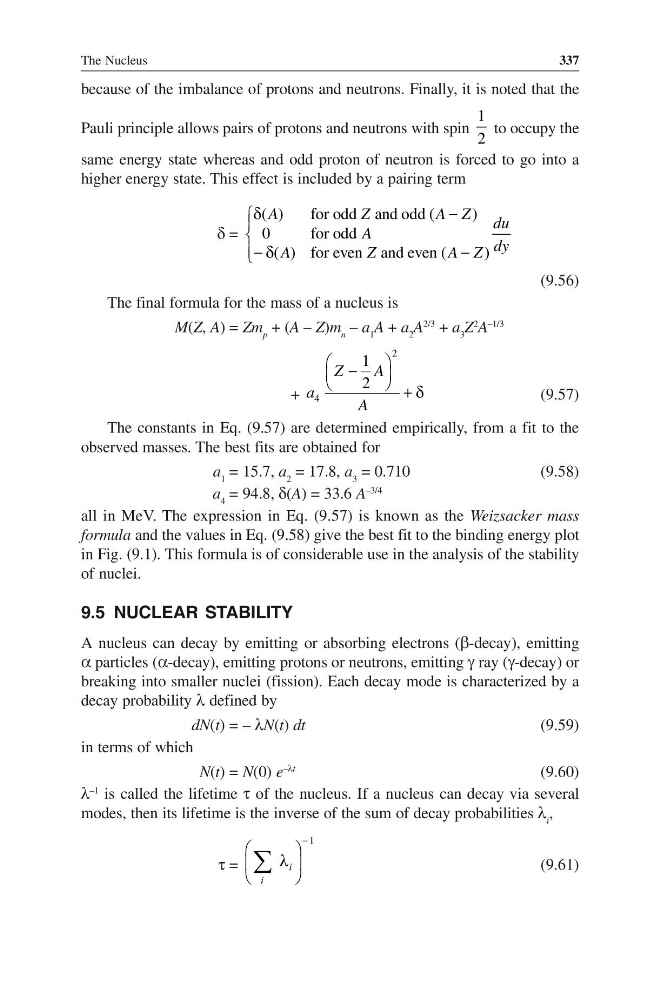
higher energy state. This effect is included by a pairing term
δ =
( )
for odd and odd (
)
0
forodd
( ) for even and even (
)
A
Z
A Z du
A
dy
A
Z
A Z
δ
−
− δ
−
(9.56)
The final formula for the mass of a nucleus is
M(Z, A) = Zm p + (A – Z)m n – a 1 A + a 2 A
2/3
+ a 3 Z
2
A
–1/3
+
2
4
1
2
Z
A
a
A
−
+ δ
(9.57)
The constants in Eq. (9.57) are determined empirically, from a fit to the
observed masses. The best fits are obtained for
a 1 = 15.7, a 2 = 17.8, a 3 = 0.710
(9.58)
a 4 = 94.8, δ(A) = 33.6 A
–3/4
all in MeV. The expression in Eq. (9.57) is known as the Weizsacker mass
formula and the values in Eq. (9.58) give the best fit to the binding energy plot
in Fig. (9.1). This formula is of considerable use in the analysis of the stability
of nuclei.
9.5 NUCLEAR STABILITY
A nucleus can decay by emitting or absorbing electrons (β-decay), emitting
α particles (α-decay), emitting protons or neutrons, emitting γ ray (γ-decay) or
breaking into smaller nuclei (fission). Each decay mode is characterized by a
decay probability λ defined by
dN(t) = – λN(t) dt
(9.59)
in terms of which
N(t) = N(0) e
–λt
(9.60)
λ
–1
is called the lifetime τ of the nucleus. If a nucleus can decay via several
modes, then its lifetime is the inverse of the sum of decay probabilities λ i ,
τ =
1
i
i
−
λ
∑
(9.61)
337
because of the imbalance of protons and neutrons. Finally, it is noted that the
Pauli principle allows pairs of protons and neutrons with spin
1
2
to occupy the
same energy state whereas and odd proton of neutron is forced to go into a
higher energy state. This effect is included by a pairing term
δ =
( )
for odd and odd (
)
0
forodd
( ) for even and even (
)
A
Z
A Z du
A
dy
A
Z
A Z
δ
−
− δ
−
(9.56)
The final formula for the mass of a nucleus is
M(Z, A) = Zm p + (A – Z)m n – a 1 A + a 2 A
2/3
+ a 3 Z
2
A
–1/3
+
2
4
1
2
Z
A
a
A
−
+ δ
(9.57)
The constants in Eq. (9.57) are determined empirically, from a fit to the
observed masses. The best fits are obtained for
a 1 = 15.7, a 2 = 17.8, a 3 = 0.710
(9.58)
a 4 = 94.8, δ(A) = 33.6 A
–3/4
all in MeV. The expression in Eq. (9.57) is known as the Weizsacker mass
formula and the values in Eq. (9.58) give the best fit to the binding energy plot
in Fig. (9.1). This formula is of considerable use in the analysis of the stability
of nuclei.
9.5 NUCLEAR STABILITY
A nucleus can decay by emitting or absorbing electrons (β-decay), emitting
α particles (α-decay), emitting protons or neutrons, emitting γ ray (γ-decay) or
breaking into smaller nuclei (fission). Each decay mode is characterized by a
decay probability λ defined by
dN(t) = – λN(t) dt
(9.59)
in terms of which
N(t) = N(0) e
–λt
(9.60)
λ
–1
is called the lifetime τ of the nucleus. If a nucleus can decay via several
modes, then its lifetime is the inverse of the sum of decay probabilities λ i ,
τ =
1
i
i
−
λ
∑
(9.61)