

Special Theory of Relativity
21
1
,
µ
=
φ
A
c
A
(1.70)
also transforms as a Lorentz 4-vector. Hence, Maxwell’s equations are seen to
be consistent with the special theory of relativity.
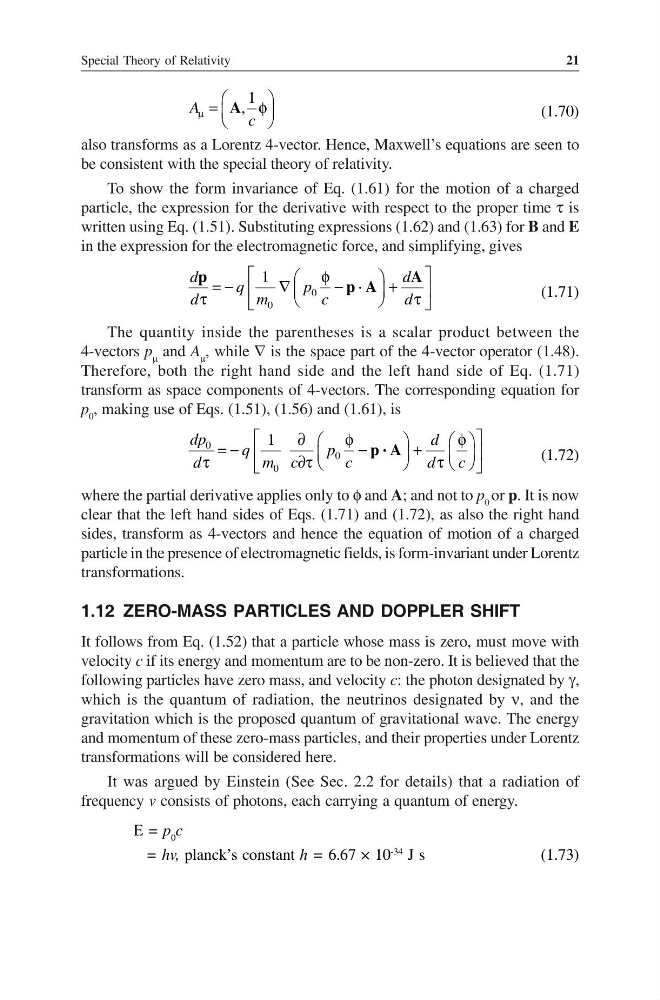
To show the form invariance of Eq. (1.61) for the motion of a charged
particle, the expression for the derivative with respect to the proper time τ is
written using Eq. (1.51). Substituting expressions (1.62) and (1.63) for B and E
in the expression for the electromagnetic force, and simplifying, gives
0
0
1
φ
= −
∇
− ⋅
+
τ
τ
d
d
q
p
d
m
c
d
p
A
p A
(1.71)
The quantity inside the parentheses is a scalar product between the
4-vectors p µ and A µ , while ∇ is the space part of the 4-vector operator (1.48).
Therefore, both the right hand side and the left hand side of Eq. (1.71)
transform as space components of 4-vectors. The corresponding equation for
p 0 , making use of Eqs. (1.51), (1.56) and (1.61), is
0
0
0
1
dp
d
q
p
d
m c
c
d c
∂
φ
φ
= −
−
+
τ
∂ τ
τ
.
p A
(1.72)
where the partial derivative applies only to φ and A; and not to p 0 or p. It is now
clear that the left hand sides of Eqs. (1.71) and (1.72), as also the right hand
sides, transform as 4-vectors and hence the equation of motion of a charged
particle in the presence of electromagnetic fields, is form-invariant under Lorentz
transformations.
1.12 ZERO-MASS PARTICLES AND DOPPLER SHIFT
It follows from Eq. (1.52) that a particle whose mass is zero, must move with
velocity c if its energy and momentum are to be non-zero. It is believed that the
following particles have zero mass, and velocity c: the photon designated by γ,
which is the quantum of radiation, the neutrinos designated by ν, and the
gravitation which is the proposed quantum of gravitational wave. The energy
and momentum of these zero-mass particles, and their properties under Lorentz
transformations will be considered here.
It was argued by Einstein (See Sec. 2.2 for details) that a radiation of
frequency v consists of photons, each carrying a quantum of energy.
E = p 0 c
= hv, planck’s constant h = 6.67 × 10
-34
J s
(1.73)
21
1
,
µ
=
φ
A
c
A
(1.70)
also transforms as a Lorentz 4-vector. Hence, Maxwell’s equations are seen to
be consistent with the special theory of relativity.
To show the form invariance of Eq. (1.61) for the motion of a charged
particle, the expression for the derivative with respect to the proper time τ is
written using Eq. (1.51). Substituting expressions (1.62) and (1.63) for B and E
in the expression for the electromagnetic force, and simplifying, gives
0
0
1
φ
= −
∇
− ⋅
+
τ
τ
d
d
q
p
d
m
c
d
p
A
p A
(1.71)
The quantity inside the parentheses is a scalar product between the
4-vectors p µ and A µ , while ∇ is the space part of the 4-vector operator (1.48).
Therefore, both the right hand side and the left hand side of Eq. (1.71)
transform as space components of 4-vectors. The corresponding equation for
p 0 , making use of Eqs. (1.51), (1.56) and (1.61), is
0
0
0
1
dp
d
q
p
d
m c
c
d c
∂
φ
φ
= −
−
+
τ
∂ τ
τ
.
p A
(1.72)
where the partial derivative applies only to φ and A; and not to p 0 or p. It is now
clear that the left hand sides of Eqs. (1.71) and (1.72), as also the right hand
sides, transform as 4-vectors and hence the equation of motion of a charged
particle in the presence of electromagnetic fields, is form-invariant under Lorentz
transformations.
1.12 ZERO-MASS PARTICLES AND DOPPLER SHIFT
It follows from Eq. (1.52) that a particle whose mass is zero, must move with
velocity c if its energy and momentum are to be non-zero. It is believed that the
following particles have zero mass, and velocity c: the photon designated by γ,
which is the quantum of radiation, the neutrinos designated by ν, and the
gravitation which is the proposed quantum of gravitational wave. The energy
and momentum of these zero-mass particles, and their properties under Lorentz
transformations will be considered here.
It was argued by Einstein (See Sec. 2.2 for details) that a radiation of
frequency v consists of photons, each carrying a quantum of energy.
E = p 0 c
= hv, planck’s constant h = 6.67 × 10
-34
J s
(1.73)