

Elements of Modern Physics
20
2
1
0
∂φ
∆ ⋅ +
=
∂t
c
A
(1.66)
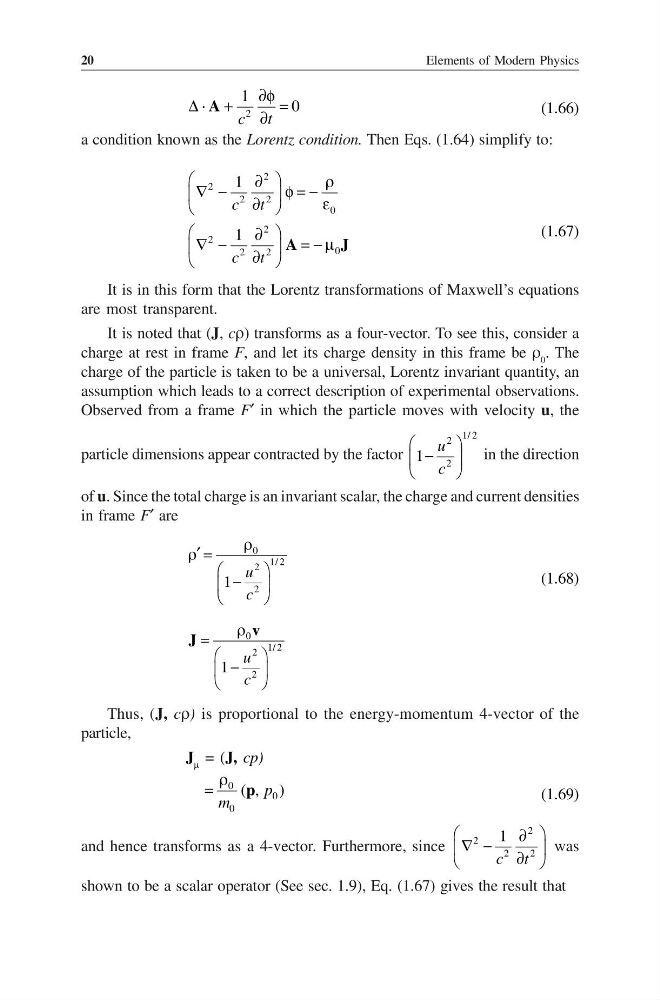
a condition known as the Lorentz condition. Then Eqs. (1.64) simplify to:
2
2
2
2
0
2
2
0
2
2
1
1
c t
c t
∂
ρ
∇ −
φ = −
ε
∂
∂
∇ −
= − µ
∂
A
J
(1.67)
It is in this form that the Lorentz transformations of Maxwell’s equations
are most transparent.
It is noted that (J, cρ) transforms as a four-vector. To see this, consider a
charge at rest in frame F, and let its charge density in this frame be ρ 0 . The
charge of the particle is taken to be a universal, Lorentz invariant quantity, an
assumption which leads to a correct description of experimental observations.
Observed from a frame F′ in which the particle moves with velocity u, the
particle dimensions appear contracted by the factor
1/ 2
2
2
1
u
c
−
in the direction
of u. Since the total charge is an invariant scalar, the charge and current densities
in frame F′ are
0
1/ 2
2
2
1
u
c
ρ
′
ρ =
−
(1.68)
1/ 2
2
2
1
0
ρ
=
−
u
c
v
J
Thus, (J, cρ) is proportional to the energy-momentum 4-vector of the
particle,
J µ = (J, cp)
0
0
0
( , )
p
m
ρ
=
p
(1.69)
and hence transforms as a 4-vector. Furthermore, since
2
2
2
2
1
c t
∂
∇ −
∂
was
shown to be a scalar operator (See sec. 1.9), Eq. (1.67) gives the result that
20
2
1
0
∂φ
∆ ⋅ +
=
∂t
c
A
(1.66)
a condition known as the Lorentz condition. Then Eqs. (1.64) simplify to:
2
2
2
2
0
2
2
0
2
2
1
1
c t
c t
∂
ρ
∇ −
φ = −
ε
∂
∂
∇ −
= − µ
∂
A
J
(1.67)
It is in this form that the Lorentz transformations of Maxwell’s equations
are most transparent.
It is noted that (J, cρ) transforms as a four-vector. To see this, consider a
charge at rest in frame F, and let its charge density in this frame be ρ 0 . The
charge of the particle is taken to be a universal, Lorentz invariant quantity, an
assumption which leads to a correct description of experimental observations.
Observed from a frame F′ in which the particle moves with velocity u, the
particle dimensions appear contracted by the factor
1/ 2
2
2
1
u
c
−
in the direction
of u. Since the total charge is an invariant scalar, the charge and current densities
in frame F′ are
0
1/ 2
2
2
1
u
c
ρ
′
ρ =
−
(1.68)
1/ 2
2
2
1
0
ρ
=
−
u
c
v
J
Thus, (J, cρ) is proportional to the energy-momentum 4-vector of the
particle,
J µ = (J, cp)
0
0
0
( , )
p
m
ρ
=
p
(1.69)
and hence transforms as a 4-vector. Furthermore, since
2
2
2
2
1
c t
∂
∇ −
∂
was
shown to be a scalar operator (See sec. 1.9), Eq. (1.67) gives the result that