

Elements of Modern Physics
22
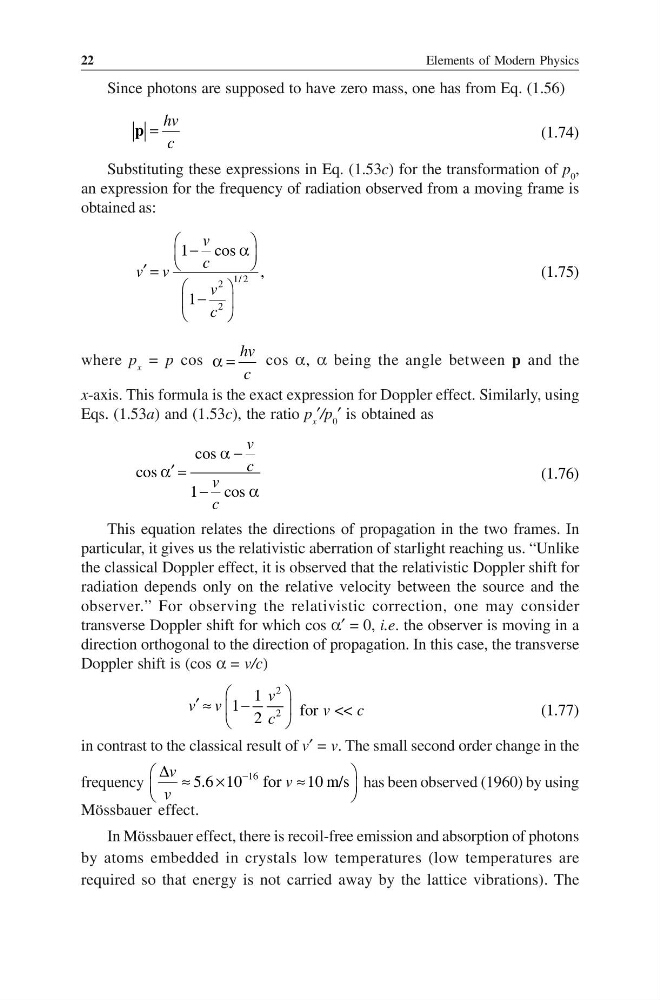
Since photons are supposed to have zero mass, one has from Eq. (1.56)
=
hv
c
p
(1.74)
Substituting these expressions in Eq. (1.53c) for the transformation of p 0 ,
an expression for the frequency of radiation observed from a moving frame is
obtained as:
1/ 2
2
2
1
cos
1
v
c
v v
v
c
−
α
′ =
−
,
(1.75)
where p x = p cos
hv
c
α =
cos α, α being the angle between p and the
x-axis. This formula is the exact expression for Doppler effect. Similarly, using
Eqs. (1.53a) and (1.53c), the ratio p x ′/p 0 ′ is obtained as
cos
cos
1
cos
v
c
v
c
α −
′
α =
−
α
(1.76)
This equation relates the directions of propagation in the two frames. In
particular, it gives us the relativistic aberration of starlight reaching us. “Unlike
the classical Doppler effect, it is observed that the relativistic Doppler shift for
radiation depends only on the relative velocity between the source and the
observer.” For observing the relativistic correction, one may consider
transverse Doppler shift for which cos α′ = 0, i.e. the observer is moving in a
direction orthogonal to the direction of propagation. In this case, the transverse
Doppler shift is (cos α = v/c)
2
2
1
1 2
v
v v
c
′ ≈
−
for v << c
(1.77)
in contrast to the classical result of v′ = v. The small second order change in the
frequency
16
5.6 10 for
10 m/s
v
v
v
−
∆
≈
×
≈
has been observed (1960) by using
Mössbauer effect.
In Mössbauer effect, there is recoil-free emission and absorption of photons
by atoms embedded in crystals low temperatures (low temperatures are
required so that energy is not carried away by the lattice vibrations). The
22
Since photons are supposed to have zero mass, one has from Eq. (1.56)
=
hv
c
p
(1.74)
Substituting these expressions in Eq. (1.53c) for the transformation of p 0 ,
an expression for the frequency of radiation observed from a moving frame is
obtained as:
1/ 2
2
2
1
cos
1
v
c
v v
v
c
−
α
′ =
−
,
(1.75)
where p x = p cos
hv
c
α =
cos α, α being the angle between p and the
x-axis. This formula is the exact expression for Doppler effect. Similarly, using
Eqs. (1.53a) and (1.53c), the ratio p x ′/p 0 ′ is obtained as
cos
cos
1
cos
v
c
v
c
α −
′
α =
−
α
(1.76)
This equation relates the directions of propagation in the two frames. In
particular, it gives us the relativistic aberration of starlight reaching us. “Unlike
the classical Doppler effect, it is observed that the relativistic Doppler shift for
radiation depends only on the relative velocity between the source and the
observer.” For observing the relativistic correction, one may consider
transverse Doppler shift for which cos α′ = 0, i.e. the observer is moving in a
direction orthogonal to the direction of propagation. In this case, the transverse
Doppler shift is (cos α = v/c)
2
2
1
1 2
v
v v
c
′ ≈
−
for v << c
(1.77)
in contrast to the classical result of v′ = v. The small second order change in the
frequency
16
5.6 10 for
10 m/s
v
v
v
−
∆
≈
×
≈
has been observed (1960) by using
Mössbauer effect.
In Mössbauer effect, there is recoil-free emission and absorption of photons
by atoms embedded in crystals low temperatures (low temperatures are
required so that energy is not carried away by the lattice vibrations). The