

Elements of Modern Physics
310
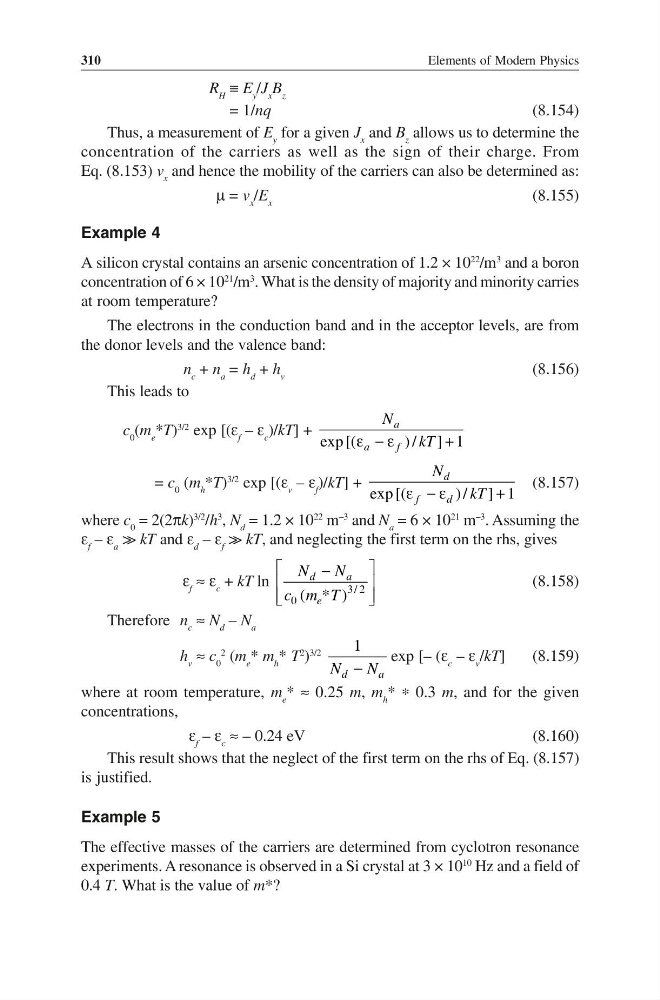
R H ≡ E y /J x B z
= 1/nq
(8.154)
Thus, a measurement of E y for a given J x and B z allows us to determine the
concentration of the carriers as well as the sign of their charge. From
Eq. (8.153) v x and hence the mobility of the carriers can also be determined as:
µ = v x /E x
(8.155)
Example 4
A silicon crystal contains an arsenic concentration of 1.2 × 10
22
/m
3
and a boron
concentration of 6 × 10
21
/m
3
. What is the density of majority and minority carries
at room temperature?
The electrons in the conduction band and in the acceptor levels, are from
the donor levels and the valence band:
n c + n a = h d + h v
(8.156)
This leads to
c 0 (m e *T)
3/2
exp [(ε f – ε c )/kT] + exp [(
) / ] 1
a
a
f
N
kT
ε − ε
+
= c 0 (m h *T)
3/2
exp [(ε v – ε f )/kT] + exp [(
) / ] 1
d
f
d
N
kT
ε − ε
+
(8.157)
where c 0 = 2(2πk)
3/2
/h
3
, N d = 1.2 × 10
22
m
–3
and N a = 6 × 10
21
m
–3
. Assuming the
ε f – ε a >> kT and ε d – ε f >> kT, and neglecting the first term on the rhs, gives
ε f ≈ ε c + kT ln
3/ 2
0 ( * )
d
a
e
N
N
c m T
−
(8.158)
Therefore n c ≈ N d – N a
h v ≈ c 0
2
(m e * m h * T
2
)
3/2
1
d
a
N
N
−
exp [– (ε c – ε v /kT]
(8.159)
where at room temperature, m e * ≈ 0.25 m, m h * ∗ 0.3 m, and for the given
concentrations,
ε f – ε c ≈ – 0.24 eV
(8.160)
This result shows that the neglect of the first term on the rhs of Eq. (8.157)
is justified.
Example 5
The effective masses of the carriers are determined from cyclotron resonance
experiments. A resonance is observed in a Si crystal at 3 × 10
10
Hz and a field of
0.4 T. What is the value of m*?
310
R H ≡ E y /J x B z
= 1/nq
(8.154)
Thus, a measurement of E y for a given J x and B z allows us to determine the
concentration of the carriers as well as the sign of their charge. From
Eq. (8.153) v x and hence the mobility of the carriers can also be determined as:
µ = v x /E x
(8.155)
Example 4
A silicon crystal contains an arsenic concentration of 1.2 × 10
22
/m
3
and a boron
concentration of 6 × 10
21
/m
3
. What is the density of majority and minority carries
at room temperature?
The electrons in the conduction band and in the acceptor levels, are from
the donor levels and the valence band:
n c + n a = h d + h v
(8.156)
This leads to
c 0 (m e *T)
3/2
exp [(ε f – ε c )/kT] + exp [(
) / ] 1
a
a
f
N
kT
ε − ε
+
= c 0 (m h *T)
3/2
exp [(ε v – ε f )/kT] + exp [(
) / ] 1
d
f
d
N
kT
ε − ε
+
(8.157)
where c 0 = 2(2πk)
3/2
/h
3
, N d = 1.2 × 10
22
m
–3
and N a = 6 × 10
21
m
–3
. Assuming the
ε f – ε a >> kT and ε d – ε f >> kT, and neglecting the first term on the rhs, gives
ε f ≈ ε c + kT ln
3/ 2
0 ( * )
d
a
e
N
N
c m T
−
(8.158)
Therefore n c ≈ N d – N a
h v ≈ c 0
2
(m e * m h * T
2
)
3/2
1
d
a
N
N
−
exp [– (ε c – ε v /kT]
(8.159)
where at room temperature, m e * ≈ 0.25 m, m h * ∗ 0.3 m, and for the given
concentrations,
ε f – ε c ≈ – 0.24 eV
(8.160)
This result shows that the neglect of the first term on the rhs of Eq. (8.157)
is justified.
Example 5
The effective masses of the carriers are determined from cyclotron resonance
experiments. A resonance is observed in a Si crystal at 3 × 10
10
Hz and a field of
0.4 T. What is the value of m*?