

Solid State Physics
309
d =
1/ 2
2
2
2
2
2
2
h
k
l
a
b
c
−
+
+
(8.146)
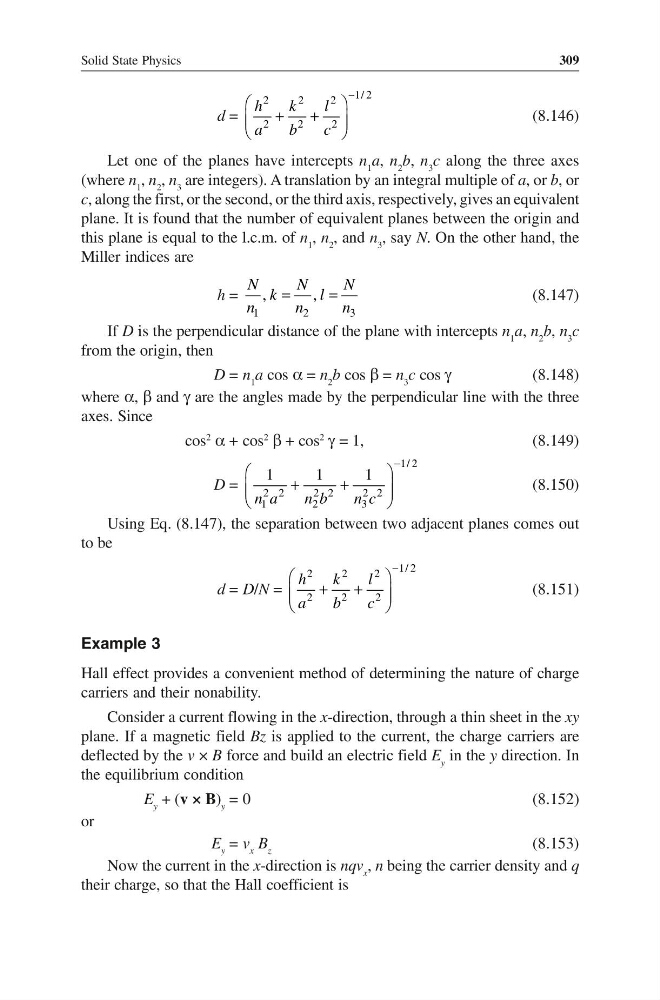
Let one of the planes have intercepts n 1 a, n 2 b, n 3 c along the three axes
(where n 1 , n 2 , n 3 are integers). A translation by an integral multiple of a, or b, or
c, along the first, or the second, or the third axis, respectively, gives an equivalent
plane. It is found that the number of equivalent planes between the origin and
this plane is equal to the l.c.m. of n 1 , n 2 , and n 3 , say N. On the other hand, the
Miller indices are
h =
1
2
3
,
,
N
N
N
k
l
n
n
n
=
=
(8.147)
If D is the perpendicular distance of the plane with intercepts n 1 a, n 2 b, n 3 c
from the origin, then
D = n 1 a cos α = n 2 b cos β = n 3 c cos γ
(8.148)
where α, β and γ are the angles made by the perpendicular line with the three
axes. Since
cos
2
α + cos
2
β + cos
2
γ = 1,
(8.149)
D =
1/ 2
2 2
2 2
2 2
1
2
3
1
1
1
n a
n b
n c
−
+
+
(8.150)
Using Eq. (8.147), the separation between two adjacent planes comes out
to be
d = D/N =
1/ 2
2
2
2
2
2
2
h
k
l
a
b
c
−
+
+
(8.151)
Example 3
Hall effect provides a convenient method of determining the nature of charge
carriers and their nonability.
Consider a current flowing in the x-direction, through a thin sheet in the xy
plane. If a magnetic field Bz is applied to the current, the charge carriers are
deflected by the v × B force and build an electric field E y in the y direction. In
the equilibrium condition
E y + (v × B) y = 0
(8.152)
or
E y = v x B z
(8.153)
Now the current in the x-direction is nqv x , n being the carrier density and q
their charge, so that the Hall coefficient is
309
d =
1/ 2
2
2
2
2
2
2
h
k
l
a
b
c
−
+
+
(8.146)
Let one of the planes have intercepts n 1 a, n 2 b, n 3 c along the three axes
(where n 1 , n 2 , n 3 are integers). A translation by an integral multiple of a, or b, or
c, along the first, or the second, or the third axis, respectively, gives an equivalent
plane. It is found that the number of equivalent planes between the origin and
this plane is equal to the l.c.m. of n 1 , n 2 , and n 3 , say N. On the other hand, the
Miller indices are
h =
1
2
3
,
,
N
N
N
k
l
n
n
n
=
=
(8.147)
If D is the perpendicular distance of the plane with intercepts n 1 a, n 2 b, n 3 c
from the origin, then
D = n 1 a cos α = n 2 b cos β = n 3 c cos γ
(8.148)
where α, β and γ are the angles made by the perpendicular line with the three
axes. Since
cos
2
α + cos
2
β + cos
2
γ = 1,
(8.149)
D =
1/ 2
2 2
2 2
2 2
1
2
3
1
1
1
n a
n b
n c
−
+
+
(8.150)
Using Eq. (8.147), the separation between two adjacent planes comes out
to be
d = D/N =
1/ 2
2
2
2
2
2
2
h
k
l
a
b
c
−
+
+
(8.151)
Example 3
Hall effect provides a convenient method of determining the nature of charge
carriers and their nonability.
Consider a current flowing in the x-direction, through a thin sheet in the xy
plane. If a magnetic field Bz is applied to the current, the charge carriers are
deflected by the v × B force and build an electric field E y in the y direction. In
the equilibrium condition
E y + (v × B) y = 0
(8.152)
or
E y = v x B z
(8.153)
Now the current in the x-direction is nqv x , n being the carrier density and q
their charge, so that the Hall coefficient is