

Elements of Modern Physics
308
8.8 EXAMPLES
Here, some examples that illustrate and extend the ideas about the solid state
are considered.
Example 1
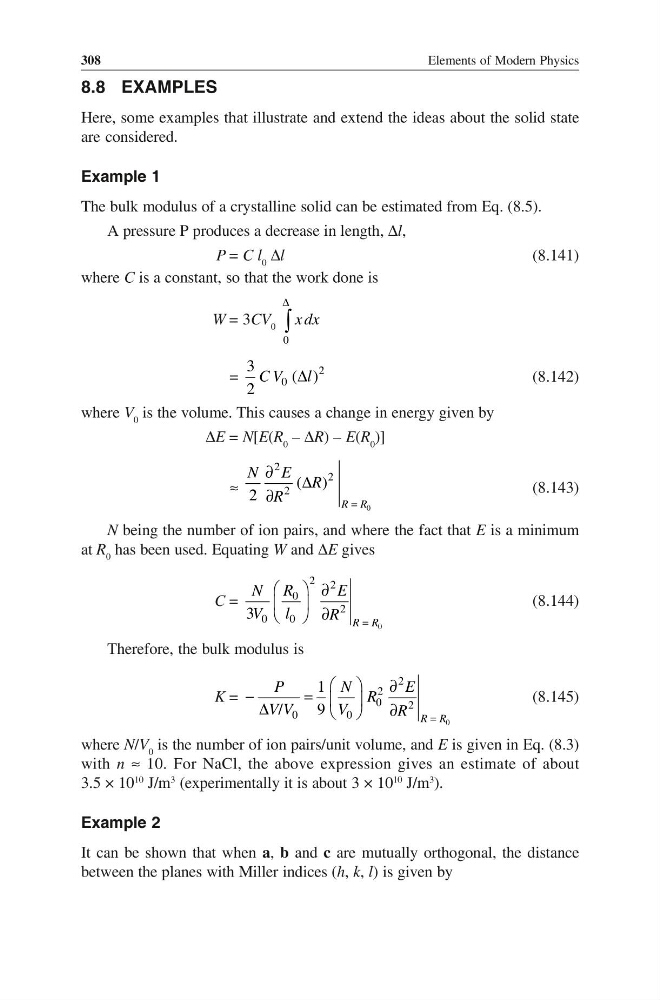
The bulk modulus of a crystalline solid can be estimated from Eq. (8.5).
A pressure P produces a decrease in length, ∆l,
P = C l 0 ∆l
(8.141)
where C is a constant, so that the work done is
W = 3CV 0
0
x dx
∆
∫
=
2
0
3
( )
2
C V
l
∆
(8.142)
where V 0 is the volume. This causes a change in energy given by
∆E = N[E(R 0 – ∆R) – E(R 0 )]
≈
0
2
2
2
( )
2
=
∂
∆
∂
R R
N E R
R
(8.143)
N being the number of ion pairs, and where the fact that E is a minimum
at R 0 has been used. Equating W and ∆E gives
C =
0
2 2
0
2
0
0
3
R R
R
N
E
V l
R =
∂
∂
(8.144)
Therefore, the bulk modulus is
K =
0
2
2
0
2
0
0
1
/
9
R R
P
N
E
R
V V
V
R =
∂
−
=
∆
∂
(8.145)
where N/V 0 is the number of ion pairs/unit volume, and E is given in Eq. (8.3)
with n ≈ 10. For NaCl, the above expression gives an estimate of about
3.5 × 10
10
J/m
3
(experimentally it is about 3 × 10
10
J/m
3
).
Example 2
It can be shown that when a, b and c are mutually orthogonal, the distance
between the planes with Miller indices (h, k, l) is given by
308
8.8 EXAMPLES
Here, some examples that illustrate and extend the ideas about the solid state
are considered.
Example 1
The bulk modulus of a crystalline solid can be estimated from Eq. (8.5).
A pressure P produces a decrease in length, ∆l,
P = C l 0 ∆l
(8.141)
where C is a constant, so that the work done is
W = 3CV 0
0
x dx
∆
∫
=
2
0
3
( )
2
C V
l
∆
(8.142)
where V 0 is the volume. This causes a change in energy given by
∆E = N[E(R 0 – ∆R) – E(R 0 )]
≈
0
2
2
2
( )
2
=
∂
∆
∂
R R
N E R
R
(8.143)
N being the number of ion pairs, and where the fact that E is a minimum
at R 0 has been used. Equating W and ∆E gives
C =
0
2 2
0
2
0
0
3
R R
R
N
E
V l
R =
∂
∂
(8.144)
Therefore, the bulk modulus is
K =
0
2
2
0
2
0
0
1
/
9
R R
P
N
E
R
V V
V
R =
∂
−
=
∆
∂
(8.145)
where N/V 0 is the number of ion pairs/unit volume, and E is given in Eq. (8.3)
with n ≈ 10. For NaCl, the above expression gives an estimate of about
3.5 × 10
10
J/m
3
(experimentally it is about 3 × 10
10
J/m
3
).
Example 2
It can be shown that when a, b and c are mutually orthogonal, the distance
between the planes with Miller indices (h, k, l) is given by