

Solid State Physics
307
Now, the contribution of electronic polarizabilities to
0
1
3
α
ε
∑ i i
i
N
is about
0.61. Assuming that the ionic contribution is about 0.39 (estimations show that
this is not unreasonable), the dielectric constant tends to infinity. Expanding
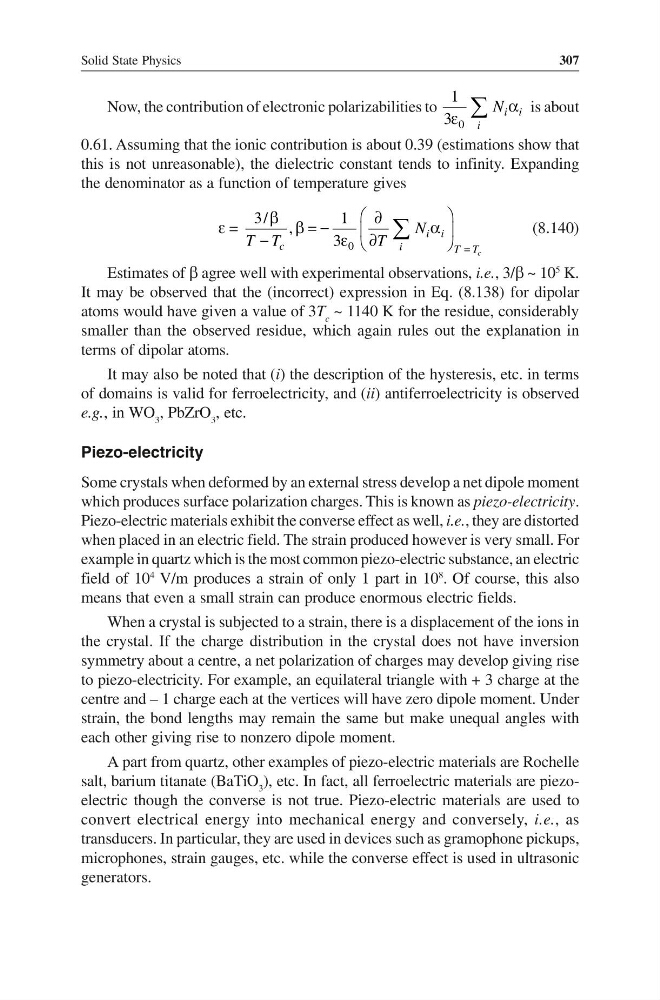
the denominator as a function of temperature gives
ε =
0
3/
1
,
3
=
β
∂
β = −
α
−
ε ∂
∑
c
i i
c
i
T T
N
T T
T
(8.140)
Estimates of β agree well with experimental observations, i.e., 3/β ~ 10
5
K.
It may be observed that the (incorrect) expression in Eq. (8.138) for dipolar
atoms would have given a value of 3T c ~ 1140 K for the residue, considerably
smaller than the observed residue, which again rules out the explanation in
terms of dipolar atoms.
It may also be noted that (i) the description of the hysteresis, etc. in terms
of domains is valid for ferroelectricity, and (ii) antiferroelectricity is observed
e.g., in WO 3 , PbZrO 3 , etc.
Piezo-electricity
Some crystals when deformed by an external stress develop a net dipole moment
which produces surface polarization charges. This is known as piezo-electricity.
Piezo-electric materials exhibit the converse effect as well, i.e., they are distorted
when placed in an electric field. The strain produced however is very small. For
example in quartz which is the most common piezo-electric substance, an electric
field of 10
4
V/m produces a strain of only 1 part in 10
8
. Of course, this also
means that even a small strain can produce enormous electric fields.
When a crystal is subjected to a strain, there is a displacement of the ions in
the crystal. If the charge distribution in the crystal does not have inversion
symmetry about a centre, a net polarization of charges may develop giving rise
to piezo-electricity. For example, an equilateral triangle with + 3 charge at the
centre and – 1 charge each at the vertices will have zero dipole moment. Under
strain, the bond lengths may remain the same but make unequal angles with
each other giving rise to nonzero dipole moment.
A part from quartz, other examples of piezo-electric materials are Rochelle
salt, barium titanate (BaTiO 3 ), etc. In fact, all ferroelectric materials are piezoelectric though the converse is not true. Piezo-electric materials are used to
convert electrical energy into mechanical energy and conversely, i.e., as
transducers. In particular, they are used in devices such as gramophone pickups,
microphones, strain gauges, etc. while the converse effect is used in ultrasonic
generators.
307
Now, the contribution of electronic polarizabilities to
0
1
3
α
ε
∑ i i
i
N
is about
0.61. Assuming that the ionic contribution is about 0.39 (estimations show that
this is not unreasonable), the dielectric constant tends to infinity. Expanding
the denominator as a function of temperature gives
ε =
0
3/
1
,
3
=
β
∂
β = −
α
−
ε ∂
∑
c
i i
c
i
T T
N
T T
T
(8.140)
Estimates of β agree well with experimental observations, i.e., 3/β ~ 10
5
K.
It may be observed that the (incorrect) expression in Eq. (8.138) for dipolar
atoms would have given a value of 3T c ~ 1140 K for the residue, considerably
smaller than the observed residue, which again rules out the explanation in
terms of dipolar atoms.
It may also be noted that (i) the description of the hysteresis, etc. in terms
of domains is valid for ferroelectricity, and (ii) antiferroelectricity is observed
e.g., in WO 3 , PbZrO 3 , etc.
Piezo-electricity
Some crystals when deformed by an external stress develop a net dipole moment
which produces surface polarization charges. This is known as piezo-electricity.
Piezo-electric materials exhibit the converse effect as well, i.e., they are distorted
when placed in an electric field. The strain produced however is very small. For
example in quartz which is the most common piezo-electric substance, an electric
field of 10
4
V/m produces a strain of only 1 part in 10
8
. Of course, this also
means that even a small strain can produce enormous electric fields.
When a crystal is subjected to a strain, there is a displacement of the ions in
the crystal. If the charge distribution in the crystal does not have inversion
symmetry about a centre, a net polarization of charges may develop giving rise
to piezo-electricity. For example, an equilateral triangle with + 3 charge at the
centre and – 1 charge each at the vertices will have zero dipole moment. Under
strain, the bond lengths may remain the same but make unequal angles with
each other giving rise to nonzero dipole moment.
A part from quartz, other examples of piezo-electric materials are Rochelle
salt, barium titanate (BaTiO 3 ), etc. In fact, all ferroelectric materials are piezoelectric though the converse is not true. Piezo-electric materials are used to
convert electrical energy into mechanical energy and conversely, i.e., as
transducers. In particular, they are used in devices such as gramophone pickups,
microphones, strain gauges, etc. while the converse effect is used in ultrasonic
generators.