

Solid State Physics
311
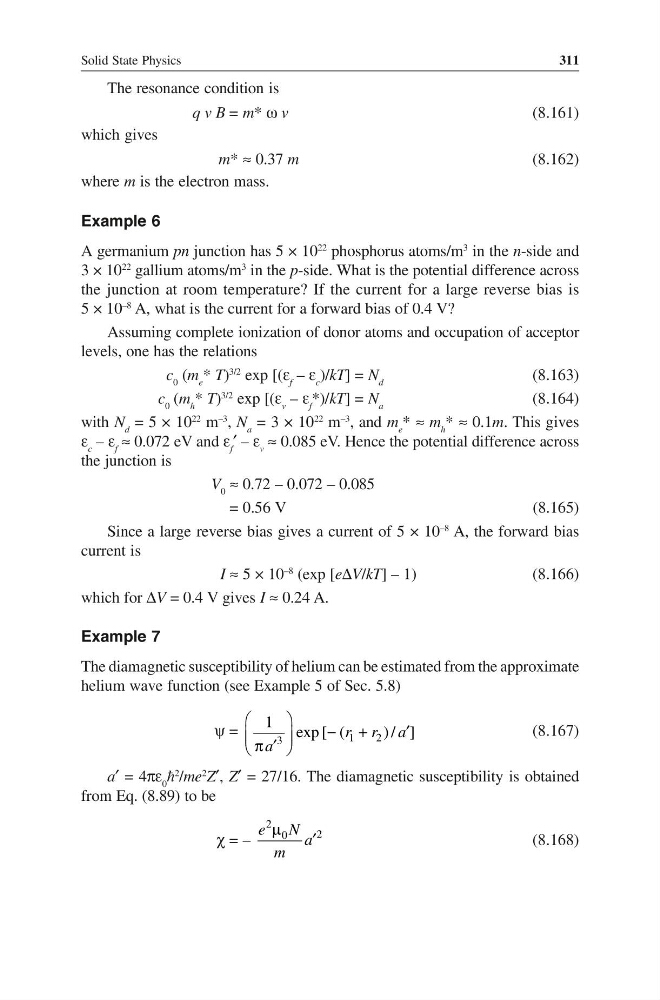
The resonance condition is
q v B = m* ω v
(8.161)
which gives
m* ≈ 0.37 m
(8.162)
where m is the electron mass.
Example 6
A germanium pn junction has 5 × 10
22
phosphorus atoms/m
3
in the n-side and
3 × 10
22
gallium atoms/m
3
in the p-side. What is the potential difference across
the junction at room temperature? If the current for a large reverse bias is
5 × 10
–8
A, what is the current for a forward bias of 0.4 V?
Assuming complete ionization of donor atoms and occupation of acceptor
levels, one has the relations
c 0 (m e * T)
3/2
exp [(ε f – ε c )/kT] = N d
(8.163)
c 0 (m h * T)
3/2
exp [(ε v – ε f *)/kT] = N a
(8.164)
with N d = 5 × 10
22
m
–3
, N a = 3 × 10
22
m
–3
, and m e * ≈ m h * ≈ 0.1m. This gives
ε c – ε f ≈ 0.072 eV and ε f ′ – ε v ≈ 0.085 eV. Hence the potential difference across
the junction is
V 0 ≈ 0.72 – 0.072 – 0.085
= 0.56 V
(8.165)
Since a large reverse bias gives a current of 5 × 10
–8
A, the forward bias
current is
I ≈ 5 × 10
–8
(exp [e∆V/kT] – 1)
(8.166)
which for ∆V = 0.4 V gives I ≈ 0.24 A.
Example 7
The diamagnetic susceptibility of helium can be estimated from the approximate
helium wave function (see Example 5 of Sec. 5.8)
ψ =
1
2
3
1 exp [ (
) / ]
r r a
a
− +
′
π ′
(8.167)
a′ = 4πε 0
2
/me
2
Z′, Z′ = 27/16. The diamagnetic susceptibility is obtained
from Eq. (8.89) to be
χ = –
2
2
0
e N a
m
µ
′
(8.168)
311
The resonance condition is
q v B = m* ω v
(8.161)
which gives
m* ≈ 0.37 m
(8.162)
where m is the electron mass.
Example 6
A germanium pn junction has 5 × 10
22
phosphorus atoms/m
3
in the n-side and
3 × 10
22
gallium atoms/m
3
in the p-side. What is the potential difference across
the junction at room temperature? If the current for a large reverse bias is
5 × 10
–8
A, what is the current for a forward bias of 0.4 V?
Assuming complete ionization of donor atoms and occupation of acceptor
levels, one has the relations
c 0 (m e * T)
3/2
exp [(ε f – ε c )/kT] = N d
(8.163)
c 0 (m h * T)
3/2
exp [(ε v – ε f *)/kT] = N a
(8.164)
with N d = 5 × 10
22
m
–3
, N a = 3 × 10
22
m
–3
, and m e * ≈ m h * ≈ 0.1m. This gives
ε c – ε f ≈ 0.072 eV and ε f ′ – ε v ≈ 0.085 eV. Hence the potential difference across
the junction is
V 0 ≈ 0.72 – 0.072 – 0.085
= 0.56 V
(8.165)
Since a large reverse bias gives a current of 5 × 10
–8
A, the forward bias
current is
I ≈ 5 × 10
–8
(exp [e∆V/kT] – 1)
(8.166)
which for ∆V = 0.4 V gives I ≈ 0.24 A.
Example 7
The diamagnetic susceptibility of helium can be estimated from the approximate
helium wave function (see Example 5 of Sec. 5.8)
ψ =
1
2
3
1 exp [ (
) / ]
r r a
a
− +
′
π ′
(8.167)
a′ = 4πε 0
2
/me
2
Z′, Z′ = 27/16. The diamagnetic susceptibility is obtained
from Eq. (8.89) to be
χ = –
2
2
0
e N a
m
µ
′
(8.168)