

Solid State Physics
295
M =
3/ 2
/2
1/ 2
3
/2
2 (2 )
2
ε +
ε −
π
ε
ε
∫
f
f
e B m
e B m
V m
e
d
m
h
≈
2
3
2 2
(0)
ε
f
e
NB
m
(8.95)
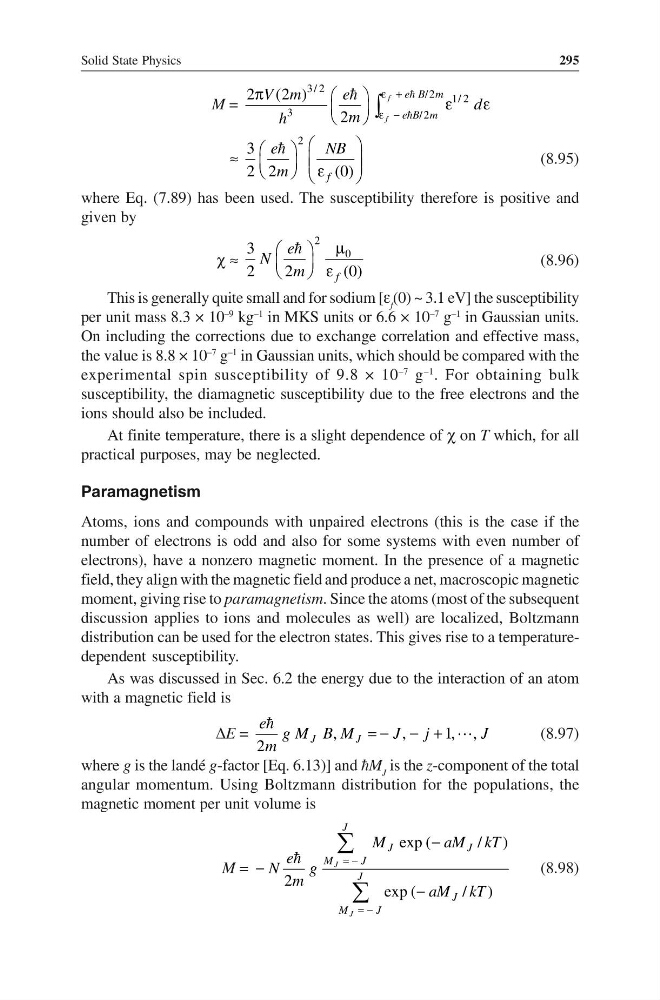
where Eq. (7.89) has been used. The susceptibility therefore is positive and
given by
χ ≈
2
0
3
2
2
(0)
µ
ε
f
e
N m
(8.96)
This is generally quite small and for sodium [ε f (0) ~ 3.1 eV] the susceptibility
per unit mass 8.3 × 10
–9
kg
–1
in MKS units or 6.6 × 10
–7
g
–1
in Gaussian units.
On including the corrections due to exchange correlation and effective mass,
the value is 8.8 × 10
–7
g
–1
in Gaussian units, which should be compared with the
experimental spin susceptibility of 9.8 × 10
–7
g
–1
. For obtaining bulk
susceptibility, the diamagnetic susceptibility due to the free electrons and the
ions should also be included.
At finite temperature, there is a slight dependence of χ on T which, for all
practical purposes, may be neglected.
Paramagnetism
Atoms, ions and compounds with unpaired electrons (this is the case if the
number of electrons is odd and also for some systems with even number of
electrons), have a nonzero magnetic moment. In the presence of a magnetic
field, they align with the magnetic field and produce a net, macroscopic magnetic
moment, giving rise to paramagnetism. Since the atoms (most of the subsequent
discussion applies to ions and molecules as well) are localized, Boltzmann
distribution can be used for the electron states. This gives rise to a temperaturedependent susceptibility.
As was discussed in Sec. 6.2 the energy due to the interaction of an atom
with a magnetic field is
∆E =
,
,
1 , ,
2
= − − +
J
J
e g M B M
J
j
J
m
(8.97)
where g is the landé g-factor [Eq. 6.13)] and M J is the z-component of the total
angular momentum. Using Boltzmann distribution for the populations, the
magnetic moment per unit volume is
M =
exp (
/ )
2
exp (
/ )
= −
= −
−
−
−
∑
∑
J
J
J
J
J
M
J
J
J
M
J
M
aM kT
e
N
g
m
aM kT
(8.98)
295
M =
3/ 2
/2
1/ 2
3
/2
2 (2 )
2
ε +
ε −
π
ε
ε
∫
f
f
e B m
e B m
V m
e
d
m
h
≈
2
3
2 2
(0)
ε
f
e
NB
m
(8.95)
where Eq. (7.89) has been used. The susceptibility therefore is positive and
given by
χ ≈
2
0
3
2
2
(0)
µ
ε
f
e
N m
(8.96)
This is generally quite small and for sodium [ε f (0) ~ 3.1 eV] the susceptibility
per unit mass 8.3 × 10
–9
kg
–1
in MKS units or 6.6 × 10
–7
g
–1
in Gaussian units.
On including the corrections due to exchange correlation and effective mass,
the value is 8.8 × 10
–7
g
–1
in Gaussian units, which should be compared with the
experimental spin susceptibility of 9.8 × 10
–7
g
–1
. For obtaining bulk
susceptibility, the diamagnetic susceptibility due to the free electrons and the
ions should also be included.
At finite temperature, there is a slight dependence of χ on T which, for all
practical purposes, may be neglected.
Paramagnetism
Atoms, ions and compounds with unpaired electrons (this is the case if the
number of electrons is odd and also for some systems with even number of
electrons), have a nonzero magnetic moment. In the presence of a magnetic
field, they align with the magnetic field and produce a net, macroscopic magnetic
moment, giving rise to paramagnetism. Since the atoms (most of the subsequent
discussion applies to ions and molecules as well) are localized, Boltzmann
distribution can be used for the electron states. This gives rise to a temperaturedependent susceptibility.
As was discussed in Sec. 6.2 the energy due to the interaction of an atom
with a magnetic field is
∆E =
,
,
1 , ,
2
= − − +
J
J
e g M B M
J
j
J
m
(8.97)
where g is the landé g-factor [Eq. 6.13)] and M J is the z-component of the total
angular momentum. Using Boltzmann distribution for the populations, the
magnetic moment per unit volume is
M =
exp (
/ )
2
exp (
/ )
= −
= −
−
−
−
∑
∑
J
J
J
J
J
M
J
J
J
M
J
M
aM kT
e
N
g
m
aM kT
(8.98)