

Elements of Modern Physics
294
χ =
2
2
0
( )
4
⊥
µ
−
∑ i
i
e N
m
r
(8.90)
where N is the number of atoms per unit volume. For the evaluation of this
quantity, an approximate value for
2
( )
⊥
〈
〉
i
r
is normally used. For a typical value
of r
2
~ 10
–20
m
2
, the molar susceptibility is
χ m ~ 5 × 10
–8
/kg. mol, in MKS units,
(8.91)
(multiply by 10
3
/4π to get the value in Gaussian units of per g mole) which
means that diamagnetism is a small effect. It is significant minly in atoms and
ions with closed shells, e.g., He, Ne, F
–
, Cl
–
, etc. which do not have a permanent
magnetic moment.
Free-Electron Paramagnetism
Free-electron paramagnetism in metals arises from the intrinsic magnetic
moment associated with the spin of the electron. In the absence of any magnetic
field, there is no preferred orientation of these magnetic moments. However, in
the presence of a magnetic field, the energies of the electron are perturbed by an
additional interaction
H =
− −
⋅
e
m
s B
(8.92)
and the resulting energy eigenvalues are
ε′ =
2
ε ±
e B
m
(8.93)
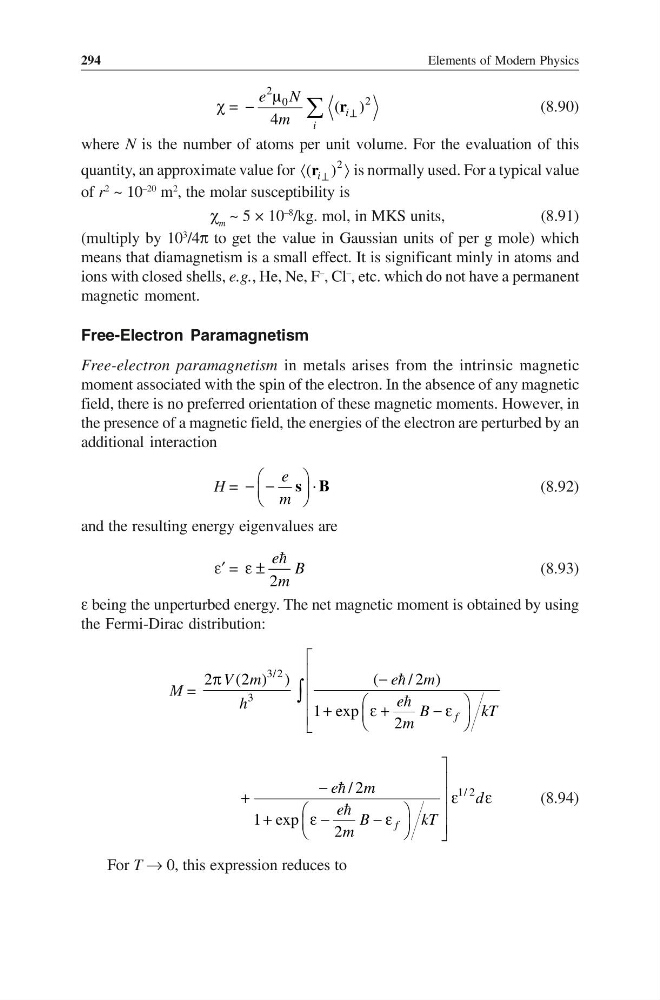
ε being the unperturbed energy. The net magnetic moment is obtained by using
the Fermi-Dirac distribution:
M =
3/2
3
2 (2 ) )
(
/2 )
1 exp
2
π
−
+
ε+
−ε
∫
f
V m
e
m
e
h
B
k T
m
1/ 2
/ 2
1 exp
2
−
+
ε
ε
+
ε−
−ε
f
e
m
d
e B
k T
m
(8.94)
For T → 0, this expression reduces to
294
χ =
2
2
0
( )
4
⊥
µ
−
∑ i
i
e N
m
r
(8.90)
where N is the number of atoms per unit volume. For the evaluation of this
quantity, an approximate value for
2
( )
⊥
〈
〉
i
r
is normally used. For a typical value
of r
2
~ 10
–20
m
2
, the molar susceptibility is
χ m ~ 5 × 10
–8
/kg. mol, in MKS units,
(8.91)
(multiply by 10
3
/4π to get the value in Gaussian units of per g mole) which
means that diamagnetism is a small effect. It is significant minly in atoms and
ions with closed shells, e.g., He, Ne, F
–
, Cl
–
, etc. which do not have a permanent
magnetic moment.
Free-Electron Paramagnetism
Free-electron paramagnetism in metals arises from the intrinsic magnetic
moment associated with the spin of the electron. In the absence of any magnetic
field, there is no preferred orientation of these magnetic moments. However, in
the presence of a magnetic field, the energies of the electron are perturbed by an
additional interaction
H =
− −
⋅
e
m
s B
(8.92)
and the resulting energy eigenvalues are
ε′ =
2
ε ±
e B
m
(8.93)
ε being the unperturbed energy. The net magnetic moment is obtained by using
the Fermi-Dirac distribution:
M =
3/2
3
2 (2 ) )
(
/2 )
1 exp
2
π
−
+
ε+
−ε
∫
f
V m
e
m
e
h
B
k T
m
1/ 2
/ 2
1 exp
2
−
+
ε
ε
+
ε−
−ε
f
e
m
d
e B
k T
m
(8.94)
For T → 0, this expression reduces to