

Solid State Physics
293
The magnetic properties are discussed conveniently in terms of magnetic
susceptibility χ defined as
χ = M/H
(8.85)
where M is the magnetic moment per unit volume, and H is the magnetic
intensity. The magnetic intensity H, the magnetic moment M and the magnetic
field B are related by
B = µ 0 (H + M)
(8.86)
where µ 0 is the vacuum permeability. Different magnetic properties, in particular
the behaviour of the associated magnetic moment and the magnetic susceptibility
will be discussed here.
Diamagnetism
When an atom is subjected to a magnetic field, the changing magnetic flux
induces currents (via the electron orbits) which, as per Lenz’s law, oppose the
change in flux. The currents persist, and have a magnetic moment which is
opposite in sign to the magnetic field intensity. The associated magnetic
susceptibility is negative and the property is known as diamagnetism.
Diamagnetism is present in all substances but is usually obscured by the larger
effects due to permanent magnetic dipole moments of the atoms.
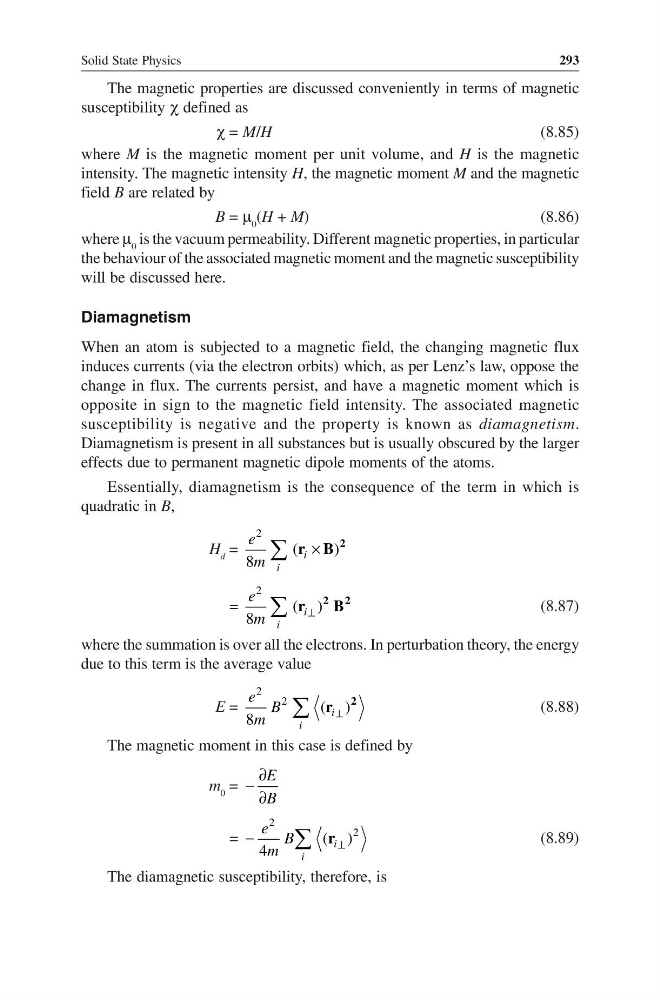
Essentially, diamagnetism is the consequence of the term in which is
quadratic in B,
H d =
2
(
)
8
×
∑ i
i
e
m
2
r B
=
2
( )
8
⊥
∑ i
i
e
m
2 2
r
B
(8.87)
where the summation is over all the electrons. In perturbation theory, the energy
due to this term is the average value
E =
2
2
( )
8
⊥
∑ i
i
e B
m
2
r
(8.88)
The magnetic moment in this case is defined by
m 0 =
∂
− ∂
E
B
=
2
2
( )
4
⊥
−
∑ i
i
e B
m
r
(8.89)
The diamagnetic susceptibility, therefore, is
293
The magnetic properties are discussed conveniently in terms of magnetic
susceptibility χ defined as
χ = M/H
(8.85)
where M is the magnetic moment per unit volume, and H is the magnetic
intensity. The magnetic intensity H, the magnetic moment M and the magnetic
field B are related by
B = µ 0 (H + M)
(8.86)
where µ 0 is the vacuum permeability. Different magnetic properties, in particular
the behaviour of the associated magnetic moment and the magnetic susceptibility
will be discussed here.
Diamagnetism
When an atom is subjected to a magnetic field, the changing magnetic flux
induces currents (via the electron orbits) which, as per Lenz’s law, oppose the
change in flux. The currents persist, and have a magnetic moment which is
opposite in sign to the magnetic field intensity. The associated magnetic
susceptibility is negative and the property is known as diamagnetism.
Diamagnetism is present in all substances but is usually obscured by the larger
effects due to permanent magnetic dipole moments of the atoms.
Essentially, diamagnetism is the consequence of the term in which is
quadratic in B,
H d =
2
(
)
8
×
∑ i
i
e
m
2
r B
=
2
( )
8
⊥
∑ i
i
e
m
2 2
r
B
(8.87)
where the summation is over all the electrons. In perturbation theory, the energy
due to this term is the average value
E =
2
2
( )
8
⊥
∑ i
i
e B
m
2
r
(8.88)
The magnetic moment in this case is defined by
m 0 =
∂
− ∂
E
B
=
2
2
( )
4
⊥
−
∑ i
i
e B
m
r
(8.89)
The diamagnetic susceptibility, therefore, is