

Elements of Modern Physics
296
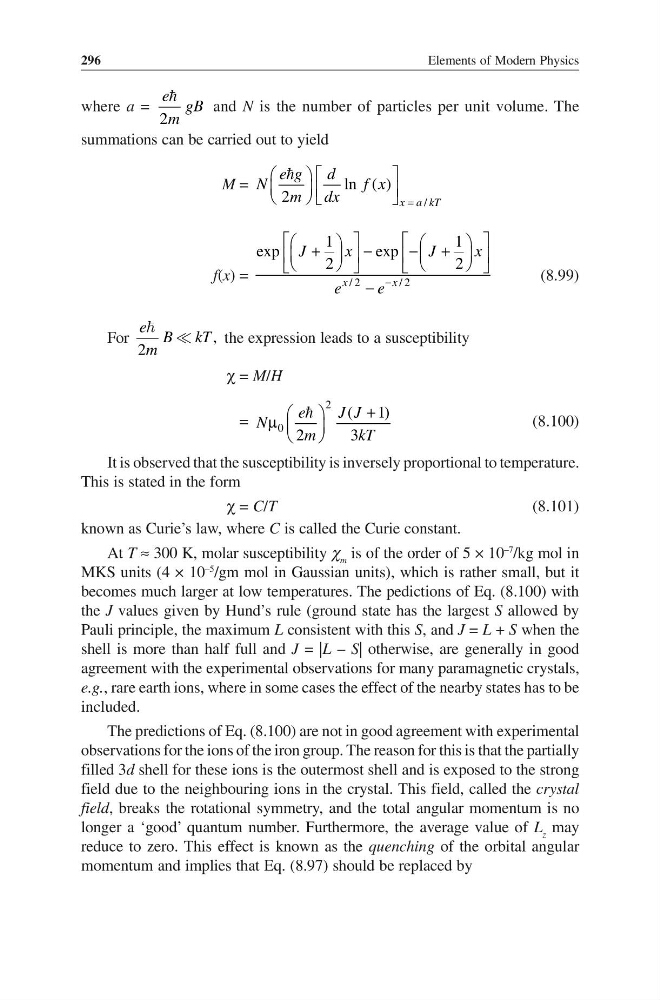
where a = 2
e gB
m
and N is the number of particles per unit volume. The
summations can be carried out to yield
M =
/
ln ( )
2
=
x a kT
e g
d
N
fx
m dx
f(x) =
/ 2
/ 2
1
1
exp
exp
2
2
−
+
−
− +
−
x
x
J
x
J
x
e
e
(8.99)
For
,
2
e B kT
m
the expression leads to a susceptibility
χ = M/H
=
2
0
(
1)
2
3
+
µ
e
J J
N
m
kT
(8.100)
It is observed that the susceptibility is inversely proportional to temperature.
This is stated in the form
χ = C/T
(8.101)
known as Curie’s law, where C is called the Curie constant.
At T ≈ 300 K, molar susceptibility χ m is of the order of 5 × 10
–7
/kg mol in
MKS units (4 × 10
–5
/gm mol in Gaussian units), which is rather small, but it
becomes much larger at low temperatures. The pedictions of Eq. (8.100) with
the J values given by Hund’s rule (ground state has the largest S allowed by
Pauli principle, the maximum L consistent with this S, and J = L + S when the
shell is more than half full and J = |L – S| otherwise, are generally in good
agreement with the experimental observations for many paramagnetic crystals,
e.g., rare earth ions, where in some cases the effect of the nearby states has to be
included.
The predictions of Eq. (8.100) are not in good agreement with experimental
observations for the ions of the iron group. The reason for this is that the partially
filled 3d shell for these ions is the outermost shell and is exposed to the strong
field due to the neighbouring ions in the crystal. This field, called the crystal
field, breaks the rotational symmetry, and the total angular momentum is no
longer a ‘good’ quantum number. Furthermore, the average value of L z may
reduce to zero. This effect is known as the quenching of the orbital angular
momentum and implies that Eq. (8.97) should be replaced by
296
where a = 2
e gB
m
and N is the number of particles per unit volume. The
summations can be carried out to yield
M =
/
ln ( )
2
=
x a kT
e g
d
N
fx
m dx
f(x) =
/ 2
/ 2
1
1
exp
exp
2
2
−
+
−
− +
−
x
x
J
x
J
x
e
e
(8.99)
For
,
2
e B kT
m
the expression leads to a susceptibility
χ = M/H
=
2
0
(
1)
2
3
+
µ
e
J J
N
m
kT
(8.100)
It is observed that the susceptibility is inversely proportional to temperature.
This is stated in the form
χ = C/T
(8.101)
known as Curie’s law, where C is called the Curie constant.
At T ≈ 300 K, molar susceptibility χ m is of the order of 5 × 10
–7
/kg mol in
MKS units (4 × 10
–5
/gm mol in Gaussian units), which is rather small, but it
becomes much larger at low temperatures. The pedictions of Eq. (8.100) with
the J values given by Hund’s rule (ground state has the largest S allowed by
Pauli principle, the maximum L consistent with this S, and J = L + S when the
shell is more than half full and J = |L – S| otherwise, are generally in good
agreement with the experimental observations for many paramagnetic crystals,
e.g., rare earth ions, where in some cases the effect of the nearby states has to be
included.
The predictions of Eq. (8.100) are not in good agreement with experimental
observations for the ions of the iron group. The reason for this is that the partially
filled 3d shell for these ions is the outermost shell and is exposed to the strong
field due to the neighbouring ions in the crystal. This field, called the crystal
field, breaks the rotational symmetry, and the total angular momentum is no
longer a ‘good’ quantum number. Furthermore, the average value of L z may
reduce to zero. This effect is known as the quenching of the orbital angular
momentum and implies that Eq. (8.97) should be replaced by