

Solid State Physics
279
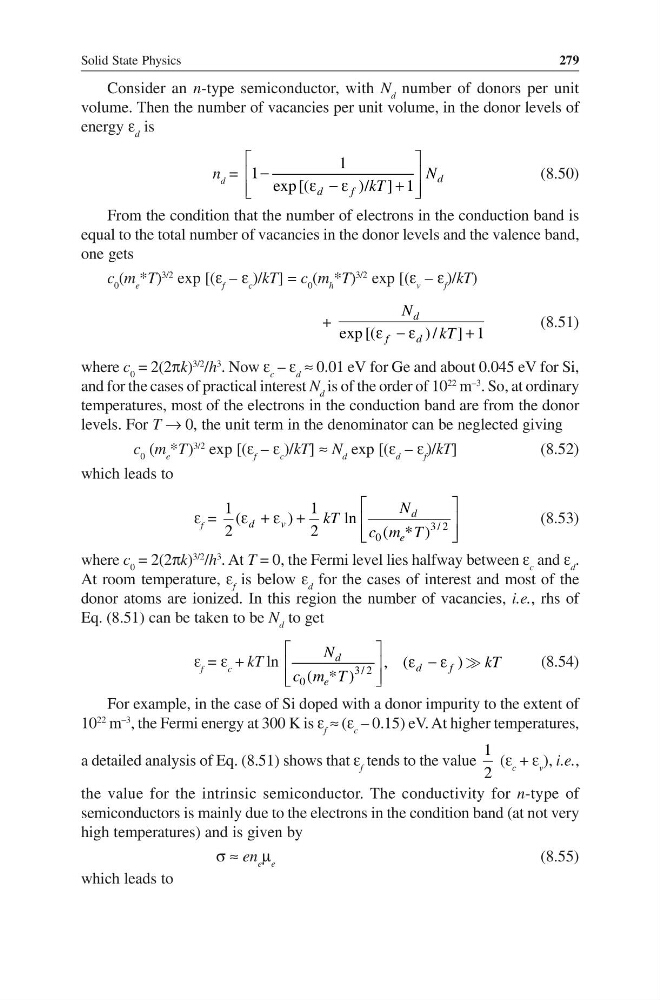
Consider an n-type semiconductor, with N d number of donors per unit
volume. Then the number of vacancies per unit volume, in the donor levels of
energy ε d is
n d =
1
1 exp [(
)/ ] 1
−
ε − ε
+
d
d
f
N
kT
(8.50)
From the condition that the number of electrons in the conduction band is
equal to the total number of vacancies in the donor levels and the valence band,
one gets
c 0 (m e *T)
3/2
exp [(ε f – ε c )/kT] = c 0 (m h *T)
3/2
exp [(ε v – ε f )/kT)
+ exp [(
) / ] 1
ε − ε
+
d
f
d
N
kT
(8.51)
where c 0 = 2(2πk)
3/2
/h
3
. Now ε c – ε d ≈ 0.01 eV for Ge and about 0.045 eV for Si,
and for the cases of practical interest N d is of the order of 10
22
m
–3
. So, at ordinary
temperatures, most of the electrons in the conduction band are from the donor
levels. For T → 0, the unit term in the denominator can be neglected giving
c 0 (m e *T)
3/2
exp [(ε f – ε c )/kT] ≈ N d exp [(ε d – ε f )/kT]
(8.52)
which leads to
ε f =
3 / 2
0
1
1
(
)
ln
2
2
( * )
ε + ε +
d
d
v
e
N
kT
c m T
(8.53)
where c 0 = 2(2πk)
3/2
/h
3
. At T = 0, the Fermi level lies halfway between ε c and ε d .
At room temperature, ε f is below ε d for the cases of interest and most of the
donor atoms are ionized. In this region the number of vacancies, i.e., rhs of
Eq. (8.51) can be taken to be N d to get
ε f = ε c + kT ln
3 / 2
0
, (
)
( * )
d
d
f
e
N
kT
c m T
ε − ε
(8.54)
For example, in the case of Si doped with a donor impurity to the extent of
10
22
m
–3
, the Fermi energy at 300 K is ε f ≈ (ε c – 0.15) eV. At higher temperatures,
a detailed analysis of Eq. (8.51) shows that ε f tends to the value
1
2
(ε c + ε v ), i.e.,
the value for the intrinsic semiconductor. The conductivity for n-type of
semiconductors is mainly due to the electrons in the condition band (at not very
high temperatures) and is given by
σ ≈ en e µ e
(8.55)
which leads to
279
Consider an n-type semiconductor, with N d number of donors per unit
volume. Then the number of vacancies per unit volume, in the donor levels of
energy ε d is
n d =
1
1 exp [(
)/ ] 1
−
ε − ε
+
d
d
f
N
kT
(8.50)
From the condition that the number of electrons in the conduction band is
equal to the total number of vacancies in the donor levels and the valence band,
one gets
c 0 (m e *T)
3/2
exp [(ε f – ε c )/kT] = c 0 (m h *T)
3/2
exp [(ε v – ε f )/kT)
+ exp [(
) / ] 1
ε − ε
+
d
f
d
N
kT
(8.51)
where c 0 = 2(2πk)
3/2
/h
3
. Now ε c – ε d ≈ 0.01 eV for Ge and about 0.045 eV for Si,
and for the cases of practical interest N d is of the order of 10
22
m
–3
. So, at ordinary
temperatures, most of the electrons in the conduction band are from the donor
levels. For T → 0, the unit term in the denominator can be neglected giving
c 0 (m e *T)
3/2
exp [(ε f – ε c )/kT] ≈ N d exp [(ε d – ε f )/kT]
(8.52)
which leads to
ε f =
3 / 2
0
1
1
(
)
ln
2
2
( * )
ε + ε +
d
d
v
e
N
kT
c m T
(8.53)
where c 0 = 2(2πk)
3/2
/h
3
. At T = 0, the Fermi level lies halfway between ε c and ε d .
At room temperature, ε f is below ε d for the cases of interest and most of the
donor atoms are ionized. In this region the number of vacancies, i.e., rhs of
Eq. (8.51) can be taken to be N d to get
ε f = ε c + kT ln
3 / 2
0
, (
)
( * )
d
d
f
e
N
kT
c m T
ε − ε
(8.54)
For example, in the case of Si doped with a donor impurity to the extent of
10
22
m
–3
, the Fermi energy at 300 K is ε f ≈ (ε c – 0.15) eV. At higher temperatures,
a detailed analysis of Eq. (8.51) shows that ε f tends to the value
1
2
(ε c + ε v ), i.e.,
the value for the intrinsic semiconductor. The conductivity for n-type of
semiconductors is mainly due to the electrons in the condition band (at not very
high temperatures) and is given by
σ ≈ en e µ e
(8.55)
which leads to