

Elements of Modern Physics
278
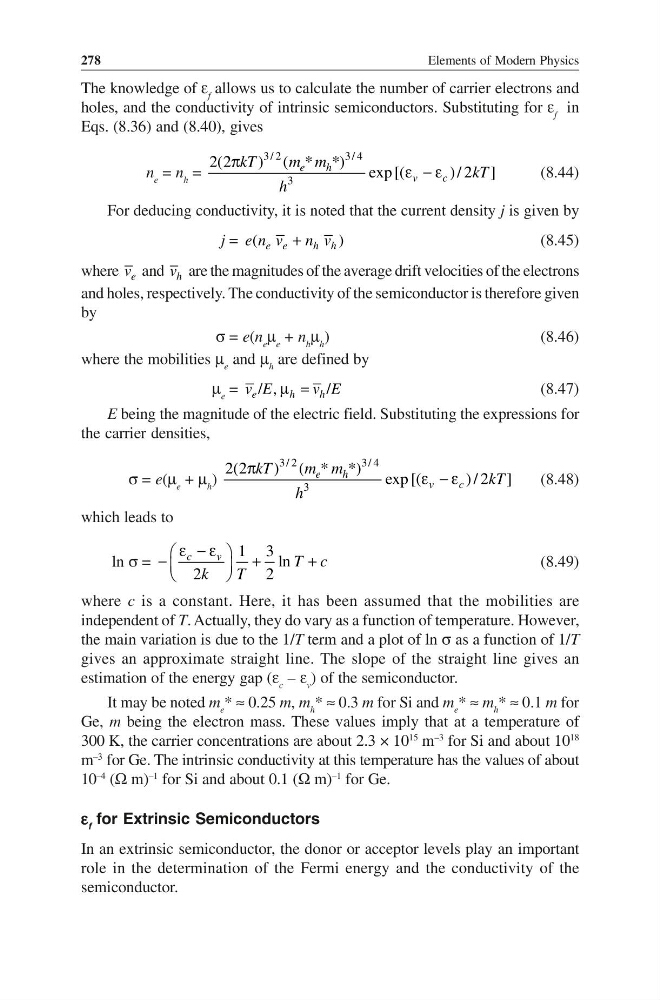
The knowledge of ε f allows us to calculate the number of carrier electrons and
holes, and the conductivity of intrinsic semiconductors. Substituting for ε f in
Eqs. (8.36) and (8.40), gives
n e = n h =
3/ 2
3/ 4
3
2(2
) ( * *) exp [(
) / 2 ]
π
ε − ε
e
h
v
c
kT
m m
kT
h
(8.44)
For deducing conductivity, it is noted that the current density j is given by
j = (
)
+
e e
h h
e n v n v
(8.45)
where e
v and h
v are the magnitudes of the average drift velocities of the electrons
and holes, respectively. The conductivity of the semiconductor is therefore given
by
σ = e(n e µ e + n h µ h )
(8.46)
where the mobilities µ e and µ h are defined by
µ e = / ,
/
µ =
e
h
h
v E
v E
(8.47)
E being the magnitude of the electric field. Substituting the expressions for
the carrier densities,
σ = e(µ e + µ h )
3/ 2
3/ 4
3
2(2
) ( * *) exp [(
) / 2 ]
π
ε − ε
e
h
v
c
kT
m m
kT
h
(8.48)
which leads to
ln σ =
1 3 ln
2
2
ε − ε
−
+
+
c
v
T c
k
T
(8.49)
where c is a constant. Here, it has been assumed that the mobilities are
independent of T. Actually, they do vary as a function of temperature. However,
the main variation is due to the 1/T term and a plot of ln σ as a function of 1/T
gives an approximate straight line. The slope of the straight line gives an
estimation of the energy gap (ε c – ε v ) of the semiconductor.
It may be noted m e * ≈ 0.25 m, m h * ≈ 0.3 m for Si and m e * ≈ m h * ≈ 0.1 m for
Ge, m being the electron mass. These values imply that at a temperature of
300 K, the carrier concentrations are about 2.3 × 10
15
m
–3
for Si and about 10
18
m
–3
for Ge. The intrinsic conductivity at this temperature has the values of about
10
–4
(Ω m)
–1
for Si and about 0.1 (Ω m)
–1
for Ge.
ε
ε ε
ε ε f for Extrinsic Semiconductors
In an extrinsic semiconductor, the donor or acceptor levels play an important
role in the determination of the Fermi energy and the conductivity of the
semiconductor.
278
The knowledge of ε f allows us to calculate the number of carrier electrons and
holes, and the conductivity of intrinsic semiconductors. Substituting for ε f in
Eqs. (8.36) and (8.40), gives
n e = n h =
3/ 2
3/ 4
3
2(2
) ( * *) exp [(
) / 2 ]
π
ε − ε
e
h
v
c
kT
m m
kT
h
(8.44)
For deducing conductivity, it is noted that the current density j is given by
j = (
)
+
e e
h h
e n v n v
(8.45)
where e
v and h
v are the magnitudes of the average drift velocities of the electrons
and holes, respectively. The conductivity of the semiconductor is therefore given
by
σ = e(n e µ e + n h µ h )
(8.46)
where the mobilities µ e and µ h are defined by
µ e = / ,
/
µ =
e
h
h
v E
v E
(8.47)
E being the magnitude of the electric field. Substituting the expressions for
the carrier densities,
σ = e(µ e + µ h )
3/ 2
3/ 4
3
2(2
) ( * *) exp [(
) / 2 ]
π
ε − ε
e
h
v
c
kT
m m
kT
h
(8.48)
which leads to
ln σ =
1 3 ln
2
2
ε − ε
−
+
+
c
v
T c
k
T
(8.49)
where c is a constant. Here, it has been assumed that the mobilities are
independent of T. Actually, they do vary as a function of temperature. However,
the main variation is due to the 1/T term and a plot of ln σ as a function of 1/T
gives an approximate straight line. The slope of the straight line gives an
estimation of the energy gap (ε c – ε v ) of the semiconductor.
It may be noted m e * ≈ 0.25 m, m h * ≈ 0.3 m for Si and m e * ≈ m h * ≈ 0.1 m for
Ge, m being the electron mass. These values imply that at a temperature of
300 K, the carrier concentrations are about 2.3 × 10
15
m
–3
for Si and about 10
18
m
–3
for Ge. The intrinsic conductivity at this temperature has the values of about
10
–4
(Ω m)
–1
for Si and about 0.1 (Ω m)
–1
for Ge.
ε
ε ε
ε ε f for Extrinsic Semiconductors
In an extrinsic semiconductor, the donor or acceptor levels play an important
role in the determination of the Fermi energy and the conductivity of the
semiconductor.