

Solid State Physics
277
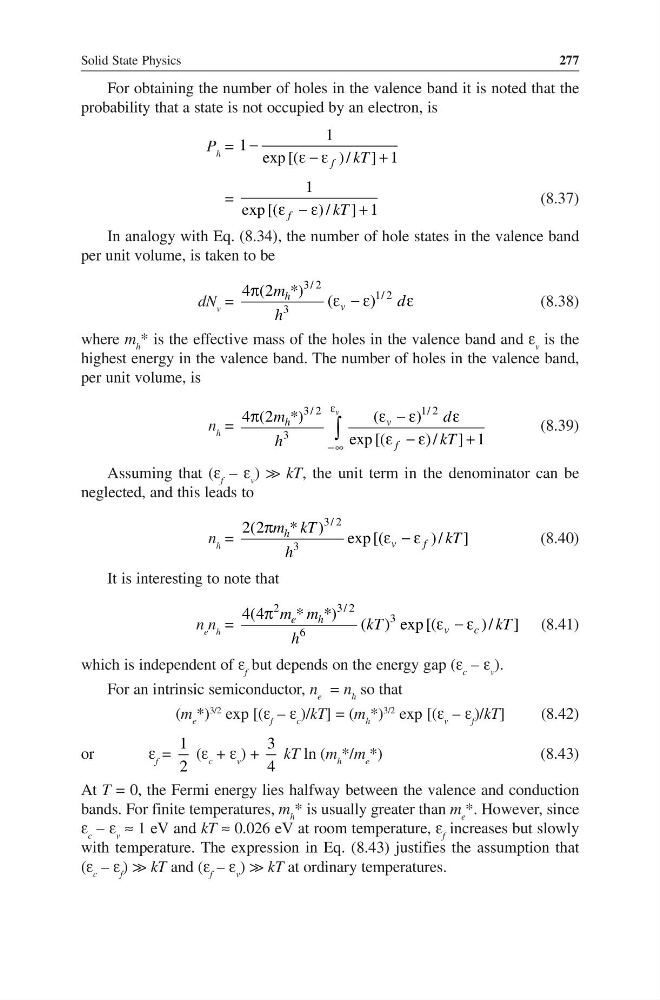
For obtaining the number of holes in the valence band it is noted that the
probability that a state is not occupied by an electron, is
P h =
1
1 exp [(
) / ] 1
−
ε − ε
+
f
kT
=
1
exp [(
) / ] 1
ε − ε
+
f
kT
(8.37)
In analogy with Eq. (8.34), the number of hole states in the valence band
per unit volume, is taken to be
dN v =
3/ 2
1/ 2
3
4 (2 *) (
)
π
ε − ε
ε
h
v
m
d
h
(8.38)
where m h * is the effective mass of the holes in the valence band and ε v is the
highest energy in the valence band. The number of holes in the valence band,
per unit volume, is
n h =
3 / 2
1/ 2
3
4 (2 *)
(
)
exp [(
) / ] 1
ε
− ∞
π
ε− ε
ε
ε − ε
+
∫
v
h
v
f
m
d
kT
h
(8.39)
Assuming that (ε f – ε v ) >> kT, the unit term in the denominator can be
neglected, and this leads to
n h =
3/ 2
3
2(2
* ) exp [(
) / ]
π
ε − ε
h
v
f
m kT
kT
h
(8.40)
It is interesting to note that
n e n h =
2
3 / 2
3
6
4(4
* *) ( ) exp[(
)/ ]
π
ε − ε
e
h
v
c
m m
kT
kT
h
(8.41)
which is independent of ε f but depends on the energy gap (ε c – ε v ).
For an intrinsic semiconductor, n e = n h so that
(m e *)
3/2
exp [(ε f – ε c )/kT] = (m h *)
3/2
exp [(ε v – ε f )/kT]
(8.42)
or
ε f =
1
2
(ε c + ε v ) +
3
4
kT ln (m h */m e *)
(8.43)
At T = 0, the Fermi energy lies halfway between the valence and conduction
bands. For finite temperatures, m h * is usually greater than m e *. However, since
ε c – ε v ≈ 1 eV and kT ≈ 0.026 eV at room temperature, ε f increases but slowly
with temperature. The expression in Eq. (8.43) justifies the assumption that
(ε c – ε f ) >> kT and (ε f – ε v ) >> kT at ordinary temperatures.
277
For obtaining the number of holes in the valence band it is noted that the
probability that a state is not occupied by an electron, is
P h =
1
1 exp [(
) / ] 1
−
ε − ε
+
f
kT
=
1
exp [(
) / ] 1
ε − ε
+
f
kT
(8.37)
In analogy with Eq. (8.34), the number of hole states in the valence band
per unit volume, is taken to be
dN v =
3/ 2
1/ 2
3
4 (2 *) (
)
π
ε − ε
ε
h
v
m
d
h
(8.38)
where m h * is the effective mass of the holes in the valence band and ε v is the
highest energy in the valence band. The number of holes in the valence band,
per unit volume, is
n h =
3 / 2
1/ 2
3
4 (2 *)
(
)
exp [(
) / ] 1
ε
− ∞
π
ε− ε
ε
ε − ε
+
∫
v
h
v
f
m
d
kT
h
(8.39)
Assuming that (ε f – ε v ) >> kT, the unit term in the denominator can be
neglected, and this leads to
n h =
3/ 2
3
2(2
* ) exp [(
) / ]
π
ε − ε
h
v
f
m kT
kT
h
(8.40)
It is interesting to note that
n e n h =
2
3 / 2
3
6
4(4
* *) ( ) exp[(
)/ ]
π
ε − ε
e
h
v
c
m m
kT
kT
h
(8.41)
which is independent of ε f but depends on the energy gap (ε c – ε v ).
For an intrinsic semiconductor, n e = n h so that
(m e *)
3/2
exp [(ε f – ε c )/kT] = (m h *)
3/2
exp [(ε v – ε f )/kT]
(8.42)
or
ε f =
1
2
(ε c + ε v ) +
3
4
kT ln (m h */m e *)
(8.43)
At T = 0, the Fermi energy lies halfway between the valence and conduction
bands. For finite temperatures, m h * is usually greater than m e *. However, since
ε c – ε v ≈ 1 eV and kT ≈ 0.026 eV at room temperature, ε f increases but slowly
with temperature. The expression in Eq. (8.43) justifies the assumption that
(ε c – ε f ) >> kT and (ε f – ε v ) >> kT at ordinary temperatures.