

Elements of Modern Physics
276
Extra
electron
P
B
a hole
Conduction band
Conduction band
Donor level
Valence band
Valence band
(a)
(b)
Acceptor level
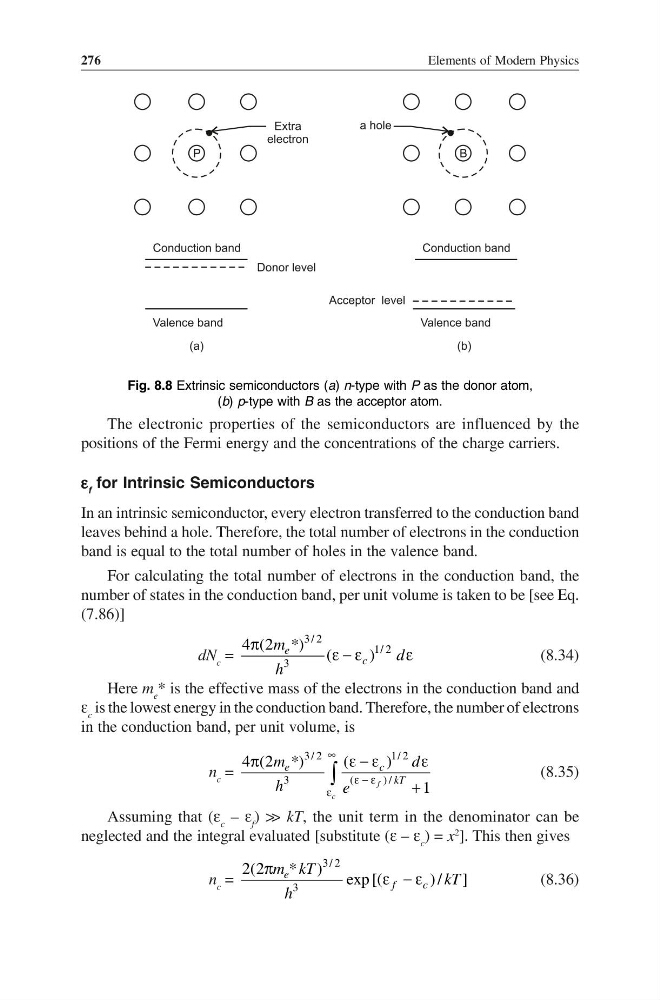
Fig. 8.8 Extrinsic semiconductors (a) n-type with P as the donor atom,
(b) p-type with B as the acceptor atom.
The electronic properties of the semiconductors are influenced by the
positions of the Fermi energy and the concentrations of the charge carriers.
ε
ε ε
ε ε f for Intrinsic Semiconductors
In an intrinsic semiconductor, every electron transferred to the conduction band
leaves behind a hole. Therefore, the total number of electrons in the conduction
band is equal to the total number of holes in the valence band.
For calculating the total number of electrons in the conduction band, the
number of states in the conduction band, per unit volume is taken to be [see Eq.
(7.86)]
dN c =
3/ 2
1/ 2
3
4 (2 *) (
)
π
ε − ε
ε
e
c
m
d
h
(8.34)
Here m e * is the effective mass of the electrons in the conduction band and
ε c is the lowest energy in the conduction band. Therefore, the number of electrons
in the conduction band, per unit volume, is
n c =
3 / 2
1/ 2
3
(
) /
4 (2 *)
(
)
1
∞
ε − ε
ε
π
ε− ε
ε
+
∫
f
c
e
c
kT
m
d
h
e
(8.35)
Assuming that (ε c – ε f ) >> kT, the unit term in the denominator can be
neglected and the integral evaluated [substitute (ε – ε c ) = x
2
]. This then gives
n c =
3/ 2
3
2(2
* ) exp [(
) / ]
π
ε − ε
e
f
c
m kT
kT
h
(8.36)
276
Extra
electron
P
B
a hole
Conduction band
Conduction band
Donor level
Valence band
Valence band
(a)
(b)
Acceptor level
Fig. 8.8 Extrinsic semiconductors (a) n-type with P as the donor atom,
(b) p-type with B as the acceptor atom.
The electronic properties of the semiconductors are influenced by the
positions of the Fermi energy and the concentrations of the charge carriers.
ε
ε ε
ε ε f for Intrinsic Semiconductors
In an intrinsic semiconductor, every electron transferred to the conduction band
leaves behind a hole. Therefore, the total number of electrons in the conduction
band is equal to the total number of holes in the valence band.
For calculating the total number of electrons in the conduction band, the
number of states in the conduction band, per unit volume is taken to be [see Eq.
(7.86)]
dN c =
3/ 2
1/ 2
3
4 (2 *) (
)
π
ε − ε
ε
e
c
m
d
h
(8.34)
Here m e * is the effective mass of the electrons in the conduction band and
ε c is the lowest energy in the conduction band. Therefore, the number of electrons
in the conduction band, per unit volume, is
n c =
3 / 2
1/ 2
3
(
) /
4 (2 *)
(
)
1
∞
ε − ε
ε
π
ε− ε
ε
+
∫
f
c
e
c
kT
m
d
h
e
(8.35)
Assuming that (ε c – ε f ) >> kT, the unit term in the denominator can be
neglected and the integral evaluated [substitute (ε – ε c ) = x
2
]. This then gives
n c =
3/ 2
3
2(2
* ) exp [(
) / ]
π
ε − ε
e
f
c
m kT
kT
h
(8.36)