

Elements of Modern Physics
250
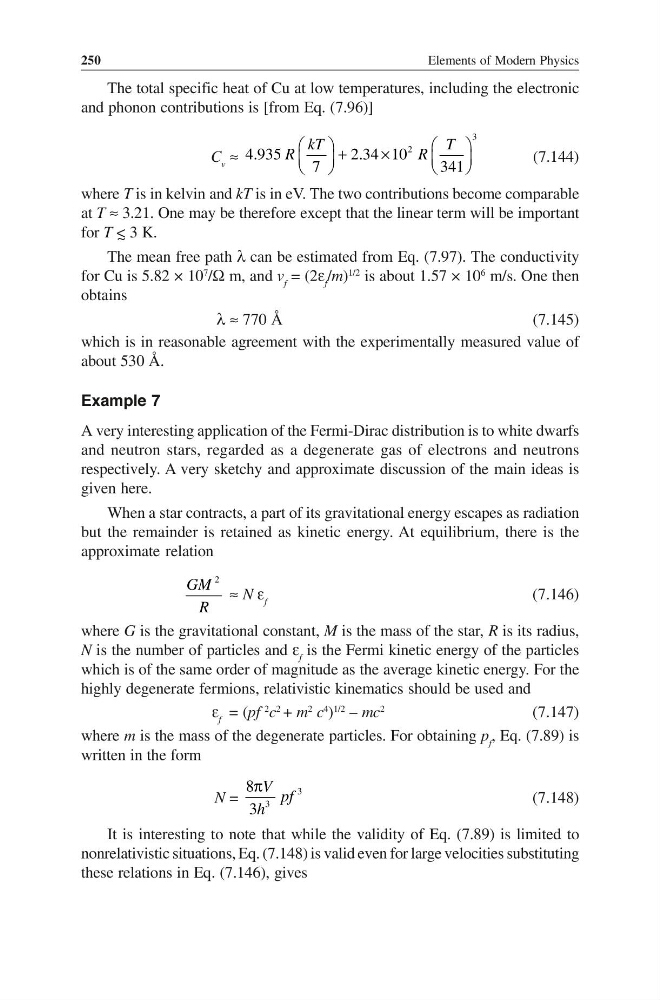
The total specific heat of Cu at low temperatures, including the electronic
and phonon contributions is [from Eq. (7.96)]
C v ≈
3
2
4.935
2.34 10
7
3 4 1
kT
T
R
R
+
×
(7.144)
where T is in kelvin and kT is in eV. The two contributions become comparable
at T ≈ 3.21. One may be therefore except that the linear term will be important
for T < ~ 3 K.
The mean free path λ can be estimated from Eq. (7.97). The conductivity
for Cu is 5.82 × 10
7
/Ω m, and v f = (2ε f /m)
1/2
is about 1.57 × 10
6
m/s. One then
obtains
λ ≈ 770 Å
(7.145)
which is in reasonable agreement with the experimentally measured value of
about 530 Å.
Example 7
A very interesting application of the Fermi-Dirac distribution is to white dwarfs
and neutron stars, regarded as a degenerate gas of electrons and neutrons
respectively. A very sketchy and approximate discussion of the main ideas is
given here.
When a star contracts, a part of its gravitational energy escapes as radiation
but the remainder is retained as kinetic energy. At equilibrium, there is the
approximate relation
2
GM
R
≈ N ε f
(7.146)
where G is the gravitational constant, M is the mass of the star, R is its radius,
N is the number of particles and ε f is the Fermi kinetic energy of the particles
which is of the same order of magnitude as the average kinetic energy. For the
highly degenerate fermions, relativistic kinematics should be used and
ε f = (pf
2
c
2
+ m
2
c
4
)
1/2
– mc
2
(7.147)
where m is the mass of the degenerate particles. For obtaining p f , Eq. (7.89) is
written in the form
N =
3
3
8
3
V pf
h
π
(7.148)
It is interesting to note that while the validity of Eq. (7.89) is limited to
nonrelativistic situations, Eq. (7.148) is valid even for large velocities substituting
these relations in Eq. (7.146), gives
250
The total specific heat of Cu at low temperatures, including the electronic
and phonon contributions is [from Eq. (7.96)]
C v ≈
3
2
4.935
2.34 10
7
3 4 1
kT
T
R
R
+
×
(7.144)
where T is in kelvin and kT is in eV. The two contributions become comparable
at T ≈ 3.21. One may be therefore except that the linear term will be important
for T < ~ 3 K.
The mean free path λ can be estimated from Eq. (7.97). The conductivity
for Cu is 5.82 × 10
7
/Ω m, and v f = (2ε f /m)
1/2
is about 1.57 × 10
6
m/s. One then
obtains
λ ≈ 770 Å
(7.145)
which is in reasonable agreement with the experimentally measured value of
about 530 Å.
Example 7
A very interesting application of the Fermi-Dirac distribution is to white dwarfs
and neutron stars, regarded as a degenerate gas of electrons and neutrons
respectively. A very sketchy and approximate discussion of the main ideas is
given here.
When a star contracts, a part of its gravitational energy escapes as radiation
but the remainder is retained as kinetic energy. At equilibrium, there is the
approximate relation
2
GM
R
≈ N ε f
(7.146)
where G is the gravitational constant, M is the mass of the star, R is its radius,
N is the number of particles and ε f is the Fermi kinetic energy of the particles
which is of the same order of magnitude as the average kinetic energy. For the
highly degenerate fermions, relativistic kinematics should be used and
ε f = (pf
2
c
2
+ m
2
c
4
)
1/2
– mc
2
(7.147)
where m is the mass of the degenerate particles. For obtaining p f , Eq. (7.89) is
written in the form
N =
3
3
8
3
V pf
h
π
(7.148)
It is interesting to note that while the validity of Eq. (7.89) is limited to
nonrelativistic situations, Eq. (7.148) is valid even for large velocities substituting
these relations in Eq. (7.146), gives