

Quantum Statistics
251
2
GM
R
=
1/2
2/3
3
2
2 4
2
3
8
Nh
N
c m c
N m c
V
+
−
π
(7.149)
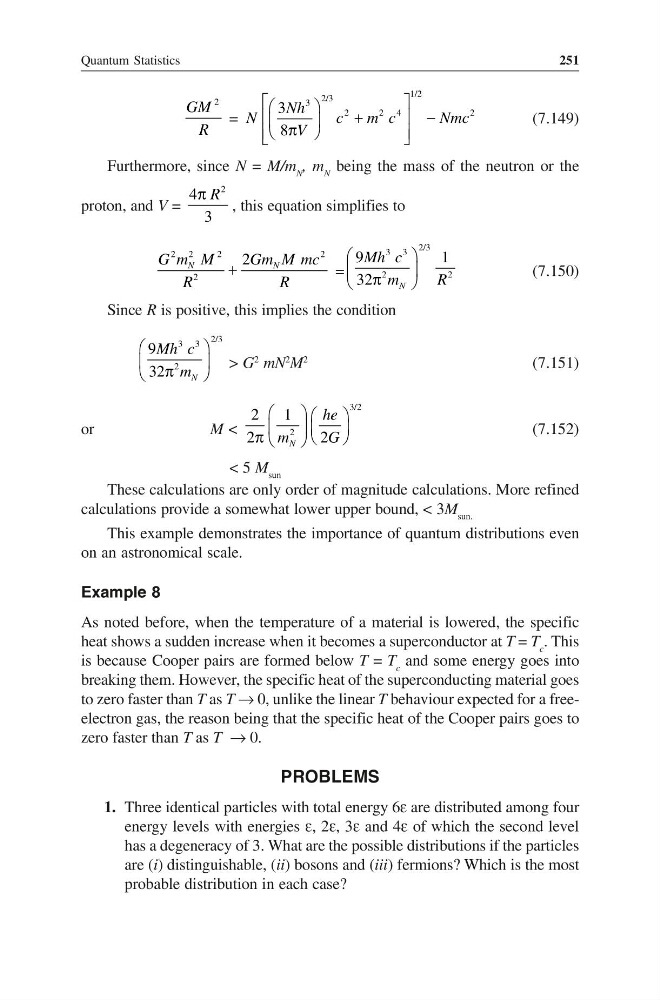
Furthermore, since N = M/m N , m N being the mass of the neutron or the
proton, and V =
2
4
3
R
π
, this equation simplifies to
2 2
2
2
2
2
N
N
G m M
Gm M mc
R
R
+
=
2/3
3 3
2
2
9
1
32
N
Mh c
m
R
π
(7.150)
Since R is positive, this implies the condition
2/3
3 3
2
9
32
N
Mh c
m
π
> G
2
mN
2
M
2
(7.151)
or
M <
3/2
2
2
1
2
2
N
he
m
G
π
(7.152)
< 5 M sun
These calculations are only order of magnitude calculations. More refined
calculations provide a somewhat lower upper bound, < 3M sun.
This example demonstrates the importance of quantum distributions even
on an astronomical scale.
Example 8
As noted before, when the temperature of a material is lowered, the specific
heat shows a sudden increase when it becomes a superconductor at T = T c . This
is because Cooper pairs are formed below T = T c and some energy goes into
breaking them. However, the specific heat of the superconducting material goes
to zero faster than T as T → 0, unlike the linear T behaviour expected for a freeelectron gas, the reason being that the specific heat of the Cooper pairs goes to
zero faster than T as T → 0.
PROBLEMS
1. Three identical particles with total energy 6ε are distributed among four
energy levels with energies ε, 2ε, 3ε and 4ε of which the second level
has a degeneracy of 3. What are the possible distributions if the particles
are (i) distinguishable, (ii) bosons and (iii) fermions? Which is the most
probable distribution in each case?
251
2
GM
R
=
1/2
2/3
3
2
2 4
2
3
8
Nh
N
c m c
N m c
V
+
−
π
(7.149)
Furthermore, since N = M/m N , m N being the mass of the neutron or the
proton, and V =
2
4
3
R
π
, this equation simplifies to
2 2
2
2
2
2
N
N
G m M
Gm M mc
R
R
+
=
2/3
3 3
2
2
9
1
32
N
Mh c
m
R
π
(7.150)
Since R is positive, this implies the condition
2/3
3 3
2
9
32
N
Mh c
m
π
> G
2
mN
2
M
2
(7.151)
or
M <
3/2
2
2
1
2
2
N
he
m
G
π
(7.152)
< 5 M sun
These calculations are only order of magnitude calculations. More refined
calculations provide a somewhat lower upper bound, < 3M sun.
This example demonstrates the importance of quantum distributions even
on an astronomical scale.
Example 8
As noted before, when the temperature of a material is lowered, the specific
heat shows a sudden increase when it becomes a superconductor at T = T c . This
is because Cooper pairs are formed below T = T c and some energy goes into
breaking them. However, the specific heat of the superconducting material goes
to zero faster than T as T → 0, unlike the linear T behaviour expected for a freeelectron gas, the reason being that the specific heat of the Cooper pairs goes to
zero faster than T as T → 0.
PROBLEMS
1. Three identical particles with total energy 6ε are distributed among four
energy levels with energies ε, 2ε, 3ε and 4ε of which the second level
has a degeneracy of 3. What are the possible distributions if the particles
are (i) distinguishable, (ii) bosons and (iii) fermions? Which is the most
probable distribution in each case?