

Quantum Statistics
249
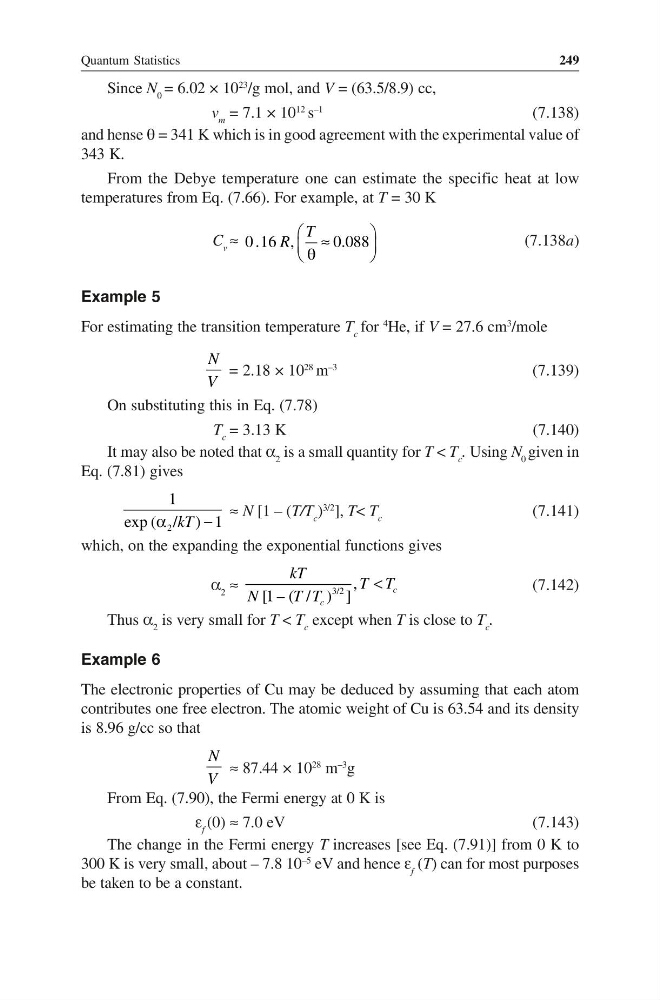
Since N 0 = 6.02 × 10
23
/g mol, and V = (63.5/8.9) cc,
v m = 7.1 × 10
12
s
–1
(7.138)
and hense θ = 341 K which is in good agreement with the experimental value of
343 K.
From the Debye temperature one can estimate the specific heat at low
temperatures from Eq. (7.66). For example, at T = 30 K
C v ≈ 0 .16 ,
0.088
T
R
≈
θ
(7.138a)
Example 5
For estimating the transition temperature T c for
4
He, if V = 27.6 cm
3
/mole
N
V
= 2.18 × 10
28
m
–3
(7.139)
On substituting this in Eq. (7.78)
T c = 3.13 K
(7.140)
It may also be noted that α 2 is a small quantity for T < T c . Using N 0 given in
Eq. (7.81) gives
2
1
exp ( / ) 1
kT
α
−
≈ N [1 – (T/T c )
3/2
], T< T c
(7.141)
which, on the expanding the exponential functions gives
α 2 ≈
3/2
,
[1 – ( / ) ]
c
c
kT
T T
N
T T
<
(7.142)
Thus α 2 is very small for T < T c except when T is close to T c .
Example 6
The electronic properties of Cu may be deduced by assuming that each atom
contributes one free electron. The atomic weight of Cu is 63.54 and its density
is 8.96 g/cc so that
N
V
≈ 87.44 × 10
28
m
–3
g
From Eq. (7.90), the Fermi energy at 0 K is
ε f (0) ≈ 7.0 eV
(7.143)
The change in the Fermi energy T increases [see Eq. (7.91)] from 0 K to
300 K is very small, about – 7.8 10
–5
eV and hence ε f (T) can for most purposes
be taken to be a constant.
249
Since N 0 = 6.02 × 10
23
/g mol, and V = (63.5/8.9) cc,
v m = 7.1 × 10
12
s
–1
(7.138)
and hense θ = 341 K which is in good agreement with the experimental value of
343 K.
From the Debye temperature one can estimate the specific heat at low
temperatures from Eq. (7.66). For example, at T = 30 K
C v ≈ 0 .16 ,
0.088
T
R
≈
θ
(7.138a)
Example 5
For estimating the transition temperature T c for
4
He, if V = 27.6 cm
3
/mole
N
V
= 2.18 × 10
28
m
–3
(7.139)
On substituting this in Eq. (7.78)
T c = 3.13 K
(7.140)
It may also be noted that α 2 is a small quantity for T < T c . Using N 0 given in
Eq. (7.81) gives
2
1
exp ( / ) 1
kT
α
−
≈ N [1 – (T/T c )
3/2
], T< T c
(7.141)
which, on the expanding the exponential functions gives
α 2 ≈
3/2
,
[1 – ( / ) ]
c
c
kT
T T
N
T T
<
(7.142)
Thus α 2 is very small for T < T c except when T is close to T c .
Example 6
The electronic properties of Cu may be deduced by assuming that each atom
contributes one free electron. The atomic weight of Cu is 63.54 and its density
is 8.96 g/cc so that
N
V
≈ 87.44 × 10
28
m
–3
g
From Eq. (7.90), the Fermi energy at 0 K is
ε f (0) ≈ 7.0 eV
(7.143)
The change in the Fermi energy T increases [see Eq. (7.91)] from 0 K to
300 K is very small, about – 7.8 10
–5
eV and hence ε f (T) can for most purposes
be taken to be a constant.