

Elements of Modern Physics
248
In deriving this relation, the degeneracy of states has been ignored. The
degeneracy can be incorporated by multiplying the right-hand side by g + g e /g 0
where g is the degeneracy of the appropriate state, in particular, g e = 2
corresponding to the two spin states of the electron. As an illustration it is noted
that if M 0 is the hydrogen atom in the ground state and M + is the proton, then
g + = 2 and g 0 = 4 so that the degeneracy factor is 1. The Saha equations is very
useful in plasma physics and also in astrophysics.
Example 3
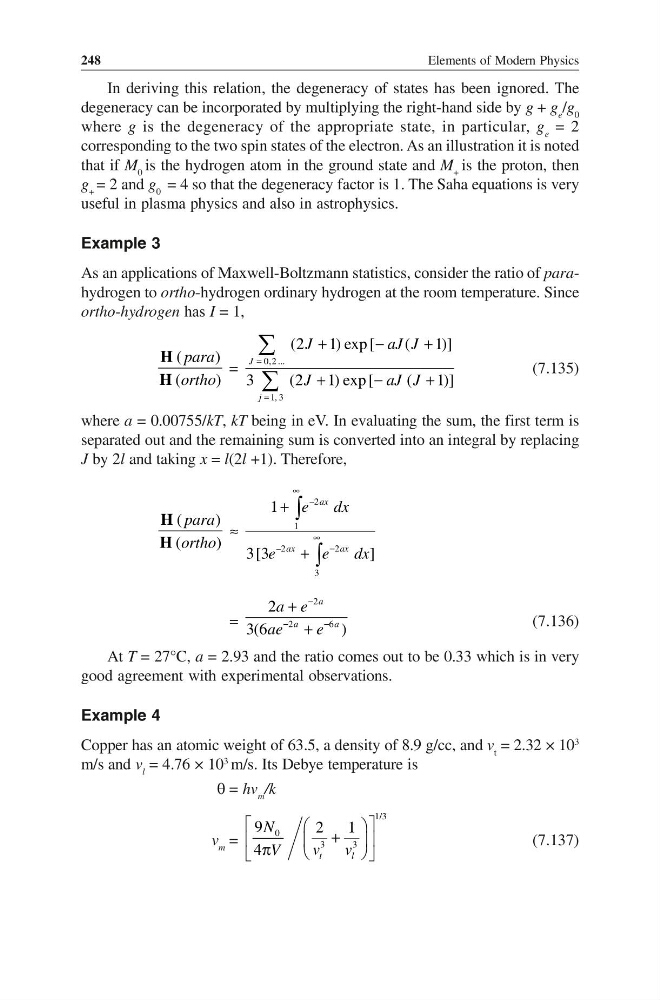
As an applications of Maxwell-Boltzmann statistics, consider the ratio of parahydrogen to ortho-hydrogen ordinary hydrogen at the room temperature. Since
ortho-hydrogen has I = 1,
(
)
(
)
para
ortho
H
H
=
0,2 ...
1, 3
(2
1) exp [
(
1)]
3
(2
1)exp[
(
1)]
J
j
J
a JJ
J
a J J
=
=
+
−
+
+
−
+
∑
∑
(7.135)
where a = 0.00755/kT, kT being in eV. In evaluating the sum, the first term is
separated out and the remaining sum is converted into an integral by replacing
J by 2l and taking x = l(2l +1). Therefore,
(
)
(
)
para
ortho
H
H
≈
–2
1
–2
2
3
1
3[3
]
ax
ax
ax
e
dx
e
e
dx
∞
∞
−
+
+
∫
∫
=
2
2
6
2
3(6
)
a
a
a
a e
ae
e
−
−
−
+
+
(7.136)
At T = 27°C, a = 2.93 and the ratio comes out to be 0.33 which is in very
good agreement with experimental observations.
Example 4
Copper has an atomic weight of 63.5, a density of 8.9 g/cc, and v t = 2.32 × 10
3
m/s and v l = 4.76 × 10
3
m/s. Its Debye temperature is
θ = hv m /k
v m =
1/3
0
3
3
9
2
1
4
t
l
N
v
v
V
+
π
(7.137)
248
In deriving this relation, the degeneracy of states has been ignored. The
degeneracy can be incorporated by multiplying the right-hand side by g + g e /g 0
where g is the degeneracy of the appropriate state, in particular, g e = 2
corresponding to the two spin states of the electron. As an illustration it is noted
that if M 0 is the hydrogen atom in the ground state and M + is the proton, then
g + = 2 and g 0 = 4 so that the degeneracy factor is 1. The Saha equations is very
useful in plasma physics and also in astrophysics.
Example 3
As an applications of Maxwell-Boltzmann statistics, consider the ratio of parahydrogen to ortho-hydrogen ordinary hydrogen at the room temperature. Since
ortho-hydrogen has I = 1,
(
)
(
)
para
ortho
H
H
=
0,2 ...
1, 3
(2
1) exp [
(
1)]
3
(2
1)exp[
(
1)]
J
j
J
a JJ
J
a J J
=
=
+
−
+
+
−
+
∑
∑
(7.135)
where a = 0.00755/kT, kT being in eV. In evaluating the sum, the first term is
separated out and the remaining sum is converted into an integral by replacing
J by 2l and taking x = l(2l +1). Therefore,
(
)
(
)
para
ortho
H
H
≈
–2
1
–2
2
3
1
3[3
]
ax
ax
ax
e
dx
e
e
dx
∞
∞
−
+
+
∫
∫
=
2
2
6
2
3(6
)
a
a
a
a e
ae
e
−
−
−
+
+
(7.136)
At T = 27°C, a = 2.93 and the ratio comes out to be 0.33 which is in very
good agreement with experimental observations.
Example 4
Copper has an atomic weight of 63.5, a density of 8.9 g/cc, and v t = 2.32 × 10
3
m/s and v l = 4.76 × 10
3
m/s. Its Debye temperature is
θ = hv m /k
v m =
1/3
0
3
3
9
2
1
4
t
l
N
v
v
V
+
π
(7.137)