

Elements of Modern Physics
244
1 ( )
b t
i
t
∂
∂
= v (cos ωt) b 1 (t)
(7.121)
2 ( )
b t
i
t
∂
∂
= 0
(7.122)
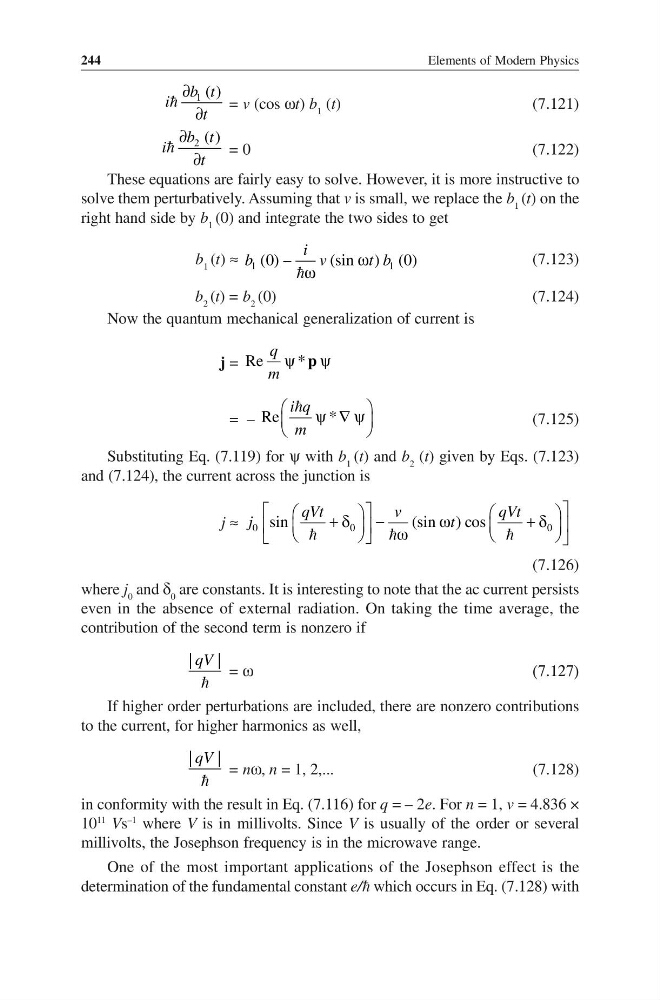
These equations are fairly easy to solve. However, it is more instructive to
solve them perturbatively. Assuming that v is small, we replace the b 1 (t) on the
right hand side by b 1 (0) and integrate the two sides to get
b 1 (t) ≈ 1
1
(0) –
(sin ) (0)
ω
ω
i
b
v
t b
(7.123)
b 2 (t) = b 2 (0)
(7.124)
Now the quantum mechanical generalization of current is
j = Re
*
q
m
ψ
ψ
p
= – Re
*
i q
m
ψ ∇ ψ
(7.125)
Substituting Eq. (7.119) for ψ with b 1 (t) and b 2 (t) given by Eqs. (7.123)
and (7.124), the current across the junction is
j ≈ 0
0
0
sin
(sin ) cos
qVt
v
qVt
j
t
+ δ
−
ω
+ δ
ω
(7.126)
where j 0 and δ 0 are constants. It is interesting to note that the ac current persists
even in the absence of external radiation. On taking the time average, the
contribution of the second term is nonzero if
|
|
qV
= ω
(7.127)
If higher order perturbations are included, there are nonzero contributions
to the current, for higher harmonics as well,
|
|
qV
= nω, n = 1, 2,...
(7.128)
in conformity with the result in Eq. (7.116) for q = – 2e. For n = 1, v = 4.836 ×
10
11
Vs
–1
where V is in millivolts. Since V is usually of the order or several
millivolts, the Josephson frequency is in the microwave range.
One of the most important applications of the Josephson effect is the
determination of the fundamental constant e/ which occurs in Eq. (7.128) with
244
1 ( )
b t
i
t
∂
∂
= v (cos ωt) b 1 (t)
(7.121)
2 ( )
b t
i
t
∂
∂
= 0
(7.122)
These equations are fairly easy to solve. However, it is more instructive to
solve them perturbatively. Assuming that v is small, we replace the b 1 (t) on the
right hand side by b 1 (0) and integrate the two sides to get
b 1 (t) ≈ 1
1
(0) –
(sin ) (0)
ω
ω
i
b
v
t b
(7.123)
b 2 (t) = b 2 (0)
(7.124)
Now the quantum mechanical generalization of current is
j = Re
*
q
m
ψ
ψ
p
= – Re
*
i q
m
ψ ∇ ψ
(7.125)
Substituting Eq. (7.119) for ψ with b 1 (t) and b 2 (t) given by Eqs. (7.123)
and (7.124), the current across the junction is
j ≈ 0
0
0
sin
(sin ) cos
qVt
v
qVt
j
t
+ δ
−
ω
+ δ
ω
(7.126)
where j 0 and δ 0 are constants. It is interesting to note that the ac current persists
even in the absence of external radiation. On taking the time average, the
contribution of the second term is nonzero if
|
|
qV
= ω
(7.127)
If higher order perturbations are included, there are nonzero contributions
to the current, for higher harmonics as well,
|
|
qV
= nω, n = 1, 2,...
(7.128)
in conformity with the result in Eq. (7.116) for q = – 2e. For n = 1, v = 4.836 ×
10
11
Vs
–1
where V is in millivolts. Since V is usually of the order or several
millivolts, the Josephson frequency is in the microwave range.
One of the most important applications of the Josephson effect is the
determination of the fundamental constant e/ which occurs in Eq. (7.128) with