

Quantum Statistics
243
Consider two pieces of a superconductor separated by a thin layer of an
insulator (about 20 Å in thickness). If now a voltage V is applied to the
superconductors, an ac current j flows across the junction. This effect, known
as Josephson effect, is due to the tunnelling of the superconducting electrons
across the insulator. In the process they emit microwave radiation of angular
frequency ω such that
ω
= | |
q V
(7.115)
where q = – 2e is the charge of a Cooper pair. It was also found that when the
junction was illuminated by a radiation of frequency ω, and the potential V was
varied, the current across the junction showed a jump whenever the condition
n ω
= 2e V, n = an integer,
(7.116)
was satisfied. Thus knowing ω and V, it was possible to obtain an accurate
measurement of /e.
For obtaining the current across the junction, let ψ 1 and ψ 2 be the solutions
of the Schrödinger equation for particles on the two sides of the insulator, with
Hamiltonian H 0 in the absence of an external radiation. The approximate form
of these wave functions in the region of the junction, is
ψ 1 = exp [– (x + a)k 1 ] exp (–
)
i Et
(7.117)
ψ 2 = exp[– (a – x) k 2 ] exp [– (
) ]
i E qV t
+
(7.118)
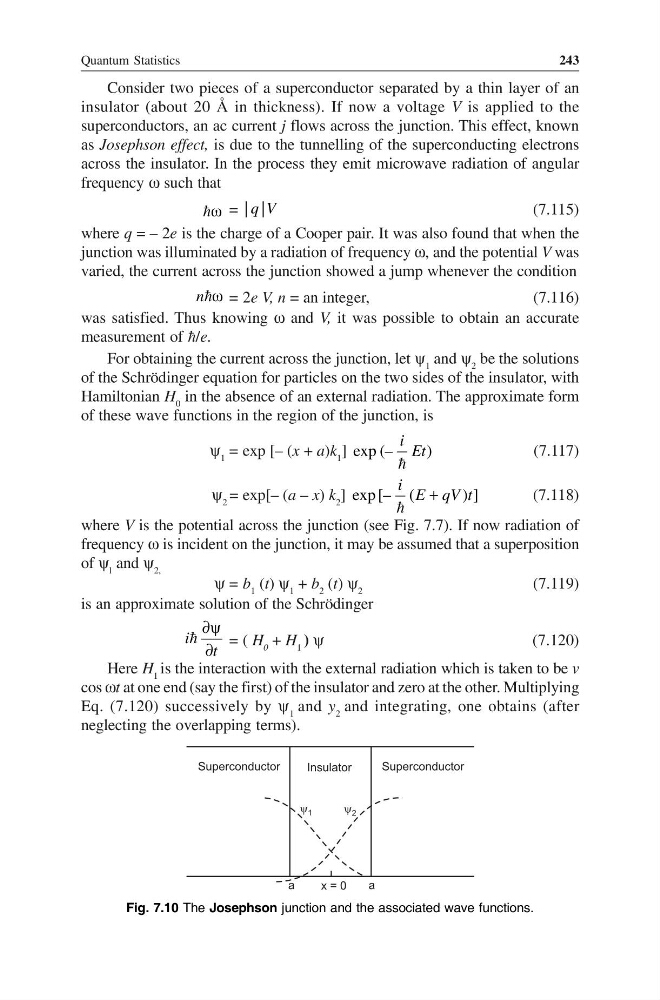
where V is the potential across the junction (see Fig. 7.7). If now radiation of
frequency ω is incident on the junction, it may be assumed that a superposition
of ψ l and ψ 2,
ψ = b 1 (t) ψ 1 + b 2 (t) ψ 2
(7.119)
is an approximate solution of the Schrödinger
i t
∂ψ
∂
= ( H 0 + H 1 ) ψ
(7.120)
Here H 1 is the interaction with the external radiation which is taken to be v
cos ωt at one end (say the first) of the insulator and zero at the other. Multiplying
Eq. (7.120) successively by ψ 1 and y 2 and integrating, one obtains (after
neglecting the overlapping terms).
y 1
y 2
a
a
x = 0
Superconductor
Superconductor
Insulator
Fig. 7.10 The Josephson junction and the associated wave functions.
243
Consider two pieces of a superconductor separated by a thin layer of an
insulator (about 20 Å in thickness). If now a voltage V is applied to the
superconductors, an ac current j flows across the junction. This effect, known
as Josephson effect, is due to the tunnelling of the superconducting electrons
across the insulator. In the process they emit microwave radiation of angular
frequency ω such that
ω
= | |
q V
(7.115)
where q = – 2e is the charge of a Cooper pair. It was also found that when the
junction was illuminated by a radiation of frequency ω, and the potential V was
varied, the current across the junction showed a jump whenever the condition
n ω
= 2e V, n = an integer,
(7.116)
was satisfied. Thus knowing ω and V, it was possible to obtain an accurate
measurement of /e.
For obtaining the current across the junction, let ψ 1 and ψ 2 be the solutions
of the Schrödinger equation for particles on the two sides of the insulator, with
Hamiltonian H 0 in the absence of an external radiation. The approximate form
of these wave functions in the region of the junction, is
ψ 1 = exp [– (x + a)k 1 ] exp (–
)
i Et
(7.117)
ψ 2 = exp[– (a – x) k 2 ] exp [– (
) ]
i E qV t
+
(7.118)
where V is the potential across the junction (see Fig. 7.7). If now radiation of
frequency ω is incident on the junction, it may be assumed that a superposition
of ψ l and ψ 2,
ψ = b 1 (t) ψ 1 + b 2 (t) ψ 2
(7.119)
is an approximate solution of the Schrödinger
i t
∂ψ
∂
= ( H 0 + H 1 ) ψ
(7.120)
Here H 1 is the interaction with the external radiation which is taken to be v
cos ωt at one end (say the first) of the insulator and zero at the other. Multiplying
Eq. (7.120) successively by ψ 1 and y 2 and integrating, one obtains (after
neglecting the overlapping terms).
y 1
y 2
a
a
x = 0
Superconductor
Superconductor
Insulator
Fig. 7.10 The Josephson junction and the associated wave functions.