

Elements of Modern Physics
242
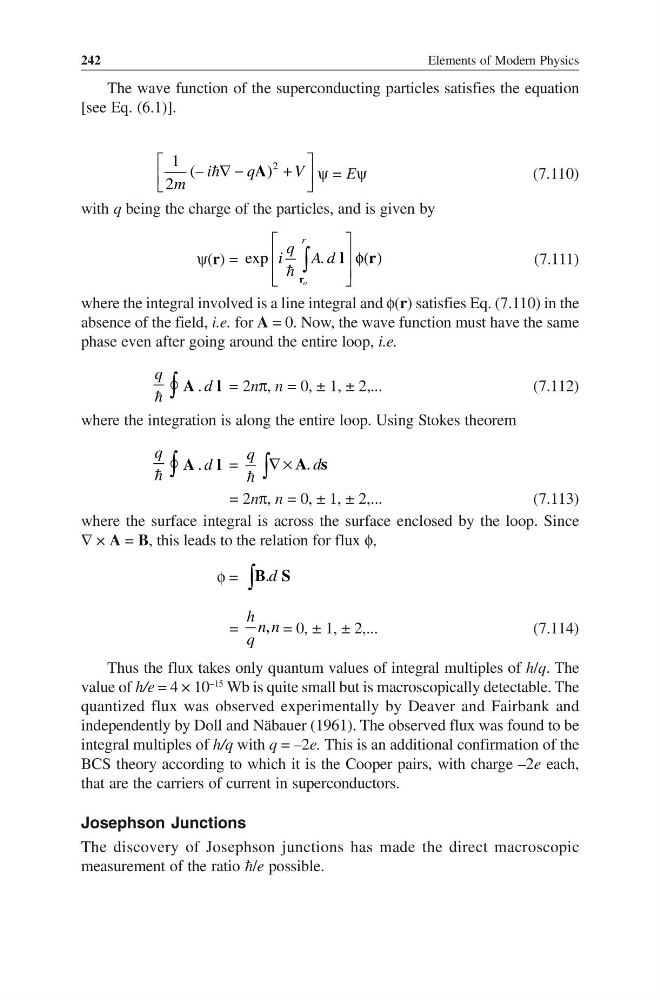
The wave function of the superconducting particles satisfies the equation
[see Eq. (6.1)].
2
1 (–
)
2
i
q
V
m
∇ −
+
A
ψ = Eψ
(7.110)
with q being the charge of the particles, and is given by
ψ(r) = exp
.
( )
o
r
q
i
A d
φ
∫
r
l
r
(7.111)
where the integral involved is a line integral and φ(r) satisfies Eq. (7.110) in the
absence of the field, i.e. for A = 0. Now, the wave function must have the same
phase even after going around the entire loop, i.e.
q
z .
A l
d = 2nπ, n = 0, ± 1, ± 2,...
(7.112)
where the integration is along the entire loop. Using Stokes theorem
q
z .
A l
d =
.
q
d
∇ ×
∫ A s
= 2nπ, n = 0, ± 1, ± 2,...
(7.113)
where the surface integral is across the surface enclosed by the loop. Since
∇ × A = B, this leads to the relation for flux φ,
φ =
.d
∫ B S
=
,
h n n
q
= 0, ± 1, ± 2,...
(7.114)
Thus the flux takes only quantum values of integral multiples of h/q. The
value of h/e = 4 × 10
–15
Wb is quite small but is macroscopically detectable. The
quantized flux was observed experimentally by Deaver and Fairbank and
independently by Doll and Näbauer (1961). The observed flux was found to be
integral multiples of h/q with q = –2e. This is an additional confirmation of the
BCS theory according to which it is the Cooper pairs, with charge –2e each,
that are the carriers of current in superconductors.
Josephson Junctions
The discovery of Josephson junctions has made the direct macroscopic
measurement of the ratio /e possible.
242
The wave function of the superconducting particles satisfies the equation
[see Eq. (6.1)].
2
1 (–
)
2
i
q
V
m
∇ −
+
A
ψ = Eψ
(7.110)
with q being the charge of the particles, and is given by
ψ(r) = exp
.
( )
o
r
q
i
A d
φ
∫
r
l
r
(7.111)
where the integral involved is a line integral and φ(r) satisfies Eq. (7.110) in the
absence of the field, i.e. for A = 0. Now, the wave function must have the same
phase even after going around the entire loop, i.e.
q
z .
A l
d = 2nπ, n = 0, ± 1, ± 2,...
(7.112)
where the integration is along the entire loop. Using Stokes theorem
q
z .
A l
d =
.
q
d
∇ ×
∫ A s
= 2nπ, n = 0, ± 1, ± 2,...
(7.113)
where the surface integral is across the surface enclosed by the loop. Since
∇ × A = B, this leads to the relation for flux φ,
φ =
.d
∫ B S
=
,
h n n
q
= 0, ± 1, ± 2,...
(7.114)
Thus the flux takes only quantum values of integral multiples of h/q. The
value of h/e = 4 × 10
–15
Wb is quite small but is macroscopically detectable. The
quantized flux was observed experimentally by Deaver and Fairbank and
independently by Doll and Näbauer (1961). The observed flux was found to be
integral multiples of h/q with q = –2e. This is an additional confirmation of the
BCS theory according to which it is the Cooper pairs, with charge –2e each,
that are the carriers of current in superconductors.
Josephson Junctions
The discovery of Josephson junctions has made the direct macroscopic
measurement of the ratio /e possible.