

Quantum Statistics
245
q = –2e. It has been possible to determine this ratio to an accuracy of a few
parts in 10
6
. It is to be noted that Josephson effect is very sensitive to the
magnetic field. The use of this property has led to many important applications
of Josephson junctions, singly or in combinations.
Around 1986 Georg Bednorz and Karl Müller, working at IBM in Zurich,
discovered that certain semiconducting oxides became superconducting at 35 K,
then considered a relatively high temperature. In particular, the lanthanum barium
copper oxides, an oxygen deficient perovskite-related material, proved
promising.
Later on, Maw-Kuen Wu and his graduate students, Ashburn and in 1987,
and Paul Chu and his students around same time discovered YBCO has a T c of
93 K. (The first samples were Y 1.2 Ba 08 CuO 4 .) Their work led to a rapid succession
of new high temperature superconducting materials, ushering in a new era in
material science and chemistry.
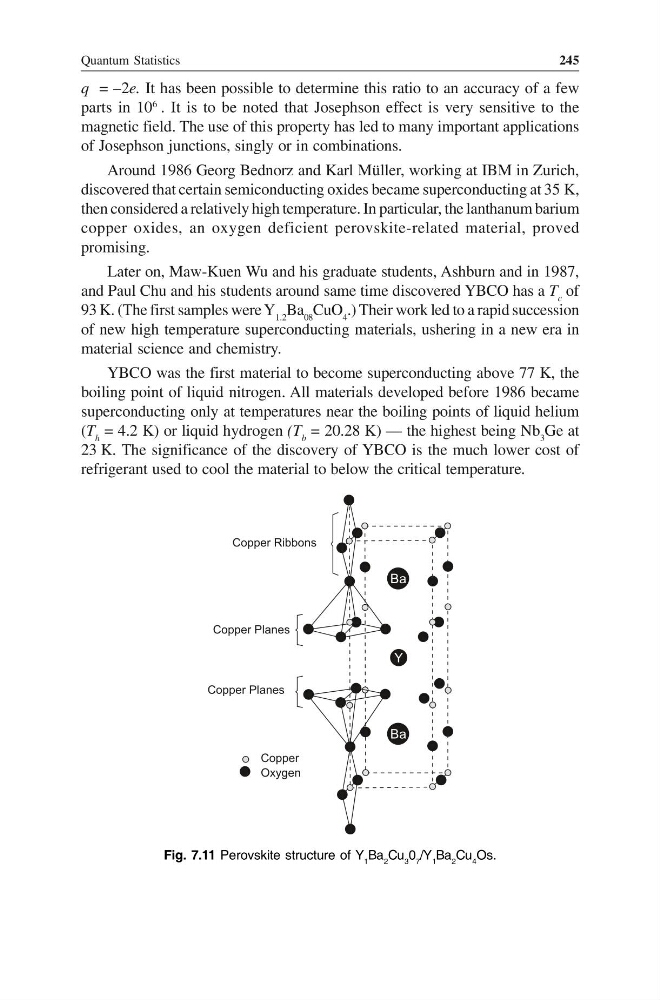
YBCO was the first material to become superconducting above 77 K, the
boiling point of liquid nitrogen. All materials developed before 1986 became
superconducting only at temperatures near the boiling points of liquid helium
(T h = 4.2 K) or liquid hydrogen (T b = 20.28 K) — the highest being Nb 3 Ge at
23 K. The significance of the discovery of YBCO is the much lower cost of
refrigerant used to cool the material to below the critical temperature.
Ba
Y
Ba
Copper Ribbons
Copper Planes
Copper Planes
Copper
Oxygen
Fig. 7.11 Perovskite structure of Y 1 Ba 2 Cu 3 0 7 /Y 1 Ba 2 Cu 4 Os.
245
q = –2e. It has been possible to determine this ratio to an accuracy of a few
parts in 10
6
. It is to be noted that Josephson effect is very sensitive to the
magnetic field. The use of this property has led to many important applications
of Josephson junctions, singly or in combinations.
Around 1986 Georg Bednorz and Karl Müller, working at IBM in Zurich,
discovered that certain semiconducting oxides became superconducting at 35 K,
then considered a relatively high temperature. In particular, the lanthanum barium
copper oxides, an oxygen deficient perovskite-related material, proved
promising.
Later on, Maw-Kuen Wu and his graduate students, Ashburn and in 1987,
and Paul Chu and his students around same time discovered YBCO has a T c of
93 K. (The first samples were Y 1.2 Ba 08 CuO 4 .) Their work led to a rapid succession
of new high temperature superconducting materials, ushering in a new era in
material science and chemistry.
YBCO was the first material to become superconducting above 77 K, the
boiling point of liquid nitrogen. All materials developed before 1986 became
superconducting only at temperatures near the boiling points of liquid helium
(T h = 4.2 K) or liquid hydrogen (T b = 20.28 K) — the highest being Nb 3 Ge at
23 K. The significance of the discovery of YBCO is the much lower cost of
refrigerant used to cool the material to below the critical temperature.
Ba
Y
Ba
Copper Ribbons
Copper Planes
Copper Planes
Copper
Oxygen
Fig. 7.11 Perovskite structure of Y 1 Ba 2 Cu 3 0 7 /Y 1 Ba 2 Cu 4 Os.