

Quantum Statistics
227
N =
2
1
exp ( / ) 1
kT
+
α
−
3/2
1/2
3
2
2 (2 )
exp [(
) / ] – 1
V m
d
h
k T
∞
δ
π
ε ε
ε + α
∫
(7.79)
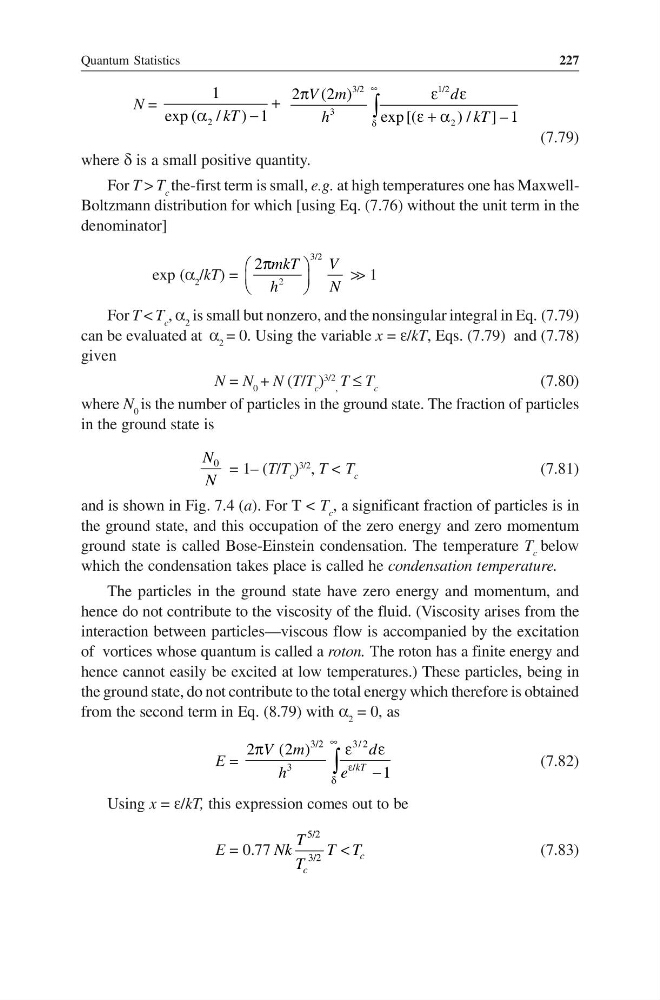
where δ is a small positive quantity.
For T > T c the-first term is small, e.g. at high temperatures one has MaxwellBoltzmann distribution for which [using Eq. (7.76) without the unit term in the
denominator]
exp (α 2 /kT) =
3/2
2
2 mkT
V
h
N
π
>> 1
For T < T c , α 2 is small but nonzero, and the nonsingular integral in Eq. (7.79)
can be evaluated at α 2 = 0. Using the variable x = ε/kT, Eqs. (7.79) and (7.78)
given
N = N 0 + N (T/T c )
3/2
,
T ≤ T c
(7.80)
where N 0 is the number of particles in the ground state. The fraction of particles
in the ground state is
0
N
N
= 1– (T/T c )
3/2
, T < T c
(7.81)
and is shown in Fig. 7.4 (a). For T < T c , a significant fraction of particles is in
the ground state, and this occupation of the zero energy and zero momentum
ground state is called Bose-Einstein condensation. The temperature T c below
which the condensation takes place is called he condensation temperature.
The particles in the ground state have zero energy and momentum, and
hence do not contribute to the viscosity of the fluid. (Viscosity arises from the
interaction between particles—viscous flow is accompanied by the excitation
of vortices whose quantum is called a roton. The roton has a finite energy and
hence cannot easily be excited at low temperatures.) These particles, being in
the ground state, do not contribute to the total energy which therefore is obtained
from the second term in Eq. (8.79) with α 2 = 0, as
E =
3/2
3/ 2
3
/
2
(2 )
1
kT
V m
d
h
e
∞
ε
δ
π
ε
ε
−
∫
(7.82)
Using x = ε/kT, this expression comes out to be
E = 0.77
5/2
3/2
c
c
T
Nk
T T
T
<
(7.83)
227
N =
2
1
exp ( / ) 1
kT
+
α
−
3/2
1/2
3
2
2 (2 )
exp [(
) / ] – 1
V m
d
h
k T
∞
δ
π
ε ε
ε + α
∫
(7.79)
where δ is a small positive quantity.
For T > T c the-first term is small, e.g. at high temperatures one has MaxwellBoltzmann distribution for which [using Eq. (7.76) without the unit term in the
denominator]
exp (α 2 /kT) =
3/2
2
2 mkT
V
h
N
π
>> 1
For T < T c , α 2 is small but nonzero, and the nonsingular integral in Eq. (7.79)
can be evaluated at α 2 = 0. Using the variable x = ε/kT, Eqs. (7.79) and (7.78)
given
N = N 0 + N (T/T c )
3/2
,
T ≤ T c
(7.80)
where N 0 is the number of particles in the ground state. The fraction of particles
in the ground state is
0
N
N
= 1– (T/T c )
3/2
, T < T c
(7.81)
and is shown in Fig. 7.4 (a). For T < T c , a significant fraction of particles is in
the ground state, and this occupation of the zero energy and zero momentum
ground state is called Bose-Einstein condensation. The temperature T c below
which the condensation takes place is called he condensation temperature.
The particles in the ground state have zero energy and momentum, and
hence do not contribute to the viscosity of the fluid. (Viscosity arises from the
interaction between particles—viscous flow is accompanied by the excitation
of vortices whose quantum is called a roton. The roton has a finite energy and
hence cannot easily be excited at low temperatures.) These particles, being in
the ground state, do not contribute to the total energy which therefore is obtained
from the second term in Eq. (8.79) with α 2 = 0, as
E =
3/2
3/ 2
3
/
2
(2 )
1
kT
V m
d
h
e
∞
ε
δ
π
ε
ε
−
∫
(7.82)
Using x = ε/kT, this expression comes out to be
E = 0.77
5/2
3/2
c
c
T
Nk
T T
T
<
(7.83)