

Elements of Modern Physics
226
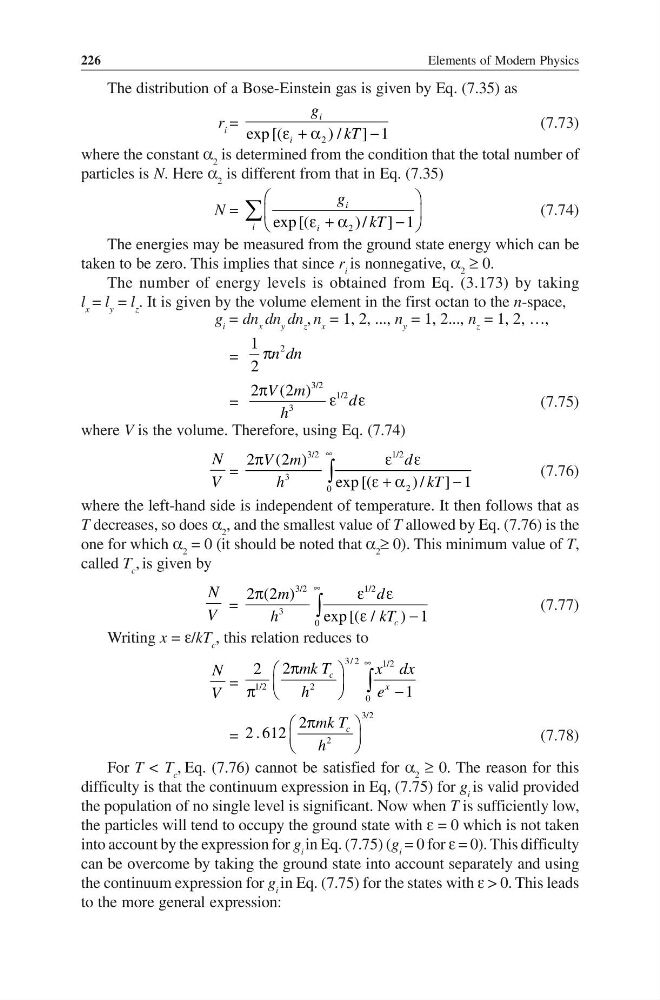
The distribution of a Bose-Einstein gas is given by Eq. (7.35) as
r i =
2
exp [(
) / ] 1
i
i
g
kT
ε + α
−
(7.73)
where the constant α 2 is determined from the condition that the total number of
particles is N. Here α 2 is different from that in Eq. (7.35)
N =
2
exp [(
) / ] 1
i
i
i
g
kT
ε + α
−
∑
(7.74)
The energies may be measured from the ground state energy which can be
taken to be zero. This implies that since r i is nonnegative, α 2 ≥ 0.
The number of energy levels is obtained from Eq. (3.173) by taking
l x = l y = l z . It is given by the volume element in the first octan to the n-space,
g i = dn x dn y dn z , n x = 1, 2, ..., n y = 1, 2..., n z = 1, 2, …,
=
2
1
2
n dn
π
=
3/2
1/2
3
2 (2 )
V m
d
h
π
ε ε
(7.75)
where V is the volume. Therefore, using Eq. (7.74)
N
V
=
3/2
1/2
3
2
0
2 (2 )
exp [(
) / ] 1
V m
d
h
k T
∞
π
ε ε
ε + α
−
∫
(7.76)
where the left-hand side is independent of temperature. It then follows that as
T decreases, so does α 2 , and the smallest value of T allowed by Eq. (7.76) is the
one for which α 2 = 0 (it should be noted that α 2 ≥ 0). This minimum value of T,
called T c , is given by
N
V
=
3/2
1/2
3
0
2 (2 )
exp [( /
) 1
c
m
d
h
k T
∞
π
ε ε
ε
−
∫
(7.77)
Writing x = ε/kT c , this relation reduces to
N
V
=
3/ 2
1/2
1/2
2
0
2
2
1
c
x
mk T
x dx
h
e
∞
π
π
−
∫
=
3/2
2
2
2 . 612
c
mk T
h
π
(7.78)
For T < T c , Eq. (7.76) cannot be satisfied for α 2 ≥ 0. The reason for this
difficulty is that the continuum expression in Eq, (7.75) for g i is valid provided
the population of no single level is significant. Now when T is sufficiently low,
the particles will tend to occupy the ground state with ε = 0 which is not taken
into account by the expression for g i in Eq. (7.75) (g i = 0 for ε = 0). This difficulty
can be overcome by taking the ground state into account separately and using
the continuum expression for g i in Eq. (7.75) for the states with ε > 0. This leads
to the more general expression:
226
The distribution of a Bose-Einstein gas is given by Eq. (7.35) as
r i =
2
exp [(
) / ] 1
i
i
g
kT
ε + α
−
(7.73)
where the constant α 2 is determined from the condition that the total number of
particles is N. Here α 2 is different from that in Eq. (7.35)
N =
2
exp [(
) / ] 1
i
i
i
g
kT
ε + α
−
∑
(7.74)
The energies may be measured from the ground state energy which can be
taken to be zero. This implies that since r i is nonnegative, α 2 ≥ 0.
The number of energy levels is obtained from Eq. (3.173) by taking
l x = l y = l z . It is given by the volume element in the first octan to the n-space,
g i = dn x dn y dn z , n x = 1, 2, ..., n y = 1, 2..., n z = 1, 2, …,
=
2
1
2
n dn
π
=
3/2
1/2
3
2 (2 )
V m
d
h
π
ε ε
(7.75)
where V is the volume. Therefore, using Eq. (7.74)
N
V
=
3/2
1/2
3
2
0
2 (2 )
exp [(
) / ] 1
V m
d
h
k T
∞
π
ε ε
ε + α
−
∫
(7.76)
where the left-hand side is independent of temperature. It then follows that as
T decreases, so does α 2 , and the smallest value of T allowed by Eq. (7.76) is the
one for which α 2 = 0 (it should be noted that α 2 ≥ 0). This minimum value of T,
called T c , is given by
N
V
=
3/2
1/2
3
0
2 (2 )
exp [( /
) 1
c
m
d
h
k T
∞
π
ε ε
ε
−
∫
(7.77)
Writing x = ε/kT c , this relation reduces to
N
V
=
3/ 2
1/2
1/2
2
0
2
2
1
c
x
mk T
x dx
h
e
∞
π
π
−
∫
=
3/2
2
2
2 . 612
c
mk T
h
π
(7.78)
For T < T c , Eq. (7.76) cannot be satisfied for α 2 ≥ 0. The reason for this
difficulty is that the continuum expression in Eq, (7.75) for g i is valid provided
the population of no single level is significant. Now when T is sufficiently low,
the particles will tend to occupy the ground state with ε = 0 which is not taken
into account by the expression for g i in Eq. (7.75) (g i = 0 for ε = 0). This difficulty
can be overcome by taking the ground state into account separately and using
the continuum expression for g i in Eq. (7.75) for the states with ε > 0. This leads
to the more general expression: