

Quantum Statistics
225
0
0.5
1.0
1.5
2.0
T/q
3R
2R
R
0
C v
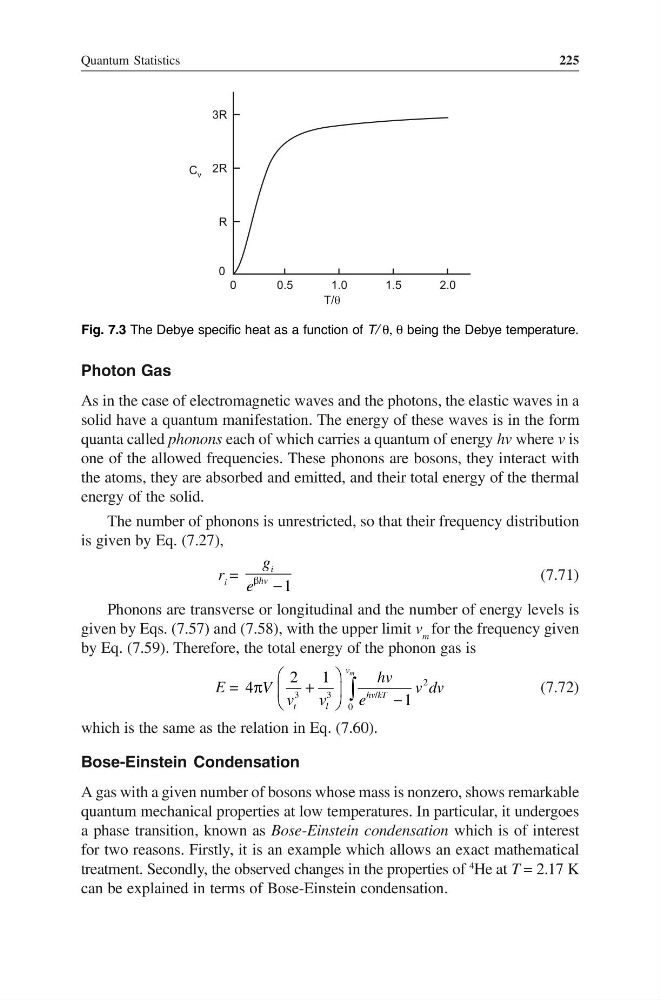
Fig. 7.3 The Debye specific heat as a function of T/ θ, θ being the Debye temperature.
Photon Gas
As in the case of electromagnetic waves and the photons, the elastic waves in a
solid have a quantum manifestation. The energy of these waves is in the form
quanta called phonons each of which carries a quantum of energy hv where v is
one of the allowed frequencies. These phonons are bosons, they interact with
the atoms, they are absorbed and emitted, and their total energy of the thermal
energy of the solid.
The number of phonons is unrestricted, so that their frequency distribution
is given by Eq. (7.27),
r i =
1
i
hv
g
e
β
−
(7.71)
Phonons are transverse or longitudinal and the number of energy levels is
given by Eqs. (7.57) and (7.58), with the upper limit v m for the frequency given
by Eq. (7.59). Therefore, the total energy of the phonon gas is
E =
2
3
3
/
0
2 1
4
1
m
v
hv kT
t
l
hv
V
v d v
v
v
e
π
+
−
∫
(7.72)
which is the same as the relation in Eq. (7.60).
Bose-Einstein Condensation
A gas with a given number of bosons whose mass is nonzero, shows remarkable
quantum mechanical properties at low temperatures. In particular, it undergoes
a phase transition, known as Bose-Einstein condensation which is of interest
for two reasons. Firstly, it is an example which allows an exact mathematical
treatment. Secondly, the observed changes in the properties of
4
He at T = 2.17 K
can be explained in terms of Bose-Einstein condensation.
225
0
0.5
1.0
1.5
2.0
T/q
3R
2R
R
0
C v
Fig. 7.3 The Debye specific heat as a function of T/ θ, θ being the Debye temperature.
Photon Gas
As in the case of electromagnetic waves and the photons, the elastic waves in a
solid have a quantum manifestation. The energy of these waves is in the form
quanta called phonons each of which carries a quantum of energy hv where v is
one of the allowed frequencies. These phonons are bosons, they interact with
the atoms, they are absorbed and emitted, and their total energy of the thermal
energy of the solid.
The number of phonons is unrestricted, so that their frequency distribution
is given by Eq. (7.27),
r i =
1
i
hv
g
e
β
−
(7.71)
Phonons are transverse or longitudinal and the number of energy levels is
given by Eqs. (7.57) and (7.58), with the upper limit v m for the frequency given
by Eq. (7.59). Therefore, the total energy of the phonon gas is
E =
2
3
3
/
0
2 1
4
1
m
v
hv kT
t
l
hv
V
v d v
v
v
e
π
+
−
∫
(7.72)
which is the same as the relation in Eq. (7.60).
Bose-Einstein Condensation
A gas with a given number of bosons whose mass is nonzero, shows remarkable
quantum mechanical properties at low temperatures. In particular, it undergoes
a phase transition, known as Bose-Einstein condensation which is of interest
for two reasons. Firstly, it is an example which allows an exact mathematical
treatment. Secondly, the observed changes in the properties of
4
He at T = 2.17 K
can be explained in terms of Bose-Einstein condensation.