

Elements of Modern Physics
224
C v =
3 /
4
2
0
9
(
1)
T
x
x
T
x e dx
R
e
θ
θ
−
∫
(7.67)
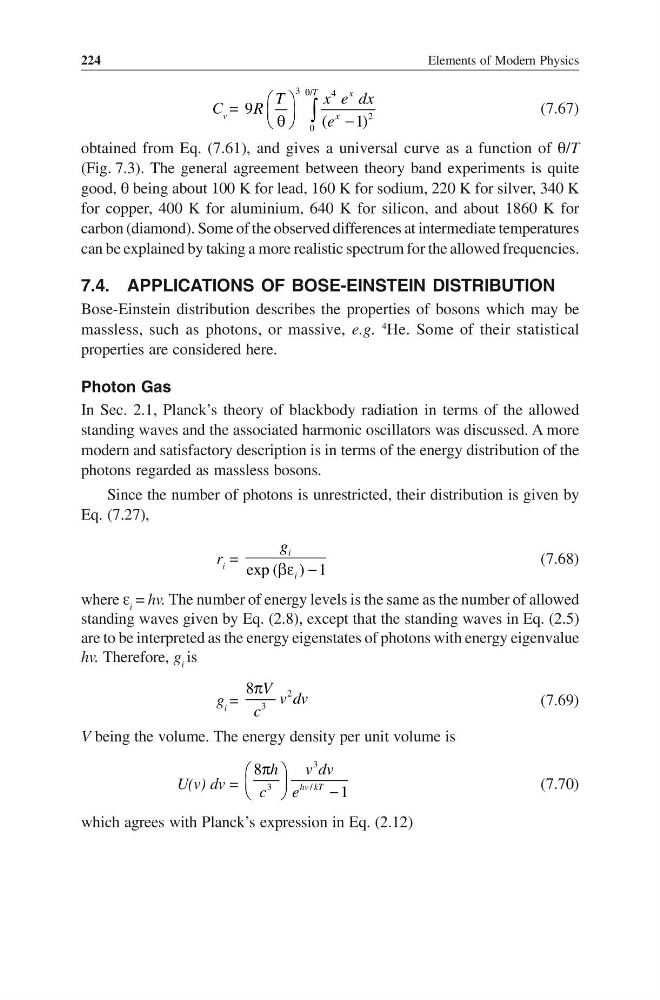
obtained from Eq. (7.61), and gives a universal curve as a function of θ/T
(Fig. 7.3). The general agreement between theory band experiments is quite
good, θ being about 100 K for lead, 160 K for sodium, 220 K for silver, 340 K
for copper, 400 K for aluminium, 640 K for silicon, and about 1860 K for
carbon (diamond). Some of the observed differences at intermediate temperatures
can be explained by taking a more realistic spectrum for the allowed frequencies.
7.4. APPLICATIONS OF BOSE-EINSTEIN DISTRIBUTION
Bose-Einstein distribution describes the properties of bosons which may be
massless, such as photons, or massive, e.g.
4
He. Some of their statistical
properties are considered here.
Photon Gas
In Sec. 2.1, Planck’s theory of blackbody radiation in terms of the allowed
standing waves and the associated harmonic oscillators was discussed. A more
modern and satisfactory description is in terms of the energy distribution of the
photons regarded as massless bosons.
Since the number of photons is unrestricted, their distribution is given by
Eq. (7.27),
r i = exp ( ) 1
i
i
g
βε −
(7.68)
where ε i = hv. The number of energy levels is the same as the number of allowed
standing waves given by Eq. (2.8), except that the standing waves in Eq. (2.5)
are to be interpreted as the energy eigenstates of photons with energy eigenvalue
hv. Therefore, g i is
g i =
2
3
8 V v dv
c
π
(7.69)
V being the volume. The energy density per unit volume is
U(v) dv =
3
3
/
8
1
hv kT
h
v dv
c
e
π
−
(7.70)
which agrees with Planck’s expression in Eq. (2.12)
224
C v =
3 /
4
2
0
9
(
1)
T
x
x
T
x e dx
R
e
θ
θ
−
∫
(7.67)
obtained from Eq. (7.61), and gives a universal curve as a function of θ/T
(Fig. 7.3). The general agreement between theory band experiments is quite
good, θ being about 100 K for lead, 160 K for sodium, 220 K for silver, 340 K
for copper, 400 K for aluminium, 640 K for silicon, and about 1860 K for
carbon (diamond). Some of the observed differences at intermediate temperatures
can be explained by taking a more realistic spectrum for the allowed frequencies.
7.4. APPLICATIONS OF BOSE-EINSTEIN DISTRIBUTION
Bose-Einstein distribution describes the properties of bosons which may be
massless, such as photons, or massive, e.g.
4
He. Some of their statistical
properties are considered here.
Photon Gas
In Sec. 2.1, Planck’s theory of blackbody radiation in terms of the allowed
standing waves and the associated harmonic oscillators was discussed. A more
modern and satisfactory description is in terms of the energy distribution of the
photons regarded as massless bosons.
Since the number of photons is unrestricted, their distribution is given by
Eq. (7.27),
r i = exp ( ) 1
i
i
g
βε −
(7.68)
where ε i = hv. The number of energy levels is the same as the number of allowed
standing waves given by Eq. (2.8), except that the standing waves in Eq. (2.5)
are to be interpreted as the energy eigenstates of photons with energy eigenvalue
hv. Therefore, g i is
g i =
2
3
8 V v dv
c
π
(7.69)
V being the volume. The energy density per unit volume is
U(v) dv =
3
3
/
8
1
hv kT
h
v dv
c
e
π
−
(7.70)
which agrees with Planck’s expression in Eq. (2.12)