

Elements of Modern Physics
228
0
0.5
1.0
1.5
2.0
0
0.5
1.0
T/T C
N /N
0
(a)
0
0.5
1.0
1.5
2.0
T/T C
(b)
3.0
2.0
1.0
C /R
V
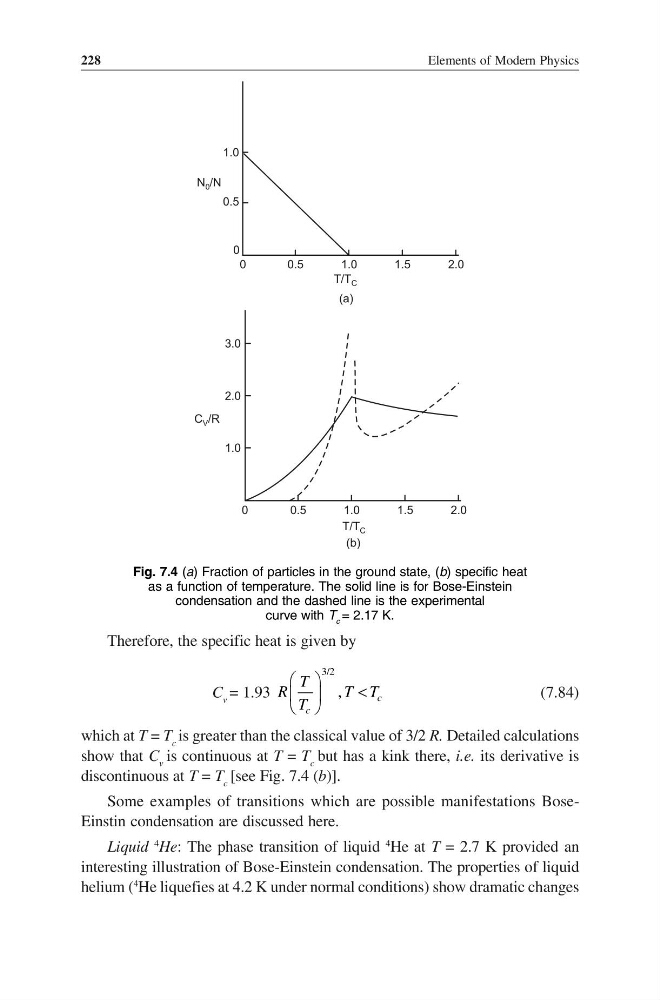
Fig. 7.4 (a) Fraction of particles in the ground state, (b) specific heat
as a function of temperature. The solid line is for Bose-Einstein
condensation and the dashed line is the experimental
curve with T c = 2.17 K.
Therefore, the specific heat is given by
C v = 1.93
3/2
,
c
c
T
R
T T
T
<
(7.84)
which at T = T c is greater than the classical value of 3/2 R. Detailed calculations
show that C v is continuous at T = T c but has a kink there, i.e. its derivative is
discontinuous at T = T c [see Fig. 7.4 (b)].
Some examples of transitions which are possible manifestations BoseEinstin condensation are discussed here.
Liquid
4
He: The phase transition of liquid
4
He at T = 2.7 K provided an
interesting illustration of Bose-Einstein condensation. The properties of liquid
helium (
4
He liquefies at 4.2 K under normal conditions) show dramatic changes
228
0
0.5
1.0
1.5
2.0
0
0.5
1.0
T/T C
N /N
0
(a)
0
0.5
1.0
1.5
2.0
T/T C
(b)
3.0
2.0
1.0
C /R
V
Fig. 7.4 (a) Fraction of particles in the ground state, (b) specific heat
as a function of temperature. The solid line is for Bose-Einstein
condensation and the dashed line is the experimental
curve with T c = 2.17 K.
Therefore, the specific heat is given by
C v = 1.93
3/2
,
c
c
T
R
T T
T
<
(7.84)
which at T = T c is greater than the classical value of 3/2 R. Detailed calculations
show that C v is continuous at T = T c but has a kink there, i.e. its derivative is
discontinuous at T = T c [see Fig. 7.4 (b)].
Some examples of transitions which are possible manifestations BoseEinstin condensation are discussed here.
Liquid
4
He: The phase transition of liquid
4
He at T = 2.7 K provided an
interesting illustration of Bose-Einstein condensation. The properties of liquid
helium (
4
He liquefies at 4.2 K under normal conditions) show dramatic changes