

Quantum Statistics
221
Specific Heat of Solids
The specific heat of solids provides an important application of MaxwellBoltzmann distribution.
It is assumed that the atoms of a solid are localized and perform simple
harmonic motion about the equilibrium position. In the classical analysis, the
number of states is taken to be proportional to d
3
p d
3
r, so that the average
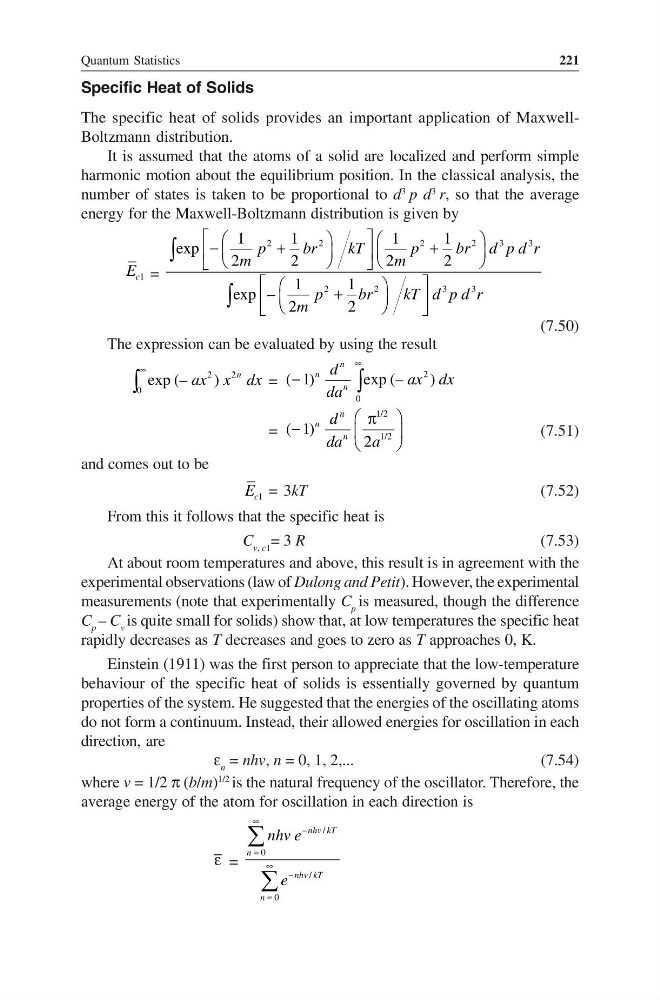
energy for the Maxwell-Boltzmann distribution is given by
1
c
E =
2
2
2
2
3
3
2
2
3
3
1
1
1
1
exp
2
2
2
2
1
1
exp – 2
2
p
br
kT
p
br d pd r
m
m
p
br
kT d pd r
m
−
+
+
+
∫
∫
(7.50)
The expression can be evaluated by using the result
2
2
0
exp (–
)
n
ax x dx
∞
∫
=
2
0
( 1)
exp (–
)
n
n
n
d
ax dx
da
∞
−
∫
=
1/2
1/2
( 1)
2
n
n
n
d
da
a
π
−
(7.51)
and comes out to be
1
c
E = 3kT
(7.52)
From this it follows that the specific heat is
C v, c1 = 3 R
(7.53)
At about room temperatures and above, this result is in agreement with the
experimental observations (law of Dulong and Petit). However, the experimental
measurements (note that experimentally C p is measured, though the difference
C p – C v is quite small for solids) show that, at low temperatures the specific heat
rapidly decreases as T decreases and goes to zero as T approaches 0, K.
Einstein (1911) was the first person to appreciate that the low-temperature
behaviour of the specific heat of solids is essentially governed by quantum
properties of the system. He suggested that the energies of the oscillating atoms
do not form a continuum. Instead, their allowed energies for oscillation in each
direction, are
ε n = nhv, n = 0, 1, 2,...
(7.54)
where v = 1/2 π (b/m)
1/2
is the natural frequency of the oscillator. Therefore, the
average energy of the atom for oscillation in each direction is
ε =
–
/
0
/
0
nhv kT
n
nhv kT
n
nhv e
e
∞
=
∞
−
=
∑
∑
221
Specific Heat of Solids
The specific heat of solids provides an important application of MaxwellBoltzmann distribution.
It is assumed that the atoms of a solid are localized and perform simple
harmonic motion about the equilibrium position. In the classical analysis, the
number of states is taken to be proportional to d
3
p d
3
r, so that the average
energy for the Maxwell-Boltzmann distribution is given by
1
c
E =
2
2
2
2
3
3
2
2
3
3
1
1
1
1
exp
2
2
2
2
1
1
exp – 2
2
p
br
kT
p
br d pd r
m
m
p
br
kT d pd r
m
−
+
+
+
∫
∫
(7.50)
The expression can be evaluated by using the result
2
2
0
exp (–
)
n
ax x dx
∞
∫
=
2
0
( 1)
exp (–
)
n
n
n
d
ax dx
da
∞
−
∫
=
1/2
1/2
( 1)
2
n
n
n
d
da
a
π
−
(7.51)
and comes out to be
1
c
E = 3kT
(7.52)
From this it follows that the specific heat is
C v, c1 = 3 R
(7.53)
At about room temperatures and above, this result is in agreement with the
experimental observations (law of Dulong and Petit). However, the experimental
measurements (note that experimentally C p is measured, though the difference
C p – C v is quite small for solids) show that, at low temperatures the specific heat
rapidly decreases as T decreases and goes to zero as T approaches 0, K.
Einstein (1911) was the first person to appreciate that the low-temperature
behaviour of the specific heat of solids is essentially governed by quantum
properties of the system. He suggested that the energies of the oscillating atoms
do not form a continuum. Instead, their allowed energies for oscillation in each
direction, are
ε n = nhv, n = 0, 1, 2,...
(7.54)
where v = 1/2 π (b/m)
1/2
is the natural frequency of the oscillator. Therefore, the
average energy of the atom for oscillation in each direction is
ε =
–
/
0
/
0
nhv kT
n
nhv kT
n
nhv e
e
∞
=
∞
−
=
∑
∑