

Elements of Modern Physics
222
=
/
– 1
hv kT
hv
e
(7.55)
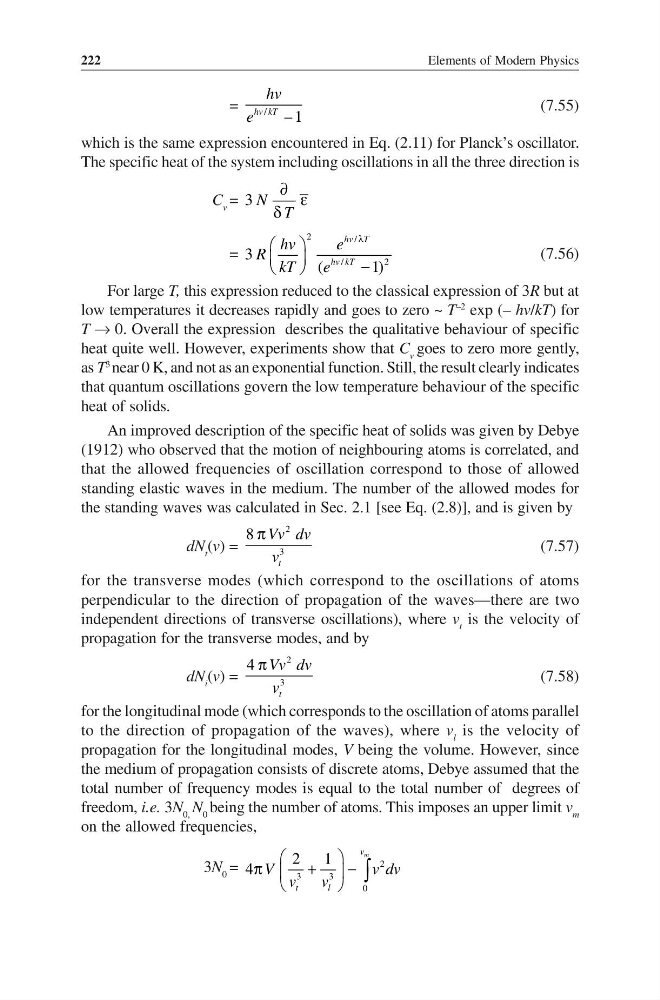
which is the same expression encountered in Eq. (2.11) for Planck’s oscillator.
The specific heat of the system including oscillations in all the three direction is
C v = 3 N T
∂ ε
δ
=
2
/
/
2
3
(
1 )
hv T
hv kT
hv
e
R kT
e
λ
−
(7.56)
For large T, this expression reduced to the classical expression of 3R but at
low temperatures it decreases rapidly and goes to zero ~ T
–2
exp (– hv/kT) for
T → 0. Overall the expression describes the qualitative behaviour of specific
heat quite well. However, experiments show that C v goes to zero more gently,
as T
3
near 0 K, and not as an exponential function. Still, the result clearly indicates
that quantum oscillations govern the low temperature behaviour of the specific
heat of solids.
An improved description of the specific heat of solids was given by Debye
(1912) who observed that the motion of neighbouring atoms is correlated, and
that the allowed frequencies of oscillation correspond to those of allowed
standing elastic waves in the medium. The number of the allowed modes for
the standing waves was calculated in Sec. 2.1 [see Eq. (2.8)], and is given by
dN t (v) =
2
3
8
t
Vv dv
v
π
(7.57)
for the transverse modes (which correspond to the oscillations of atoms
perpendicular to the direction of propagation of the waves—there are two
independent directions of transverse oscillations), where v t is the velocity of
propagation for the transverse modes, and by
dN i (v) =
2
3
4
t
Vv dv
v
π
(7.58)
for the longitudinal mode (which corresponds to the oscillation of atoms parallel
to the direction of propagation of the waves), where v l is the velocity of
propagation for the longitudinal modes, V being the volume. However, since
the medium of propagation consists of discrete atoms, Debye assumed that the
total number of frequency modes is equal to the total number of degrees of
freedom, i.e. 3N 0, N 0 being the number of atoms. This imposes an upper limit v m
on the allowed frequencies,
3N 0 =
2
3
3
0
2 1
4
m
v
t
l
V
vd v
v
v
π
+
−
∫
222
=
/
– 1
hv kT
hv
e
(7.55)
which is the same expression encountered in Eq. (2.11) for Planck’s oscillator.
The specific heat of the system including oscillations in all the three direction is
C v = 3 N T
∂ ε
δ
=
2
/
/
2
3
(
1 )
hv T
hv kT
hv
e
R kT
e
λ
−
(7.56)
For large T, this expression reduced to the classical expression of 3R but at
low temperatures it decreases rapidly and goes to zero ~ T
–2
exp (– hv/kT) for
T → 0. Overall the expression describes the qualitative behaviour of specific
heat quite well. However, experiments show that C v goes to zero more gently,
as T
3
near 0 K, and not as an exponential function. Still, the result clearly indicates
that quantum oscillations govern the low temperature behaviour of the specific
heat of solids.
An improved description of the specific heat of solids was given by Debye
(1912) who observed that the motion of neighbouring atoms is correlated, and
that the allowed frequencies of oscillation correspond to those of allowed
standing elastic waves in the medium. The number of the allowed modes for
the standing waves was calculated in Sec. 2.1 [see Eq. (2.8)], and is given by
dN t (v) =
2
3
8
t
Vv dv
v
π
(7.57)
for the transverse modes (which correspond to the oscillations of atoms
perpendicular to the direction of propagation of the waves—there are two
independent directions of transverse oscillations), where v t is the velocity of
propagation for the transverse modes, and by
dN i (v) =
2
3
4
t
Vv dv
v
π
(7.58)
for the longitudinal mode (which corresponds to the oscillation of atoms parallel
to the direction of propagation of the waves), where v l is the velocity of
propagation for the longitudinal modes, V being the volume. However, since
the medium of propagation consists of discrete atoms, Debye assumed that the
total number of frequency modes is equal to the total number of degrees of
freedom, i.e. 3N 0, N 0 being the number of atoms. This imposes an upper limit v m
on the allowed frequencies,
3N 0 =
2
3
3
0
2 1
4
m
v
t
l
V
vd v
v
v
π
+
−
∫