

Elements of Modern Physics
220
E =
3
1
1
2
2
exp( / )–1
( 1/ )
F
kT
kT
F
kT
ω
∂
+
ω+
−
ω
∂
(7.47)
F ≈ 1 + 5 exp (– 6a/kT) + 2
kT
a
exp (– 12 a/kT)
The values of ω and a are obtained from the spectrum of the hydrogen
molecule, and have the values
ω
≈ 0.5454 eV
(7.48)
a ≈ 0.007 55 eV
The specific heat of para-hydrogen obtained from Eq. (7.47)
C v = N Avo
E
T
∂
∂
(7.49)
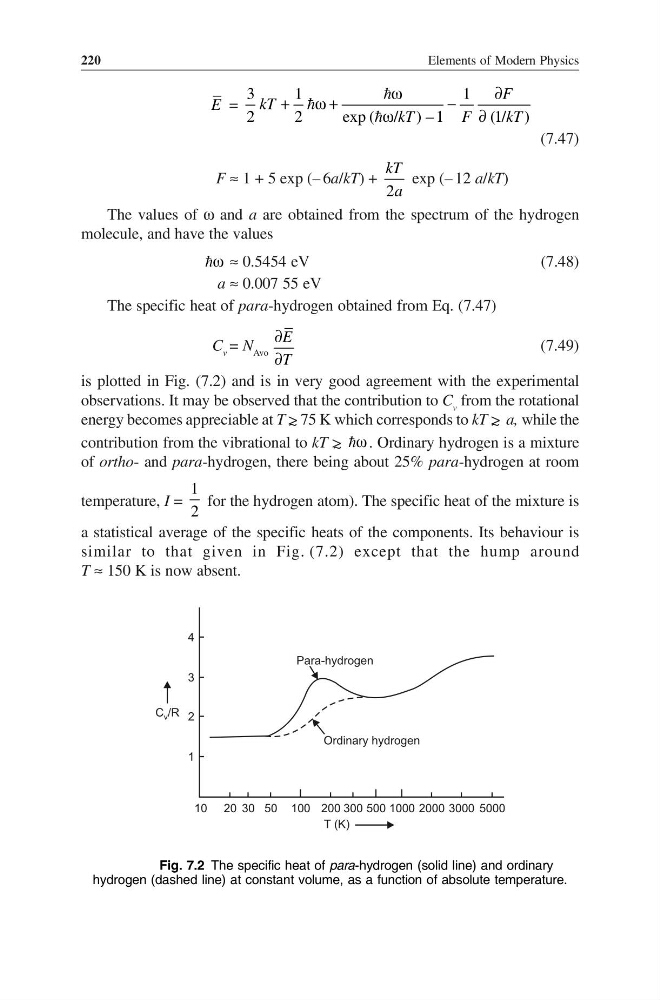
is plotted in Fig. (7.2) and is in very good agreement with the experimental
observations. It may be observed that the contribution to C v from the rotational
energy becomes appreciable at T > ~ 75 K which corresponds to kT > ~ a, while the
contribution from the vibrational to kT > ~ ω
. Ordinary hydrogen is a mixture
of ortho- and para-hydrogen, there being about 25% para-hydrogen at room
temperature, I =
1
2
for the hydrogen atom). The specific heat of the mixture is
a statistical average of the specific heats of the components. Its behaviour is
similar to that given in Fig. (7.2) except that the hump around
T ≈ 150 K is now absent.
10 20 30 50 100 200 300 500 1000 2000 3000 5000
T (K)
4
3
2
1
C /R
v
Para-hydrogen
Ordinary hydrogen
Fig. 7.2 The specific heat of para-hydrogen (solid line) and ordinary
hydrogen (dashed line) at constant volume, as a function of absolute temperature.
220
E =
3
1
1
2
2
exp( / )–1
( 1/ )
F
kT
kT
F
kT
ω
∂
+
ω+
−
ω
∂
(7.47)
F ≈ 1 + 5 exp (– 6a/kT) + 2
kT
a
exp (– 12 a/kT)
The values of ω and a are obtained from the spectrum of the hydrogen
molecule, and have the values
ω
≈ 0.5454 eV
(7.48)
a ≈ 0.007 55 eV
The specific heat of para-hydrogen obtained from Eq. (7.47)
C v = N Avo
E
T
∂
∂
(7.49)
is plotted in Fig. (7.2) and is in very good agreement with the experimental
observations. It may be observed that the contribution to C v from the rotational
energy becomes appreciable at T > ~ 75 K which corresponds to kT > ~ a, while the
contribution from the vibrational to kT > ~ ω
. Ordinary hydrogen is a mixture
of ortho- and para-hydrogen, there being about 25% para-hydrogen at room
temperature, I =
1
2
for the hydrogen atom). The specific heat of the mixture is
a statistical average of the specific heats of the components. Its behaviour is
similar to that given in Fig. (7.2) except that the hump around
T ≈ 150 K is now absent.
10 20 30 50 100 200 300 500 1000 2000 3000 5000
T (K)
4
3
2
1
C /R
v
Para-hydrogen
Ordinary hydrogen
Fig. 7.2 The specific heat of para-hydrogen (solid line) and ordinary
hydrogen (dashed line) at constant volume, as a function of absolute temperature.