

Quantum Statistics
219
It was noted in Eq. (7.32) that tr
E is
3
2
kT. The average vibrational energy
is
vib
E =
= 0
0
exp [– ( 1/2) / ] ( 1/2)
exp [– ( 1/2) / ]
n
n
n
k T n
n
k T
∞
∞
=
+
ω
+
ω
+
ω
∑
∑
(7.42)
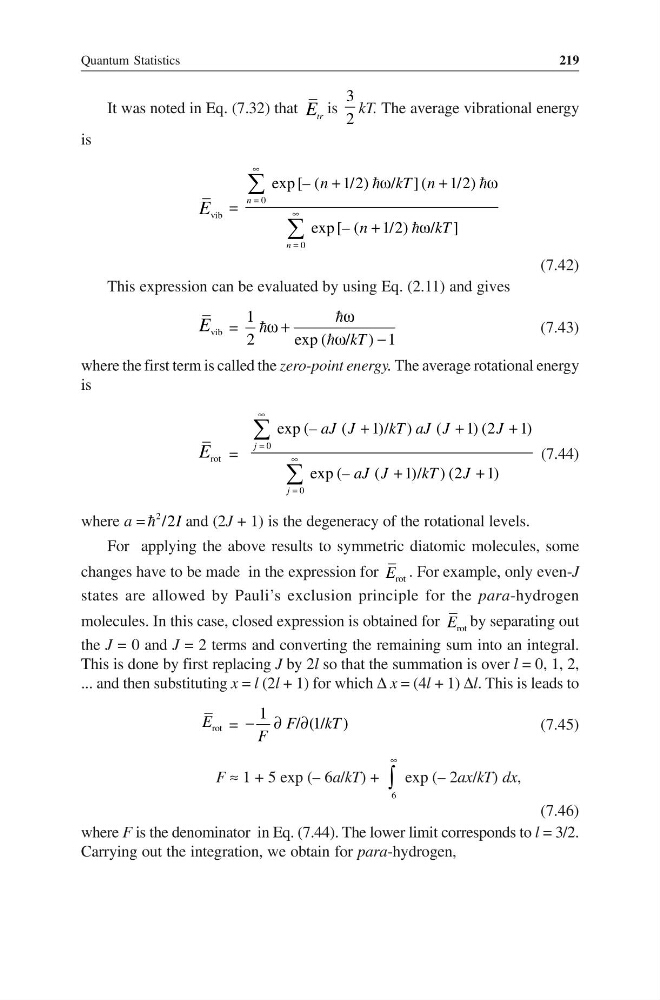
This expression can be evaluated by using Eq. (2.11) and gives
vib
E =
1
2
exp( / ) 1
kT
ω
ω +
ω
−
(7.43)
where the first term is called the zero-point energy. The average rotational energy
is
rot
E =
0
0
exp(–
(
1)/ )
(
1)(2
1)
exp (–
(
1)/ ) (2
1)
j
j
aJ J
kT aJ J
J
aJ J
kT
J
∞
=
∞
=
+
+
+
+
+
∑
∑
(7.44)
where a =
2 /2I
and (2J + 1) is the degeneracy of the rotational levels.
For applying the above results to symmetric diatomic molecules, some
changes have to be made in the expression for rot
E . For example, only even-J
states are allowed by Pauli’s exclusion principle for the para-hydrogen
molecules. In this case, closed expression is obtained for rot
E by separating out
the J = 0 and J = 2 terms and converting the remaining sum into an integral.
This is done by first replacing J by 2l so that the summation is over l = 0, 1, 2,
... and then substituting x = l (2l + 1) for which ∆ x = (4l + 1) ∆l. This is leads to
rot
E =
1
/ (1/ )
F
kT
F
− ∂ ∂
(7.45)
F ≈ 1 + 5 exp (– 6a/kT) +
6
∞
∫ exp (– 2ax/kT) dx,
(7.46)
where F is the denominator in Eq. (7.44). The lower limit corresponds to l = 3/2.
Carrying out the integration, we obtain for para-hydrogen,
219
It was noted in Eq. (7.32) that tr
E is
3
2
kT. The average vibrational energy
is
vib
E =
= 0
0
exp [– ( 1/2) / ] ( 1/2)
exp [– ( 1/2) / ]
n
n
n
k T n
n
k T
∞
∞
=
+
ω
+
ω
+
ω
∑
∑
(7.42)
This expression can be evaluated by using Eq. (2.11) and gives
vib
E =
1
2
exp( / ) 1
kT
ω
ω +
ω
−
(7.43)
where the first term is called the zero-point energy. The average rotational energy
is
rot
E =
0
0
exp(–
(
1)/ )
(
1)(2
1)
exp (–
(
1)/ ) (2
1)
j
j
aJ J
kT aJ J
J
aJ J
kT
J
∞
=
∞
=
+
+
+
+
+
∑
∑
(7.44)
where a =
2 /2I
and (2J + 1) is the degeneracy of the rotational levels.
For applying the above results to symmetric diatomic molecules, some
changes have to be made in the expression for rot
E . For example, only even-J
states are allowed by Pauli’s exclusion principle for the para-hydrogen
molecules. In this case, closed expression is obtained for rot
E by separating out
the J = 0 and J = 2 terms and converting the remaining sum into an integral.
This is done by first replacing J by 2l so that the summation is over l = 0, 1, 2,
... and then substituting x = l (2l + 1) for which ∆ x = (4l + 1) ∆l. This is leads to
rot
E =
1
/ (1/ )
F
kT
F
− ∂ ∂
(7.45)
F ≈ 1 + 5 exp (– 6a/kT) +
6
∞
∫ exp (– 2ax/kT) dx,
(7.46)
where F is the denominator in Eq. (7.44). The lower limit corresponds to l = 3/2.
Carrying out the integration, we obtain for para-hydrogen,