

Elements of Modern Physics
204
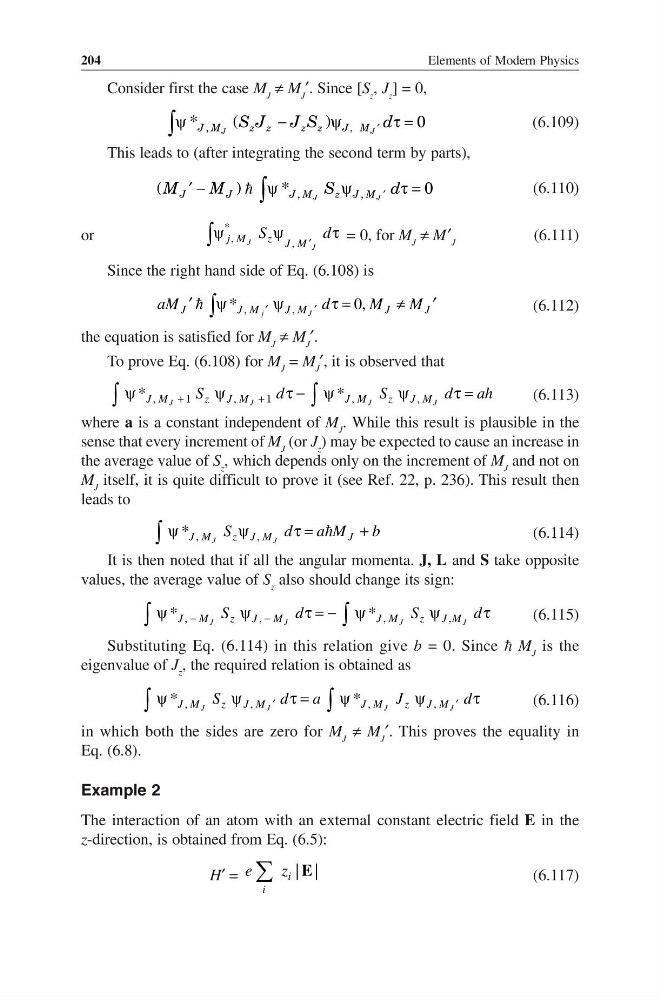
Consider first the case M J ≠ M J ′. Since [S z , J z ] = 0,
,
*
(
)
0
J
J
J M
z z
z z
J M
S J
J S
d
,
′
ψ
−
ψ
τ=
∫
(6.109)
This leads to (after integrating the second term by parts),
,
,
(
)
*
0
J
J
J
J
JM
z JM
M
M
S
d
′
′ −
ψ
ψ
τ =
∫
(6.110)
or
*
,
, ′
ψ
ψ
τ
∫
J
J
j M
z J M
S
d = 0, for M J ≠ M′ J
(6.111)
Since the right hand side of Eq. (6.108) is
,
,
*
0 ,
j
J
J
JM
JM
J
J
aM
d
M
M
′
′
′ ψ
ψ
τ=
≠
′
∫
(6.112)
the equation is satisfied for M J ≠ M J ′.
To prove Eq. (6.108) for M J = M J ′, it is observed that
,
1
,
1
,
,
*
*
J
J
J
J
J M
z
J M
J M
z
J M
S
d
S
d
a h
+
+
ψ
ψ
τ − ψ
ψ
τ =
∫
∫
(6.113)
where a is a constant independent of M J . While this result is plausible in the
sense that every increment of M J (or J z ) may be expected to cause an increase in
the average value of S z , which depends only on the increment of M J and not on
M J itself, it is quite difficult to prove it (see Ref. 22, p. 236). This result then
leads to
,
,
* J
J
J M
z J M
J
S
d
a M
b
ψ
ψ
τ=
+
∫
(6.114)
It is then noted that if all the angular momenta. J, L and S take opposite
values, the average value of S z also should change its sign:
,
,
,
,
*
*
J
J
J
J
J M
z
J M
J M
z
J M
S
d
S
d
−
−
ψ
ψ
τ=− ψ
ψ
τ
∫
∫
(6.115)
Substituting Eq. (6.114) in this relation give b = 0. Since M J is the
eigenvalue of J z , the required relation is obtained as
,
,
,
,
*
*
J
J
J
J
J M
z
J M
J M
z
J M
S
d
a
J
d
′
′
ψ
ψ
τ=
ψ
ψ
τ
∫
∫
(6.116)
in which both the sides are zero for M J ≠ M J ′. This proves the equality in
Eq. (6.8).
Example 2
The interaction of an atom with an external constant electric field E in the
z-direction, is obtained from Eq. (6.5):
H′ =
| |
i
i
e
z
∑ E
(6.117)
204
Consider first the case M J ≠ M J ′. Since [S z , J z ] = 0,
,
*
(
)
0
J
J
J M
z z
z z
J M
S J
J S
d
,
′
ψ
−
ψ
τ=
∫
(6.109)
This leads to (after integrating the second term by parts),
,
,
(
)
*
0
J
J
J
J
JM
z JM
M
M
S
d
′
′ −
ψ
ψ
τ =
∫
(6.110)
or
*
,
, ′
ψ
ψ
τ
∫
J
J
j M
z J M
S
d = 0, for M J ≠ M′ J
(6.111)
Since the right hand side of Eq. (6.108) is
,
,
*
0 ,
j
J
J
JM
JM
J
J
aM
d
M
M
′
′
′ ψ
ψ
τ=
≠
′
∫
(6.112)
the equation is satisfied for M J ≠ M J ′.
To prove Eq. (6.108) for M J = M J ′, it is observed that
,
1
,
1
,
,
*
*
J
J
J
J
J M
z
J M
J M
z
J M
S
d
S
d
a h
+
+
ψ
ψ
τ − ψ
ψ
τ =
∫
∫
(6.113)
where a is a constant independent of M J . While this result is plausible in the
sense that every increment of M J (or J z ) may be expected to cause an increase in
the average value of S z , which depends only on the increment of M J and not on
M J itself, it is quite difficult to prove it (see Ref. 22, p. 236). This result then
leads to
,
,
* J
J
J M
z J M
J
S
d
a M
b
ψ
ψ
τ=
+
∫
(6.114)
It is then noted that if all the angular momenta. J, L and S take opposite
values, the average value of S z also should change its sign:
,
,
,
,
*
*
J
J
J
J
J M
z
J M
J M
z
J M
S
d
S
d
−
−
ψ
ψ
τ=− ψ
ψ
τ
∫
∫
(6.115)
Substituting Eq. (6.114) in this relation give b = 0. Since M J is the
eigenvalue of J z , the required relation is obtained as
,
,
,
,
*
*
J
J
J
J
J M
z
J M
J M
z
J M
S
d
a
J
d
′
′
ψ
ψ
τ=
ψ
ψ
τ
∫
∫
(6.116)
in which both the sides are zero for M J ≠ M J ′. This proves the equality in
Eq. (6.8).
Example 2
The interaction of an atom with an external constant electric field E in the
z-direction, is obtained from Eq. (6.5):
H′ =
| |
i
i
e
z
∑ E
(6.117)