

Interaction with External Fields
205
This interaction has the interesting new feature that it becomes indefinitely
large and negative as z i → – ∞, so that the electrons in an atom can tunnel
through the potential barrier and ultimately escape to infinity (z → – ∞). Thus,
there are no longer any true bound stages, and each level (including the ground
state) acquires a linewidth due to the fact that it has a finite lifetime (∆ω ~ 1/τ).
Also, the first-order energy shift given by Eq. (3.125) is zero for nondegenerates
states,
*
0
n i
n
z
d
ψ
ψ τ=
∫
(6.118)
Since z i is odd and | ψ n |
2
is even (nondegradable states are even or odd
under parity). For degenerate states, which one encounters in the hydrogen
atom, the problem is more complicated.
Consider the 2p and 2s states of the hydrogen atom. From Eq. (3.127), it is
easy to show that the energies of the m i = ± 1 states are unperturbed. For the
m l = 0 states, the energy shifts are given by Eq. (3.128), with 1 standing for the
l = 1, m l = 0 state and 2 standing for the l = 0, m i = 0 state. For this case, V 11 = V 22
= 0, so that x = ± 1 and the energy shifts are
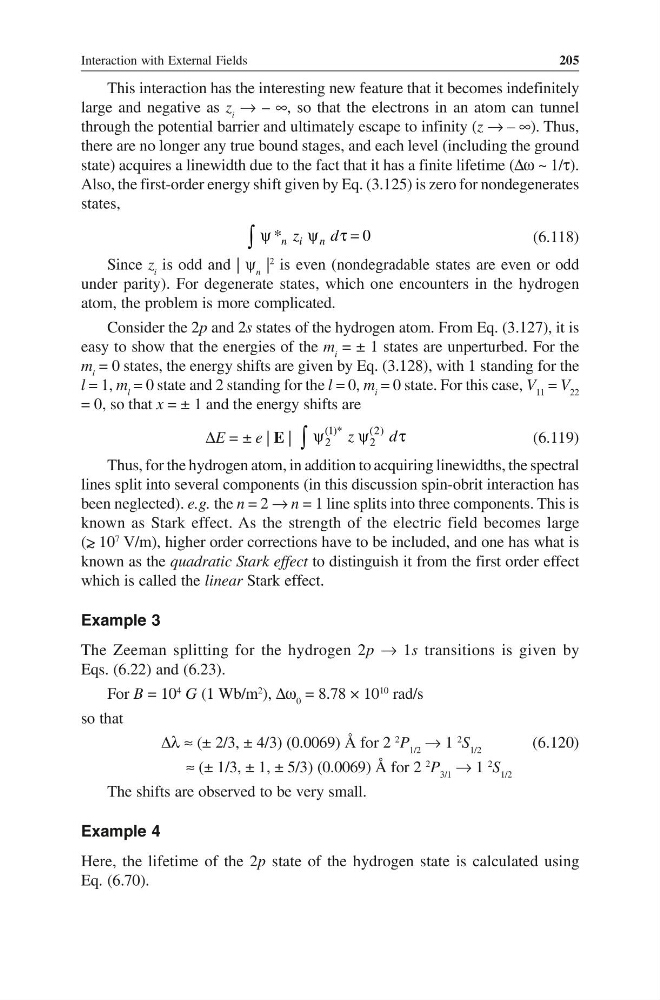
∆E = ± e | E |
(1)*
(2)
2
2
z
d
ψ
ψ
τ
∫
(6.119)
Thus, for the hydrogen atom, in addition to acquiring linewidths, the spectral
lines split into several components (in this discussion spin-obrit interaction has
been neglected). e.g. the n = 2 → n = 1 line splits into three components. This is
known as Stark effect. As the strength of the electric field becomes large
(> ~ 10
7
V/m), higher order corrections have to be included, and one has what is
known as the quadratic Stark effect to distinguish it from the first order effect
which is called the linear Stark effect.
Example 3
The Zeeman splitting for the hydrogen 2p → 1s transitions is given by
Eqs. (6.22) and (6.23).
For B = 10
4
G (1 Wb/m
2
), ∆ω 0 = 8.78 × 10
10
rad/s
so that
∆λ ≈ (± 2/3, ± 4/3) (0.0069) Å for 2
2
P 1/2 → 1
2
S 1/2
(6.120)
≈ (± 1/3, ± 1, ± 5/3) (0.0069) Å for 2
2
P 3/1 → 1
2
S 1/2
The shifts are observed to be very small.
Example 4
Here, the lifetime of the 2p state of the hydrogen state is calculated using
Eq. (6.70).
205
This interaction has the interesting new feature that it becomes indefinitely
large and negative as z i → – ∞, so that the electrons in an atom can tunnel
through the potential barrier and ultimately escape to infinity (z → – ∞). Thus,
there are no longer any true bound stages, and each level (including the ground
state) acquires a linewidth due to the fact that it has a finite lifetime (∆ω ~ 1/τ).
Also, the first-order energy shift given by Eq. (3.125) is zero for nondegenerates
states,
*
0
n i
n
z
d
ψ
ψ τ=
∫
(6.118)
Since z i is odd and | ψ n |
2
is even (nondegradable states are even or odd
under parity). For degenerate states, which one encounters in the hydrogen
atom, the problem is more complicated.
Consider the 2p and 2s states of the hydrogen atom. From Eq. (3.127), it is
easy to show that the energies of the m i = ± 1 states are unperturbed. For the
m l = 0 states, the energy shifts are given by Eq. (3.128), with 1 standing for the
l = 1, m l = 0 state and 2 standing for the l = 0, m i = 0 state. For this case, V 11 = V 22
= 0, so that x = ± 1 and the energy shifts are
∆E = ± e | E |
(1)*
(2)
2
2
z
d
ψ
ψ
τ
∫
(6.119)
Thus, for the hydrogen atom, in addition to acquiring linewidths, the spectral
lines split into several components (in this discussion spin-obrit interaction has
been neglected). e.g. the n = 2 → n = 1 line splits into three components. This is
known as Stark effect. As the strength of the electric field becomes large
(> ~ 10
7
V/m), higher order corrections have to be included, and one has what is
known as the quadratic Stark effect to distinguish it from the first order effect
which is called the linear Stark effect.
Example 3
The Zeeman splitting for the hydrogen 2p → 1s transitions is given by
Eqs. (6.22) and (6.23).
For B = 10
4
G (1 Wb/m
2
), ∆ω 0 = 8.78 × 10
10
rad/s
so that
∆λ ≈ (± 2/3, ± 4/3) (0.0069) Å for 2
2
P 1/2 → 1
2
S 1/2
(6.120)
≈ (± 1/3, ± 1, ± 5/3) (0.0069) Å for 2
2
P 3/1 → 1
2
S 1/2
The shifts are observed to be very small.
Example 4
Here, the lifetime of the 2p state of the hydrogen state is calculated using
Eq. (6.70).