

Interaction with External Fields
197
The development of methods to cool dilute vapours of trapped atoms has
made it possible to construct atomic clocks useful for precise timekeeping, e.g.,
in connection with navigation in space and the exploration of the solar system.
Another application using laser cooling is the development of atomic
interferometers in which the de Broglie wavelength of slow atoms is used for
interferometric measurements with ultrahigh precision, e.g., the acceleration of
gravity. It has become possible to develop instruments for atom optics to achieve
atomic lithography. The atomic beams may be used to form nanometer structures
on surfaces, e.g., for electronic components. The recent observation of a BoseEinstein condensation in a dilute atomic gas is also achieved using laser cooling
and trapping.
(Source: http://www.nobelprize.org/nobel_prizes/physics/laureates/1997/
back.html)
6.7 SOME EXPERIMENTAL METHODS
In this section, some experiments which are important for the study of atomic
and molecular properties are described.
q
S
3
1
2
P
(a)
3
1
2
q¢ q
=
P
Observer
(b)
S
S¢
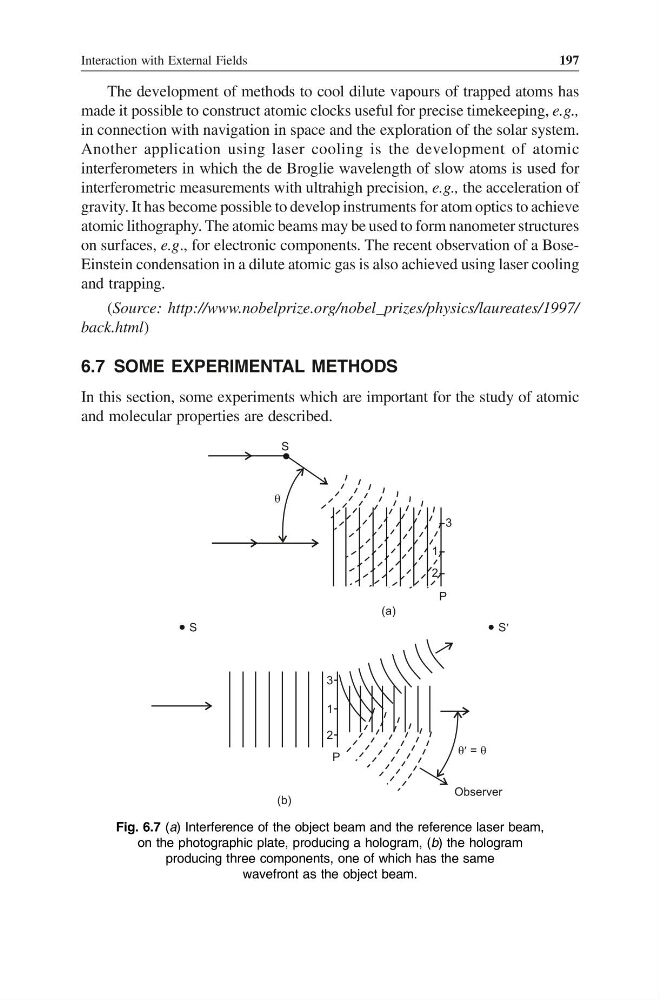
Fig. 6.7 (a) Interference of the object beam and the reference laser beam,
on the photographic plate, producing a hologram, (b) the hologram
producing three components, one of which has the same
wavefront as the object beam.
197
The development of methods to cool dilute vapours of trapped atoms has
made it possible to construct atomic clocks useful for precise timekeeping, e.g.,
in connection with navigation in space and the exploration of the solar system.
Another application using laser cooling is the development of atomic
interferometers in which the de Broglie wavelength of slow atoms is used for
interferometric measurements with ultrahigh precision, e.g., the acceleration of
gravity. It has become possible to develop instruments for atom optics to achieve
atomic lithography. The atomic beams may be used to form nanometer structures
on surfaces, e.g., for electronic components. The recent observation of a BoseEinstein condensation in a dilute atomic gas is also achieved using laser cooling
and trapping.
(Source: http://www.nobelprize.org/nobel_prizes/physics/laureates/1997/
back.html)
6.7 SOME EXPERIMENTAL METHODS
In this section, some experiments which are important for the study of atomic
and molecular properties are described.
q
S
3
1
2
P
(a)
3
1
2
q¢ q
=
P
Observer
(b)
S
S¢
Fig. 6.7 (a) Interference of the object beam and the reference laser beam,
on the photographic plate, producing a hologram, (b) the hologram
producing three components, one of which has the same
wavefront as the object beam.