

Elements of Modern Physics
196
If the object beam is a diverging beam (as in normally the case), it is easily
seen that the maximum intensity points 2 and 3 both move up with respect to 1
(see Fig. 6.6). As a consequence, the lower beam will also be diverging and will
appear to start from the object, whereas the upper beam will converge to a real
image of the object. This is seen by constructing wavefronts with circles of
radius b with centre at point 1, radius b ∓ λ with centre of point 2, radius b ± λ
with centre at point 3. The upper signs correspond to the lower beam and the
lower signs correspond to the upper beam. It may also be noted that in viewing
a hologram, the reference beam may have a frequency different from that of the
beam used for recording the image. If the wavelength of the second reference
beam is longer, the image observed will be magnified.
Holograms are very useful in studying the conditions at different levels by
focussing the microscope at different planes of the reconstructed image, e.g., in
the investigation of sizes and distribution of particles, mechanical strains, etc.
Laser Cooling
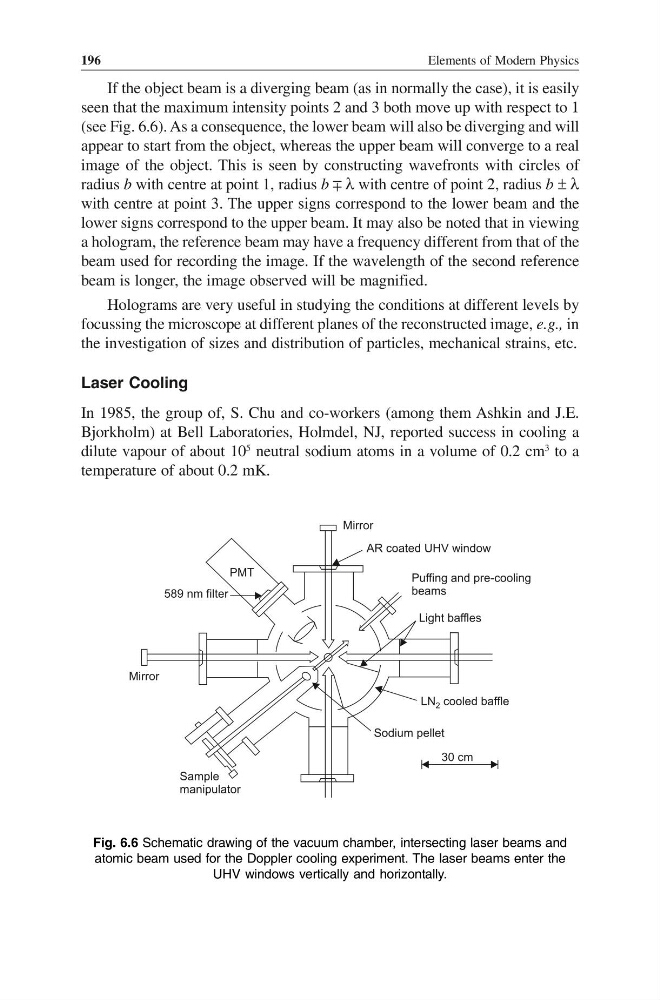
In 1985, the group of, S. Chu and co-workers (among them Ashkin and J.E.
Bjorkholm) at Bell Laboratories, Holmdel, NJ, reported success in cooling a
dilute vapour of about 10
5
neutral sodium atoms in a volume of 0.2 cm
3
to a
temperature of about 0.2 mK.
30 cm
Sodium pellet
LN cooled baffle
2
Sample
manipulator
Mirror
589 nm filter
PMT
Mirror
AR coated UHV window
Puffing and pre-cooling
beams
Light baffles
Fig. 6.6 Schematic drawing of the vacuum chamber, intersecting laser beams and
atomic beam used for the Doppler cooling experiment. The laser beams enter the
UHV windows vertically and horizontally.
196
If the object beam is a diverging beam (as in normally the case), it is easily
seen that the maximum intensity points 2 and 3 both move up with respect to 1
(see Fig. 6.6). As a consequence, the lower beam will also be diverging and will
appear to start from the object, whereas the upper beam will converge to a real
image of the object. This is seen by constructing wavefronts with circles of
radius b with centre at point 1, radius b ∓ λ with centre of point 2, radius b ± λ
with centre at point 3. The upper signs correspond to the lower beam and the
lower signs correspond to the upper beam. It may also be noted that in viewing
a hologram, the reference beam may have a frequency different from that of the
beam used for recording the image. If the wavelength of the second reference
beam is longer, the image observed will be magnified.
Holograms are very useful in studying the conditions at different levels by
focussing the microscope at different planes of the reconstructed image, e.g., in
the investigation of sizes and distribution of particles, mechanical strains, etc.
Laser Cooling
In 1985, the group of, S. Chu and co-workers (among them Ashkin and J.E.
Bjorkholm) at Bell Laboratories, Holmdel, NJ, reported success in cooling a
dilute vapour of about 10
5
neutral sodium atoms in a volume of 0.2 cm
3
to a
temperature of about 0.2 mK.
30 cm
Sodium pellet
LN cooled baffle
2
Sample
manipulator
Mirror
589 nm filter
PMT
Mirror
AR coated UHV window
Puffing and pre-cooling
beams
Light baffles
Fig. 6.6 Schematic drawing of the vacuum chamber, intersecting laser beams and
atomic beam used for the Doppler cooling experiment. The laser beams enter the
UHV windows vertically and horizontally.