

Interaction with External Fields
195
d = /sin
l
q
3
1
2
l
q
Reflected beam
Reference beam
y
(a)
3
1
2
q¢ q
=
q¢ q
=
(b)
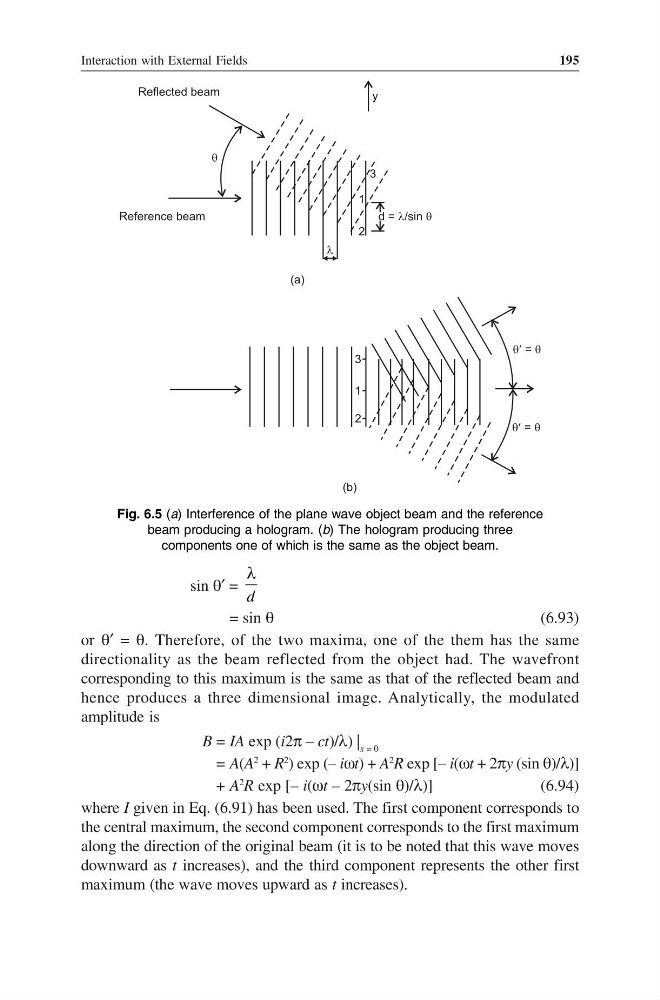
Fig. 6.5 (a) Interference of the plane wave object beam and the reference
beam producing a hologram. (b) The hologram producing three
components one of which is the same as the object beam.
sin θ′ = d
λ
= sin θ
(6.93)
or θ′ = θ. Therefore, of the two maxima, one of the them has the same
directionality as the beam reflected from the object had. The wavefront
corresponding to this maximum is the same as that of the reflected beam and
hence produces a three dimensional image. Analytically, the modulated
amplitude is
B = IA exp (i2π – ct)/λ) | x = 0
= A(A
2
+ R
2
) exp (– iωt) + A
2
R exp [– i(ωt + 2πy (sin θ)/λ)]
+ A
2
R exp [– i(ωt – 2πy(sin θ)/λ)]
(6.94)
where I given in Eq. (6.91) has been used. The first component corresponds to
the central maximum, the second component corresponds to the first maximum
along the direction of the original beam (it is to be noted that this wave moves
downward as t increases), and the third component represents the other first
maximum (the wave moves upward as t increases).
195
d = /sin
l
q
3
1
2
l
q
Reflected beam
Reference beam
y
(a)
3
1
2
q¢ q
=
q¢ q
=
(b)
Fig. 6.5 (a) Interference of the plane wave object beam and the reference
beam producing a hologram. (b) The hologram producing three
components one of which is the same as the object beam.
sin θ′ = d
λ
= sin θ
(6.93)
or θ′ = θ. Therefore, of the two maxima, one of the them has the same
directionality as the beam reflected from the object had. The wavefront
corresponding to this maximum is the same as that of the reflected beam and
hence produces a three dimensional image. Analytically, the modulated
amplitude is
B = IA exp (i2π – ct)/λ) | x = 0
= A(A
2
+ R
2
) exp (– iωt) + A
2
R exp [– i(ωt + 2πy (sin θ)/λ)]
+ A
2
R exp [– i(ωt – 2πy(sin θ)/λ)]
(6.94)
where I given in Eq. (6.91) has been used. The first component corresponds to
the central maximum, the second component corresponds to the first maximum
along the direction of the original beam (it is to be noted that this wave moves
downward as t increases), and the third component represents the other first
maximum (the wave moves upward as t increases).