

Elements of Modern Physics
198
Magnetic Resonance Experiments
These experiments depend on the interaction of an atomic or a nuclear system
that has a nonzero magnetic moment, with a static magnetic field and a radiation
field. The static field splits the levels into different components, and the radiation
field with a particular frequency, called the resonance frequency, induces
transitions between these levels. Analysis of these transitions leads to information
about the magnetic moment of the system. The resonance experiments are
described as electron paramagnetic resonance (abbreviated as epr) when applied
to electronic magnetic moments, and as nuclear magnetic resonance (abbreviated
as nmr) when applied to nuclear magnetic moments.
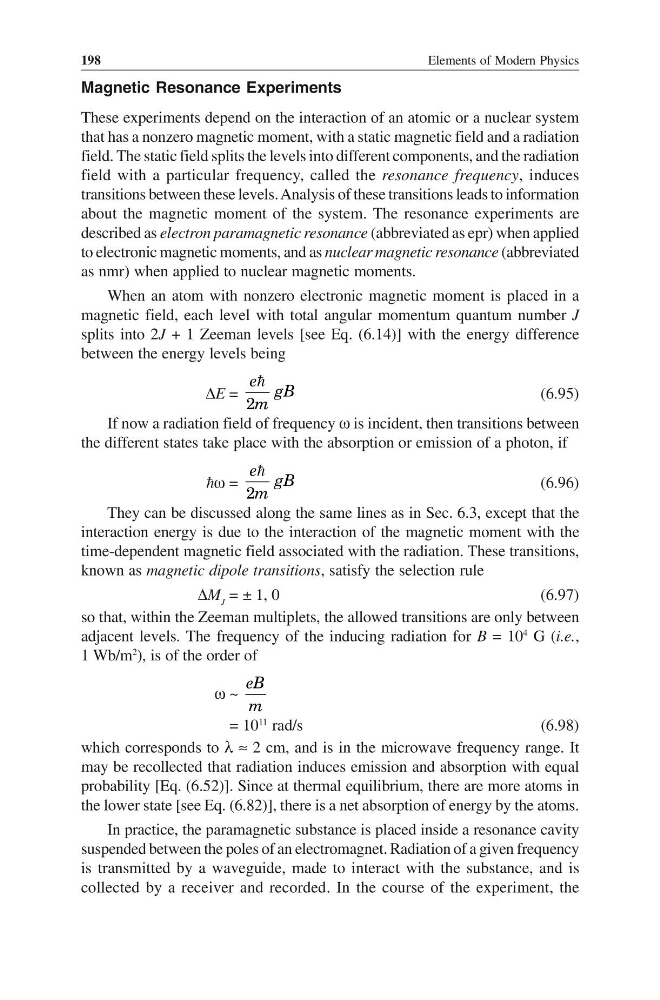
When an atom with nonzero electronic magnetic moment is placed in a
magnetic field, each level with total angular momentum quantum number J
splits into 2J + 1 Zeeman levels [see Eq. (6.14)] with the energy difference
between the energy levels being
∆E = 2
e gB
m
(6.95)
If now a radiation field of frequency ω is incident, then transitions between
the different states take place with the absorption or emission of a photon, if
ω = 2
e gB
m
(6.96)
They can be discussed along the same lines as in Sec. 6.3, except that the
interaction energy is due to the interaction of the magnetic moment with the
time-dependent magnetic field associated with the radiation. These transitions,
known as magnetic dipole transitions, satisfy the selection rule
∆M J = ± 1, 0
(6.97)
so that, within the Zeeman multiplets, the allowed transitions are only between
adjacent levels. The frequency of the inducing radiation for B = 10
4
G (i.e.,
1 Wb/m
2
), is of the order of
ω ~
eB
m
= 10
11
rad/s
(6.98)
which corresponds to λ ≈ 2 cm, and is in the microwave frequency range. It
may be recollected that radiation induces emission and absorption with equal
probability [Eq. (6.52)]. Since at thermal equilibrium, there are more atoms in
the lower state [see Eq. (6.82)], there is a net absorption of energy by the atoms.
In practice, the paramagnetic substance is placed inside a resonance cavity
suspended between the poles of an electromagnet. Radiation of a given frequency
is transmitted by a waveguide, made to interact with the substance, and is
collected by a receiver and recorded. In the course of the experiment, the
198
Magnetic Resonance Experiments
These experiments depend on the interaction of an atomic or a nuclear system
that has a nonzero magnetic moment, with a static magnetic field and a radiation
field. The static field splits the levels into different components, and the radiation
field with a particular frequency, called the resonance frequency, induces
transitions between these levels. Analysis of these transitions leads to information
about the magnetic moment of the system. The resonance experiments are
described as electron paramagnetic resonance (abbreviated as epr) when applied
to electronic magnetic moments, and as nuclear magnetic resonance (abbreviated
as nmr) when applied to nuclear magnetic moments.
When an atom with nonzero electronic magnetic moment is placed in a
magnetic field, each level with total angular momentum quantum number J
splits into 2J + 1 Zeeman levels [see Eq. (6.14)] with the energy difference
between the energy levels being
∆E = 2
e gB
m
(6.95)
If now a radiation field of frequency ω is incident, then transitions between
the different states take place with the absorption or emission of a photon, if
ω = 2
e gB
m
(6.96)
They can be discussed along the same lines as in Sec. 6.3, except that the
interaction energy is due to the interaction of the magnetic moment with the
time-dependent magnetic field associated with the radiation. These transitions,
known as magnetic dipole transitions, satisfy the selection rule
∆M J = ± 1, 0
(6.97)
so that, within the Zeeman multiplets, the allowed transitions are only between
adjacent levels. The frequency of the inducing radiation for B = 10
4
G (i.e.,
1 Wb/m
2
), is of the order of
ω ~
eB
m
= 10
11
rad/s
(6.98)
which corresponds to λ ≈ 2 cm, and is in the microwave frequency range. It
may be recollected that radiation induces emission and absorption with equal
probability [Eq. (6.52)]. Since at thermal equilibrium, there are more atoms in
the lower state [see Eq. (6.82)], there is a net absorption of energy by the atoms.
In practice, the paramagnetic substance is placed inside a resonance cavity
suspended between the poles of an electromagnet. Radiation of a given frequency
is transmitted by a waveguide, made to interact with the substance, and is
collected by a receiver and recorded. In the course of the experiment, the