

Interaction with External Fields
185
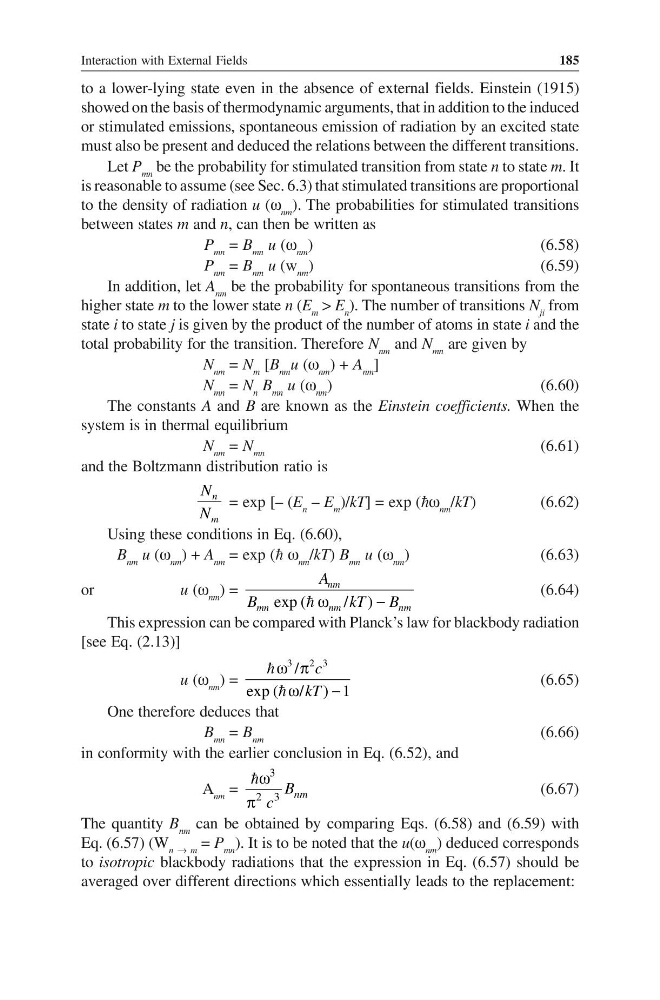
to a lower-lying state even in the absence of external fields. Einstein (1915)
showed on the basis of thermodynamic arguments, that in addition to the induced
or stimulated emissions, spontaneous emission of radiation by an excited state
must also be present and deduced the relations between the different transitions.
Let P mn be the probability for stimulated transition from state n to state m. It
is reasonable to assume (see Sec. 6.3) that stimulated transitions are proportional
to the density of radiation u (ω nm ). The probabilities for stimulated transitions
between states m and n, can then be written as
P mn = B mn u (ω nm )
(6.58)
P nm = B nm u (w nm )
(6.59)
In addition, let A nm be the probability for spontaneous transitions from the
higher state m to the lower state n (E m > E n ). The number of transitions N ji from
state i to state j is given by the product of the number of atoms in state i and the
total probability for the transition. Therefore N nm and N mn are given by
N nm = N m [B nm u (ω nm ) + A nm ]
N mn = N n B mn u (ω nm )
(6.60)
The constants A and B are known as the Einstein coefficients. When the
system is in thermal equilibrium
N nm = N mn
(6.61)
and the Boltzmann distribution ratio is
n
m
N
N
= exp [– (E n – E m )/kT] = exp (ω nm /kT)
(6.62)
Using these conditions in Eq. (6.60),
B nm u (ω nm ) + A nm = exp ( ω nm /kT) B mn u (ω nm )
(6.63)
or
u (ω nm ) =
exp (
/ )
ω
−
nm
mn
nm
nm
A
B
k T B
(6.64)
This expression can be compared with Planck’s law for blackbody radiation
[see Eq. (2.13)]
u (ω nm ) =
3
2 3
/
exp ( / ) 1
ω π
ω
−
c
kT
(6.65)
One therefore deduces that
B mn = B nm
(6.66)
in conformity with the earlier conclusion in Eq. (6.52), and
A nm =
3
2 3 nm
B
c
ω
π
(6.67)
The quantity B nm can be obtained by comparing Eqs. (6.58) and (6.59) with
Eq. (6.57) (W n → m = P mn ). It is to be noted that the u(ω nm ) deduced corresponds
to isotropic blackbody radiations that the expression in Eq. (6.57) should be
averaged over different directions which essentially leads to the replacement:
185
to a lower-lying state even in the absence of external fields. Einstein (1915)
showed on the basis of thermodynamic arguments, that in addition to the induced
or stimulated emissions, spontaneous emission of radiation by an excited state
must also be present and deduced the relations between the different transitions.
Let P mn be the probability for stimulated transition from state n to state m. It
is reasonable to assume (see Sec. 6.3) that stimulated transitions are proportional
to the density of radiation u (ω nm ). The probabilities for stimulated transitions
between states m and n, can then be written as
P mn = B mn u (ω nm )
(6.58)
P nm = B nm u (w nm )
(6.59)
In addition, let A nm be the probability for spontaneous transitions from the
higher state m to the lower state n (E m > E n ). The number of transitions N ji from
state i to state j is given by the product of the number of atoms in state i and the
total probability for the transition. Therefore N nm and N mn are given by
N nm = N m [B nm u (ω nm ) + A nm ]
N mn = N n B mn u (ω nm )
(6.60)
The constants A and B are known as the Einstein coefficients. When the
system is in thermal equilibrium
N nm = N mn
(6.61)
and the Boltzmann distribution ratio is
n
m
N
N
= exp [– (E n – E m )/kT] = exp (ω nm /kT)
(6.62)
Using these conditions in Eq. (6.60),
B nm u (ω nm ) + A nm = exp ( ω nm /kT) B mn u (ω nm )
(6.63)
or
u (ω nm ) =
exp (
/ )
ω
−
nm
mn
nm
nm
A
B
k T B
(6.64)
This expression can be compared with Planck’s law for blackbody radiation
[see Eq. (2.13)]
u (ω nm ) =
3
2 3
/
exp ( / ) 1
ω π
ω
−
c
kT
(6.65)
One therefore deduces that
B mn = B nm
(6.66)
in conformity with the earlier conclusion in Eq. (6.52), and
A nm =
3
2 3 nm
B
c
ω
π
(6.67)
The quantity B nm can be obtained by comparing Eqs. (6.58) and (6.59) with
Eq. (6.57) (W n → m = P mn ). It is to be noted that the u(ω nm ) deduced corresponds
to isotropic blackbody radiations that the expression in Eq. (6.57) should be
averaged over different directions which essentially leads to the replacement: