

Elements of Modern Physics
184
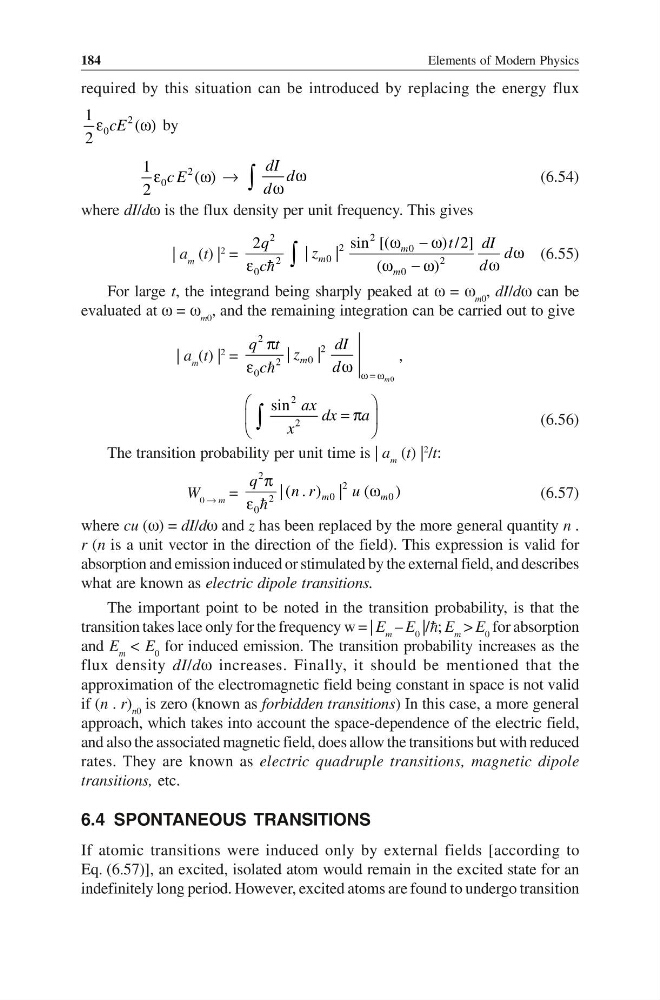
required by this situation can be introduced by replacing the energy flux
2
0
1
( )
2
ε
ω
cE
by
2
0
1
( )
2
ε
ω
c E
→
dI d
d
ω
ω
∫
(6.54)
where dI/dω is the flux density per unit frequency. This gives
| a m (t) |
2
=
2
2
2
0
0
2
2
0
0
sin [(
) /2]
2
|
|
(
)
m
m
m
t
q
d I
z
d
d
c
ω − ω
ω
ω
ε
ω − ω
∫
(6.55)
For large t, the integrand being sharply peaked at ω = ω m0 , dI/dω can be
evaluated at ω = ω m0 , and the remaining integration can be carried out to give
| a m (t) |
2
=
0
2
2
0
2
0
|
|
ω = ω
π
ω
ε
m
m
q t
dI
z
d
c
,
2
2
sin
= π
∫
ax dx
a
x
(6.56)
The transition probability per unit time is | a m (t) |
2
/t:
W 0 → m =
2
2
0
0
2
0
| ( . ) | (
)
π
ω
ε
m
m
q
n r
u
(6.57)
where cu (ω) = dI/dω and z has been replaced by the more general quantity n .
r (n is a unit vector in the direction of the field). This expression is valid for
absorption and emission induced or stimulated by the external field, and describes
what are known as electric dipole transitions.
The important point to be noted in the transition probability, is that the
transition takes lace only for the frequency w = | E m – E 0 |/; E m > E 0 for absorption
and E m < E 0 for induced emission. The transition probability increases as the
flux density dI/dω increases. Finally, it should be mentioned that the
approximation of the electromagnetic field being constant in space is not valid
if (n . r) n0 is zero (known as forbidden transitions) In this case, a more general
approach, which takes into account the space-dependence of the electric field,
and also the associated magnetic field, does allow the transitions but with reduced
rates. They are known as electric quadruple transitions, magnetic dipole
transitions, etc.
6.4 SPONTANEOUS TRANSITIONS
If atomic transitions were induced only by external fields [according to
Eq. (6.57)], an excited, isolated atom would remain in the excited state for an
indefinitely long period. However, excited atoms are found to undergo transition
184
required by this situation can be introduced by replacing the energy flux
2
0
1
( )
2
ε
ω
cE
by
2
0
1
( )
2
ε
ω
c E
→
dI d
d
ω
ω
∫
(6.54)
where dI/dω is the flux density per unit frequency. This gives
| a m (t) |
2
=
2
2
2
0
0
2
2
0
0
sin [(
) /2]
2
|
|
(
)
m
m
m
t
q
d I
z
d
d
c
ω − ω
ω
ω
ε
ω − ω
∫
(6.55)
For large t, the integrand being sharply peaked at ω = ω m0 , dI/dω can be
evaluated at ω = ω m0 , and the remaining integration can be carried out to give
| a m (t) |
2
=
0
2
2
0
2
0
|
|
ω = ω
π
ω
ε
m
m
q t
dI
z
d
c
,
2
2
sin
= π
∫
ax dx
a
x
(6.56)
The transition probability per unit time is | a m (t) |
2
/t:
W 0 → m =
2
2
0
0
2
0
| ( . ) | (
)
π
ω
ε
m
m
q
n r
u
(6.57)
where cu (ω) = dI/dω and z has been replaced by the more general quantity n .
r (n is a unit vector in the direction of the field). This expression is valid for
absorption and emission induced or stimulated by the external field, and describes
what are known as electric dipole transitions.
The important point to be noted in the transition probability, is that the
transition takes lace only for the frequency w = | E m – E 0 |/; E m > E 0 for absorption
and E m < E 0 for induced emission. The transition probability increases as the
flux density dI/dω increases. Finally, it should be mentioned that the
approximation of the electromagnetic field being constant in space is not valid
if (n . r) n0 is zero (known as forbidden transitions) In this case, a more general
approach, which takes into account the space-dependence of the electric field,
and also the associated magnetic field, does allow the transitions but with reduced
rates. They are known as electric quadruple transitions, magnetic dipole
transitions, etc.
6.4 SPONTANEOUS TRANSITIONS
If atomic transitions were induced only by external fields [according to
Eq. (6.57)], an excited, isolated atom would remain in the excited state for an
indefinitely long period. However, excited atoms are found to undergo transition