

Elements of Modern Physics
186
| (n . r) nm |
2
→
2
1 | ( ) |
3
nm
r
(6.68)
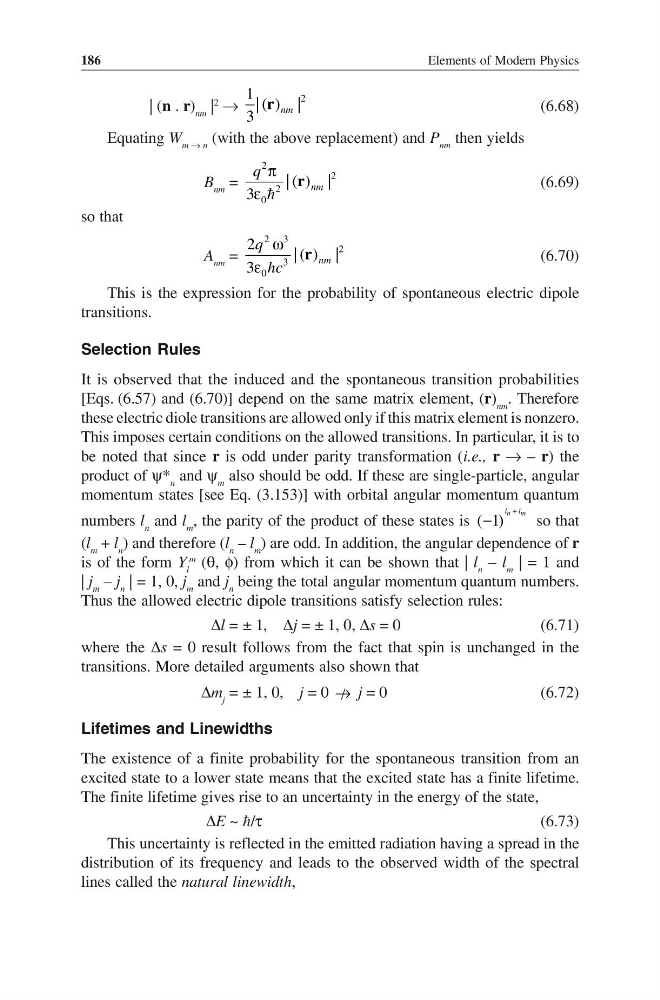
Equating W m → n (with the above replacement) and P nm then yields
B nm =
2
2
2
0
| ( ) |
3
nm
q π
ε
r
(6.69)
so that
A nm =
2 3
2
3
0
2
| ( ) |
3
nm
q
hc
ω
ε
r
(6.70)
This is the expression for the probability of spontaneous electric dipole
transitions.
Selection Rules
It is observed that the induced and the spontaneous transition probabilities
[Eqs. (6.57) and (6.70)] depend on the same matrix element, (r) nm . Therefore
these electric diole transitions are allowed only if this matrix element is nonzero.
This imposes certain conditions on the allowed transitions. In particular, it is to
be noted that since r is odd under parity transformation (i.e., r → – r) the
product of ψ* n and ψ m also should be odd. If these are single-particle, angular
momentum states [see Eq. (3.153)] with orbital angular momentum quantum
numbers l n and l m , the parity of the product of these states is ( 1)
+
−
l
l
n m so that
(l m + l n ) and therefore (l n – l m ) are odd. In addition, the angular dependence of r
is of the form Y l
m
(θ, φ) from which it can be shown that | l n – l m | = 1 and
| j m – j n | = 1, 0, j m and j n being the total angular momentum quantum numbers.
Thus the allowed electric dipole transitions satisfy selection rules:
∆l = ± 1, ∆j = ± 1, 0, ∆s = 0
(6.71)
where the ∆s = 0 result follows from the fact that spin is unchanged in the
transitions. More detailed arguments also shown that
∆m j = ± 1, 0, j = 0 → / j = 0
(6.72)
Lifetimes and Linewidths
The existence of a finite probability for the spontaneous transition from an
excited state to a lower state means that the excited state has a finite lifetime.
The finite lifetime gives rise to an uncertainty in the energy of the state,
∆E ~ /τ
(6.73)
This uncertainty is reflected in the emitted radiation having a spread in the
distribution of its frequency and leads to the observed width of the spectral
lines called the natural linewidth,
186
| (n . r) nm |
2
→
2
1 | ( ) |
3
nm
r
(6.68)
Equating W m → n (with the above replacement) and P nm then yields
B nm =
2
2
2
0
| ( ) |
3
nm
q π
ε
r
(6.69)
so that
A nm =
2 3
2
3
0
2
| ( ) |
3
nm
q
hc
ω
ε
r
(6.70)
This is the expression for the probability of spontaneous electric dipole
transitions.
Selection Rules
It is observed that the induced and the spontaneous transition probabilities
[Eqs. (6.57) and (6.70)] depend on the same matrix element, (r) nm . Therefore
these electric diole transitions are allowed only if this matrix element is nonzero.
This imposes certain conditions on the allowed transitions. In particular, it is to
be noted that since r is odd under parity transformation (i.e., r → – r) the
product of ψ* n and ψ m also should be odd. If these are single-particle, angular
momentum states [see Eq. (3.153)] with orbital angular momentum quantum
numbers l n and l m , the parity of the product of these states is ( 1)
+
−
l
l
n m so that
(l m + l n ) and therefore (l n – l m ) are odd. In addition, the angular dependence of r
is of the form Y l
m
(θ, φ) from which it can be shown that | l n – l m | = 1 and
| j m – j n | = 1, 0, j m and j n being the total angular momentum quantum numbers.
Thus the allowed electric dipole transitions satisfy selection rules:
∆l = ± 1, ∆j = ± 1, 0, ∆s = 0
(6.71)
where the ∆s = 0 result follows from the fact that spin is unchanged in the
transitions. More detailed arguments also shown that
∆m j = ± 1, 0, j = 0 → / j = 0
(6.72)
Lifetimes and Linewidths
The existence of a finite probability for the spontaneous transition from an
excited state to a lower state means that the excited state has a finite lifetime.
The finite lifetime gives rise to an uncertainty in the energy of the state,
∆E ~ /τ
(6.73)
This uncertainty is reflected in the emitted radiation having a spread in the
distribution of its frequency and leads to the observed width of the spectral
lines called the natural linewidth,