

Interaction with External Fields
181
with
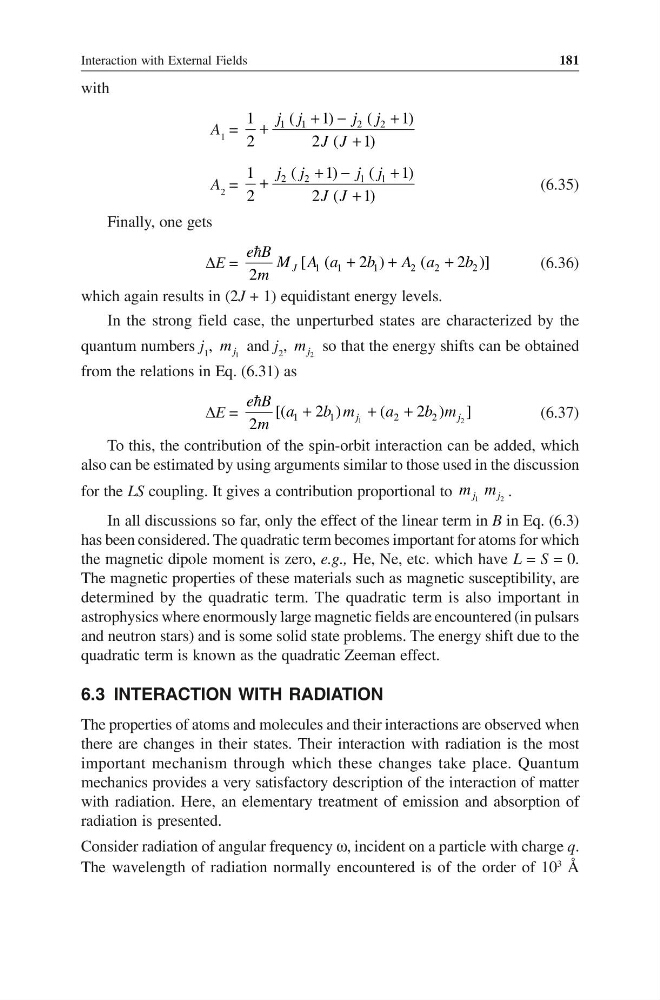
A 1 =
1
1
2
2
(
1)
(
1)
1
2
2 (
1 )
+ −
+
+
+
j j
j j
J J
A 2 =
2
2
1
1
(
1)
(
1)
1
2
2 (
1 )
j j
j j
J J
+ −
+
+
+
(6.35)
Finally, one gets
∆E =
1
1
1
2
2
2
[ (
2 )
(
2 )]
2
+
+
+
J
e B M A a
b
A a
b
m
(6.36)
which again results in (2J + 1) equidistant energy levels.
In the strong field case, the unperturbed states are characterized by the
quantum numbers j 1 , 1
j
m and j 2 , 2
j
m so that the energy shifts can be obtained
from the relations in Eq. (6.31) as
∆E =
1
2
1
1
2
2
[(
2 )
(
2 ) ]
2
j
j
e B a
b m
a
b m
m
+
+
+
(6.37)
To this, the contribution of the spin-orbit interaction can be added, which
also can be estimated by using arguments similar to those used in the discussion
for the LS coupling. It gives a contribution proportional to 1
j
m
2
j
m .
In all discussions so far, only the effect of the linear term in B in Eq. (6.3)
has been considered. The quadratic term becomes important for atoms for which
the magnetic dipole moment is zero, e.g., He, Ne, etc. which have L = S = 0.
The magnetic properties of these materials such as magnetic susceptibility, are
determined by the quadratic term. The quadratic term is also important in
astrophysics where enormously large magnetic fields are encountered (in pulsars
and neutron stars) and is some solid state problems. The energy shift due to the
quadratic term is known as the quadratic Zeeman effect.
6.3 INTERACTION WITH RADIATION
The properties of atoms and molecules and their interactions are observed when
there are changes in their states. Their interaction with radiation is the most
important mechanism through which these changes take place. Quantum
mechanics provides a very satisfactory description of the interaction of matter
with radiation. Here, an elementary treatment of emission and absorption of
radiation is presented.
Consider radiation of angular frequency ω, incident on a particle with charge q.
The wavelength of radiation normally encountered is of the order of 10
3
Å
181
with
A 1 =
1
1
2
2
(
1)
(
1)
1
2
2 (
1 )
+ −
+
+
+
j j
j j
J J
A 2 =
2
2
1
1
(
1)
(
1)
1
2
2 (
1 )
j j
j j
J J
+ −
+
+
+
(6.35)
Finally, one gets
∆E =
1
1
1
2
2
2
[ (
2 )
(
2 )]
2
+
+
+
J
e B M A a
b
A a
b
m
(6.36)
which again results in (2J + 1) equidistant energy levels.
In the strong field case, the unperturbed states are characterized by the
quantum numbers j 1 , 1
j
m and j 2 , 2
j
m so that the energy shifts can be obtained
from the relations in Eq. (6.31) as
∆E =
1
2
1
1
2
2
[(
2 )
(
2 ) ]
2
j
j
e B a
b m
a
b m
m
+
+
+
(6.37)
To this, the contribution of the spin-orbit interaction can be added, which
also can be estimated by using arguments similar to those used in the discussion
for the LS coupling. It gives a contribution proportional to 1
j
m
2
j
m .
In all discussions so far, only the effect of the linear term in B in Eq. (6.3)
has been considered. The quadratic term becomes important for atoms for which
the magnetic dipole moment is zero, e.g., He, Ne, etc. which have L = S = 0.
The magnetic properties of these materials such as magnetic susceptibility, are
determined by the quadratic term. The quadratic term is also important in
astrophysics where enormously large magnetic fields are encountered (in pulsars
and neutron stars) and is some solid state problems. The energy shift due to the
quadratic term is known as the quadratic Zeeman effect.
6.3 INTERACTION WITH RADIATION
The properties of atoms and molecules and their interactions are observed when
there are changes in their states. Their interaction with radiation is the most
important mechanism through which these changes take place. Quantum
mechanics provides a very satisfactory description of the interaction of matter
with radiation. Here, an elementary treatment of emission and absorption of
radiation is presented.
Consider radiation of angular frequency ω, incident on a particle with charge q.
The wavelength of radiation normally encountered is of the order of 10
3
Å