

Elements of Modern Physics
182
which is quate large compared with atomic sizes (~ 1 Å). Therefore, the electric
field can be regarded as being constant over atomic distances (this is called the
electric dipole approximation). Such an electric field is provided by the scalar
potential – Ez cos ωt, where it is assumed that the electric field is in the
z-direction and has an amplitude E. The interaction of the charged particle with
this scalar potential leads to the potential energy term
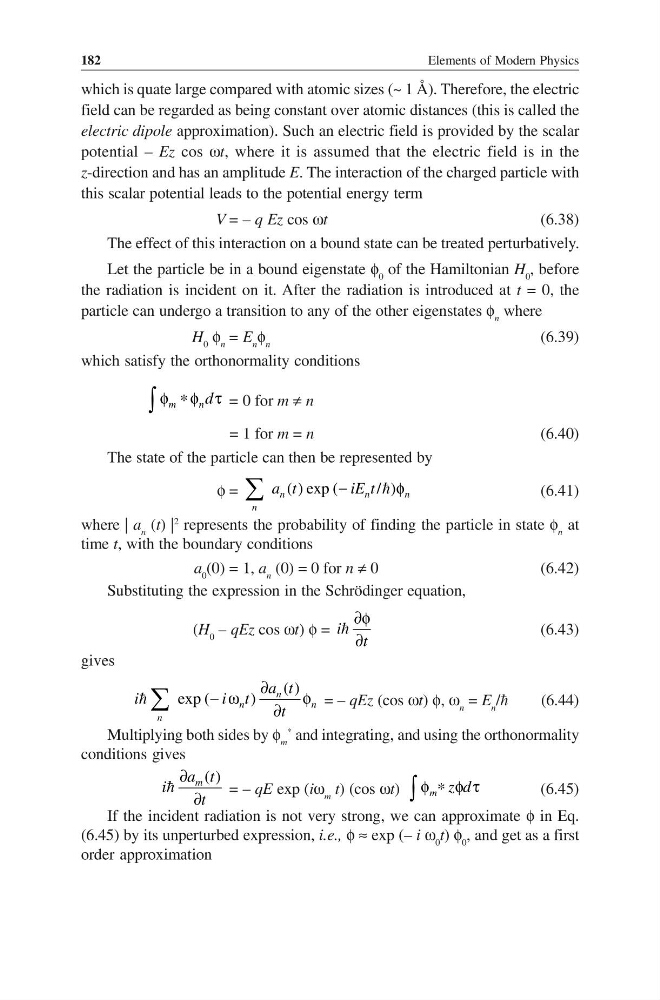
V = – q Ez cos ωt
(6.38)
The effect of this interaction on a bound state can be treated perturbatively.
Let the particle be in a bound eigenstate φ 0 of the Hamiltonian H 0 , before
the radiation is incident on it. After the radiation is introduced at t = 0, the
particle can undergo a transition to any of the other eigenstates φ n where
H 0 φ n = E n φ n
(6.39)
which satisfy the orthonormality conditions
φ ∗φ τ
∫ m n d = 0 for m ≠ n
= 1 for m = n
(6.40)
The state of the particle can then be represented by
φ =
( ) exp (
/ )
−
φ
∑
n
n
n
n
a t
iE t
(6.41)
where | a n (t) |
2
represents the probability of finding the particle in state φ n at
time t, with the boundary conditions
a 0 (0) = 1, a n (0) = 0 for n ≠ 0
(6.42)
Substituting the expression in the Schrödinger equation,
(H 0 – qEz cos ωt) φ =
∂φ
∂
i t
(6.43)
gives
( )
exp (
)
∂
− ω
φ
∂
∑
n
n
n
n
a t
i
i t
t
= – qEz (cos ωt) φ, ω n = E n /
(6.44)
Multiplying both sides by φ m
*
and integrating, and using the orthonormality
conditions gives
( )
∂
∂
m
a t
i
t
= – qE exp (iω m t) (cos ωt) φ ∗ φ τ
∫ m z d
(6.45)
If the incident radiation is not very strong, we can approximate φ in Eq.
(6.45) by its unperturbed expression, i.e., φ ≈ exp (– i ω 0 t) φ 0 , and get as a first
order approximation
182
which is quate large compared with atomic sizes (~ 1 Å). Therefore, the electric
field can be regarded as being constant over atomic distances (this is called the
electric dipole approximation). Such an electric field is provided by the scalar
potential – Ez cos ωt, where it is assumed that the electric field is in the
z-direction and has an amplitude E. The interaction of the charged particle with
this scalar potential leads to the potential energy term
V = – q Ez cos ωt
(6.38)
The effect of this interaction on a bound state can be treated perturbatively.
Let the particle be in a bound eigenstate φ 0 of the Hamiltonian H 0 , before
the radiation is incident on it. After the radiation is introduced at t = 0, the
particle can undergo a transition to any of the other eigenstates φ n where
H 0 φ n = E n φ n
(6.39)
which satisfy the orthonormality conditions
φ ∗φ τ
∫ m n d = 0 for m ≠ n
= 1 for m = n
(6.40)
The state of the particle can then be represented by
φ =
( ) exp (
/ )
−
φ
∑
n
n
n
n
a t
iE t
(6.41)
where | a n (t) |
2
represents the probability of finding the particle in state φ n at
time t, with the boundary conditions
a 0 (0) = 1, a n (0) = 0 for n ≠ 0
(6.42)
Substituting the expression in the Schrödinger equation,
(H 0 – qEz cos ωt) φ =
∂φ
∂
i t
(6.43)
gives
( )
exp (
)
∂
− ω
φ
∂
∑
n
n
n
n
a t
i
i t
t
= – qEz (cos ωt) φ, ω n = E n /
(6.44)
Multiplying both sides by φ m
*
and integrating, and using the orthonormality
conditions gives
( )
∂
∂
m
a t
i
t
= – qE exp (iω m t) (cos ωt) φ ∗ φ τ
∫ m z d
(6.45)
If the incident radiation is not very strong, we can approximate φ in Eq.
(6.45) by its unperturbed expression, i.e., φ ≈ exp (– i ω 0 t) φ 0 , and get as a first
order approximation