

Elements of Modern Physics
178
2
1/2 :
S g = 2
2
1/2 :
P g = 2/3
(6.21)
2
3/2 :
P g = 4/3
Substituting the values in Eq. (6.17) gives
∆ω = (± 2/3, ± 4/3) ∆ω 0
for
2
2
1/2
1/2
→
P
S
(6.22)
and
∆ω = (± 1/3, ± 1, ± 5/3) ∆ω 0 for
2
2
3/2
1/2
→
P
S
(6.23)
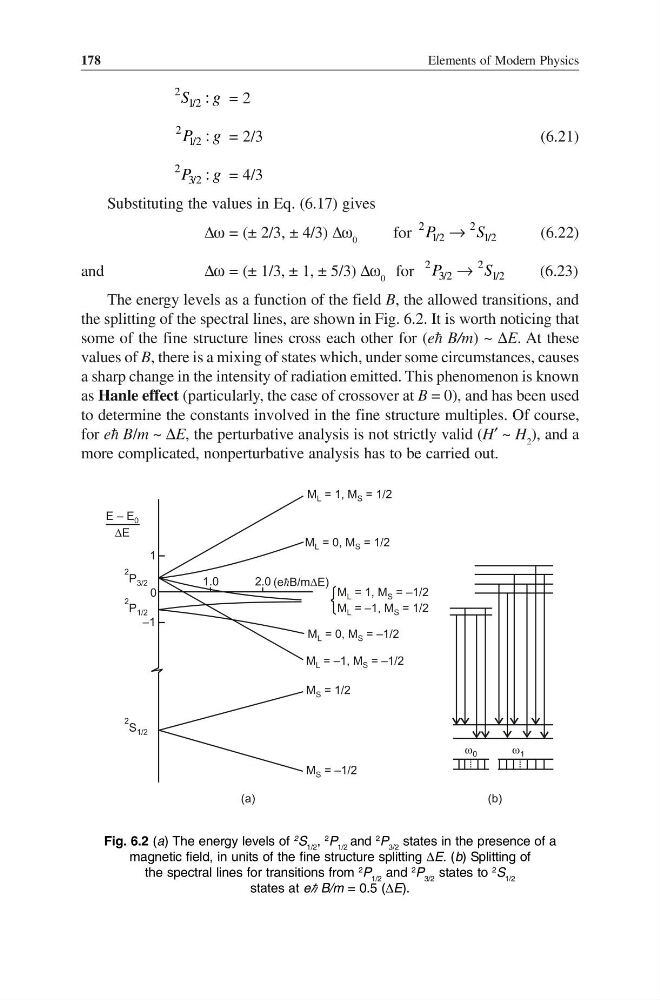
The energy levels as a function of the field B, the allowed transitions, and
the splitting of the spectral lines, are shown in Fig. 6.2. It is worth noticing that
some of the fine structure lines cross each other for (e B/m) ~ ∆E. At these
values of B, there is a mixing of states which, under some circumstances, causes
a sharp change in the intensity of radiation emitted. This phenomenon is known
as Hanle effect (particularly, the case of crossover at B = 0), and has been used
to determine the constants involved in the fine structure multiples. Of course,
for e B/m ~ ∆E, the perturbative analysis is not strictly valid (H′ ~ H 2 ), and a
more complicated, nonperturbative analysis has to be carried out.
1.0
2.0 (e B/m E)
D
E – E
E
0
D
2
P 3/2
1
–1
2
P 1/2
2 S 1/2
(a)
M = 1, M = 1/2
L
S
M = 0, M = 1/2
L
S
M = 1, M = –1/2
L
S
M = –1, M = 1/2
L
S
M = 0, M = –1/2
L
S
M = –1, M = –1/2
L
S
M = 1/2
S
w 0
w 1
(b)
0
M = –1/2
S
Fig. 6.2 (a) The energy levels of
2
S 1/2 ,
2
P 1/2 and
2
P 3/2 states in the presence of a
magnetic field, in units of the fine structure splitting ∆E. (b) Splitting of
the spectral lines for transitions from
2
P 1/2 and
2
P 3/2 states to
2
S 1/2
states at e B/m = 0.5 (∆E).
178
2
1/2 :
S g = 2
2
1/2 :
P g = 2/3
(6.21)
2
3/2 :
P g = 4/3
Substituting the values in Eq. (6.17) gives
∆ω = (± 2/3, ± 4/3) ∆ω 0
for
2
2
1/2
1/2
→
P
S
(6.22)
and
∆ω = (± 1/3, ± 1, ± 5/3) ∆ω 0 for
2
2
3/2
1/2
→
P
S
(6.23)
The energy levels as a function of the field B, the allowed transitions, and
the splitting of the spectral lines, are shown in Fig. 6.2. It is worth noticing that
some of the fine structure lines cross each other for (e B/m) ~ ∆E. At these
values of B, there is a mixing of states which, under some circumstances, causes
a sharp change in the intensity of radiation emitted. This phenomenon is known
as Hanle effect (particularly, the case of crossover at B = 0), and has been used
to determine the constants involved in the fine structure multiples. Of course,
for e B/m ~ ∆E, the perturbative analysis is not strictly valid (H′ ~ H 2 ), and a
more complicated, nonperturbative analysis has to be carried out.
1.0
2.0 (e B/m E)
D
E – E
E
0
D
2
P 3/2
1
–1
2
P 1/2
2 S 1/2
(a)
M = 1, M = 1/2
L
S
M = 0, M = 1/2
L
S
M = 1, M = –1/2
L
S
M = –1, M = 1/2
L
S
M = 0, M = –1/2
L
S
M = –1, M = –1/2
L
S
M = 1/2
S
w 0
w 1
(b)
0
M = –1/2
S
Fig. 6.2 (a) The energy levels of
2
S 1/2 ,
2
P 1/2 and
2
P 3/2 states in the presence of a
magnetic field, in units of the fine structure splitting ∆E. (b) Splitting of
the spectral lines for transitions from
2
P 1/2 and
2
P 3/2 states to
2
S 1/2
states at e B/m = 0.5 (∆E).