

Interaction with External Fields
177
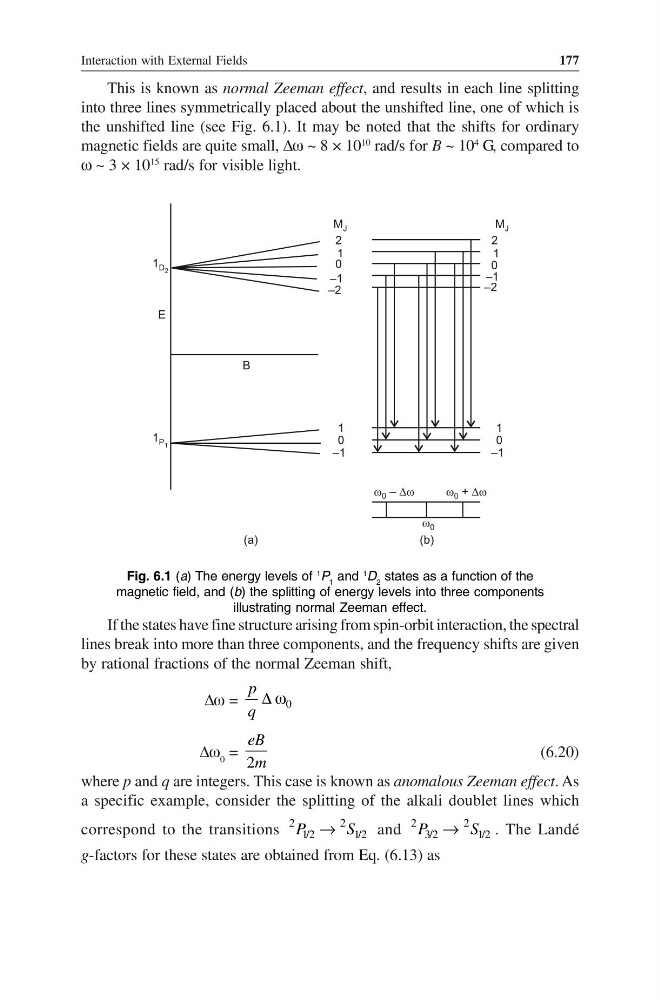
This is known as normal Zeeman effect, and results in each line splitting
into three lines symmetrically placed about the unshifted line, one of which is
the unshifted line (see Fig. 6.1). It may be noted that the shifts for ordinary
magnetic fields are quite small, ∆ω ~ 8 × 10
10
rad/s for B ~ 10
4
G, compared to
ω ~ 3 × 10
15
rad/s for visible light.
2
1
0
–1
–2
1 D 2
M J
M J
2
1
0
–1
–2
E
B
1
0
–1
1 P 1
1
0
–1
w Dw
0 –
w
Dw
0 +
w 0
(b)
(a)
Fig. 6.1 (a) The energy levels of
1
P 1 and
1
D 2 states as a function of the
magnetic field, and (b) the splitting of energy levels into three components
illustrating normal Zeeman effect.
If the states have fine structure arising from spin-orbit interaction, the spectral
lines break into more than three components, and the frequency shifts are given
by rational fractions of the normal Zeeman shift,
∆ω =
0
∆ ω
p
q
∆ω 0 = 2
eB
m
(6.20)
where p and q are integers. This case is known as anomalous Zeeman effect. As
a specific example, consider the splitting of the alkali doublet lines which
correspond to the transitions
2
2
1/2
1/2
→
P
S and
2
2
3/2
1/2
→
P
S . The Landé
g-factors for these states are obtained from Eq. (6.13) as
177
This is known as normal Zeeman effect, and results in each line splitting
into three lines symmetrically placed about the unshifted line, one of which is
the unshifted line (see Fig. 6.1). It may be noted that the shifts for ordinary
magnetic fields are quite small, ∆ω ~ 8 × 10
10
rad/s for B ~ 10
4
G, compared to
ω ~ 3 × 10
15
rad/s for visible light.
2
1
0
–1
–2
1 D 2
M J
M J
2
1
0
–1
–2
E
B
1
0
–1
1 P 1
1
0
–1
w Dw
0 –
w
Dw
0 +
w 0
(b)
(a)
Fig. 6.1 (a) The energy levels of
1
P 1 and
1
D 2 states as a function of the
magnetic field, and (b) the splitting of energy levels into three components
illustrating normal Zeeman effect.
If the states have fine structure arising from spin-orbit interaction, the spectral
lines break into more than three components, and the frequency shifts are given
by rational fractions of the normal Zeeman shift,
∆ω =
0
∆ ω
p
q
∆ω 0 = 2
eB
m
(6.20)
where p and q are integers. This case is known as anomalous Zeeman effect. As
a specific example, consider the splitting of the alkali doublet lines which
correspond to the transitions
2
2
1/2
1/2
→
P
S and
2
2
3/2
1/2
→
P
S . The Landé
g-factors for these states are obtained from Eq. (6.13) as